
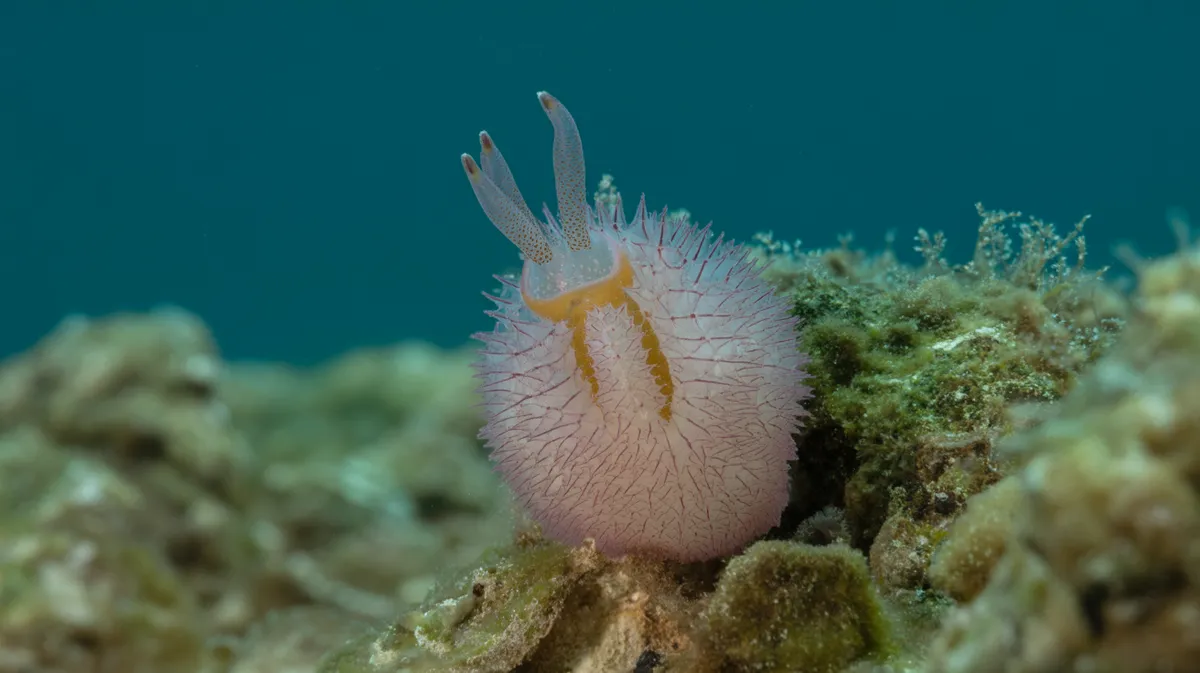
About the Sea Squirt
Sea squirts, or ascidians, spend adult life as immobile bags filtering seawater through a pharyngeal basket, and their name comes from the jet of water they fire when squeezed. Nothing about that adult suggests kinship with us, but the larva does: it is a tadpole with a notochord, a hollow dorsal nerve cord, a muscular post-anal tail and pharyngeal slits, the full chordate toolkit. Tunicates are in fact the closest living relatives of the vertebrates, closer than lancelets, a rearrangement of the family tree confirmed by genome data in the 2000s. The larva swims for only minutes to hours, does not feed, and then cements itself head-first to a rock, whereupon it resorbs its tail and notochord and reorganises its simple brain into a much smaller ganglion. The popular claim that it "eats its own brain" overstates a real reduction. Their outer tunic is stiffened with cellulose, which no other animal group makes, the genes for it apparently acquired long ago by horizontal transfer from bacteria. Some ascidians concentrate vanadium in their blood cells at up to ten million times the level in seawater, for reasons still not settled, and colonial species such as Botryllus can fuse with genetically similar neighbours and share a bloodstream, a natural allorecognition system studied as an ancestor of immune self-recognition.
Fascinating facts
Filter Feeding
Sea squirts filter thousands of liters of seawater daily to extract microscopic food particles such as plankton and detritus.
Evolutionary Link
As larvae, sea squirts have a notochord and nerve cord, making them more closely related to vertebrates than most other invertebrates.
Chemical Defenses
Some sea squirts produce toxic compounds that deter predators and are being researched for potential medical applications.
Detailed description
Sea squirts (Ascidiacea) are sessile marine invertebrates characterized by a sac-like body encased in a protective outer layer known as the tunic, which is unique among animals for being composed of cellulose-like polysaccharides. Adults typically range from a few millimeters to over 20 centimeters in length, depending on the species, and display a variety of shapes including globular, cylindrical, and vase-like forms. The body is organized into two main regions: the branchial (pharyngeal) sac, which houses the filtering apparatus, and the atrial cavity. Water enters through an oral siphon, passes through a perforated pharyngeal basket lined with cilia and mucus, and exits via the atrial siphon, facilitating efficient filter feeding. The internal anatomy is relatively simple, lacking complex organs such as a brain, but featuring a primitive heart and a rudimentary nervous system. Larval sea squirts are free-swimming and possess a notochord and dorsal nerve cord, features homologous to vertebrates, but these are resorbed during metamorphosis into the sedentary adult form. Sea squirts can be solitary or colonial; colonial forms share a common tunic and may have interconnected circulatory systems. They are found from intertidal zones to deep sea habitats worldwide, often forming dense aggregations on hard substrates. Their tunic may be transparent, leathery, or even tough and cartilaginous, sometimes incorporating sand or shell fragments for added protection. Many species possess chemical defenses, such as secondary metabolites, to deter predators and prevent fouling by other organisms.
Did you know?
Sea squirt larvae possess a backbone-like structure, but lose it as they transform into adults—a key link to the evolutionary origins of vertebrates.
Research & sources
Wikipedia summary
Ascidiacea, commonly known as the ascidians or sea squirts, is a paraphyletic class in the subphylum Tunicata of sac-like marine invertebrate filter feeders. Ascidians are characterized by a tough outer test or "tunic" made of the polysaccharide cellulose.
Behaviour & social structure
Sea squirts are predominantly sedentary as adults, remaining attached to substrates such as rocks, shells, ship hulls, or artificial structures. Their primary behavior is filter feeding, which they accomplish by generating water currents with ciliated cells in the pharyngeal basket. Some species can contract their bodies rapidly to expel water forcefully through their siphons—a behavior that gives them the common name 'sea squirt.' While generally solitary, colonial species exhibit coordinated siphon opening and closing, and may share nutrients via vascular connections. Sea squirts are capable of limited movement during their larval stage, using muscular tails to swim and disperse before settling. They are primarily nocturnal feeders in turbid or predator-rich environments, but many feed continuously. Some species exhibit allorecognition, distinguishing self from non-self tissues to prevent fusion with genetically dissimilar colonies.
Reproduction & life cycle
Reproduction in sea squirts is highly variable, with both sexual and asexual modes observed. Most solitary ascidians are hermaphroditic, releasing eggs and sperm into the water column for external fertilization, often synchronizing spawning with lunar or tidal cycles. Colonial species may reproduce asexually by budding, forming new zooids within the colony. The fertilized eggs develop into free-swimming tadpole-like larvae within hours to days, depending on temperature and species. Larvae possess a notochord and dorsal nerve cord, but these features are lost during metamorphosis as the larva settles and transforms into the sessile adult. Parental care is generally absent, though some species brood embryos internally or within the tunic until they are ready to hatch. Breeding seasons are often linked to water temperature and food availability, with peaks in spring and summer in temperate regions.
Adaptations & survival
Sea squirts exhibit several notable adaptations for survival. The tunic provides mechanical protection and may contain bioactive compounds that deter predators and inhibit microbial colonization. Their highly efficient filter-feeding system allows them to exploit plankton-rich waters, and the ability to close siphons rapidly helps avoid predation and sediment clogging. Larval mobility enables wide dispersal, increasing genetic diversity and colonization potential. Some species can regenerate lost body parts and exhibit remarkable resistance to environmental stressors, such as fluctuations in salinity and temperature. Colonial ascidians benefit from shared resources and increased resilience to localized damage. Chemical defenses, including sulfuric acid and secondary metabolites, are common and have been studied for their potential pharmaceutical applications.
Cultural significance
Sea squirts have limited direct cultural significance but are notable in scientific research, particularly in developmental biology and evolutionary studies due to their position as basal chordates. The genome of Ciona intestinalis, for example, has provided insights into the evolution of vertebrates. In some East Asian countries, certain species (notably Halocynthia roretzi, known as 'meongge' in Korea and 'hoya' in Japan) are consumed as seafood delicacies. Sea squirts also appear in marine art and symbolism, representing simplicity and transformation due to their dramatic metamorphosis.
Recent research
Recent research has focused on the molecular genetics and developmental pathways of ascidians, revealing key genes involved in chordate evolution. The sequencing of several ascidian genomes has clarified their phylogenetic relationships and provided models for studying gene regulation, regeneration, and immune recognition. Studies on their secondary metabolites have identified compounds with antimicrobial, anticancer, and antifouling properties, with potential applications in medicine and industry. Ongoing research is also investigating the ecological impacts of invasive ascidian species and their interactions with native marine communities.
Videos
Habitat
Marine coastal waters

Conservation
The Sea Squirt is currently classified as Least Concern on the IUCN Red List.
Threats & challenges
While many sea squirt species are abundant and classified as Least Concern, they face threats from habitat degradation, pollution (especially heavy metals and microplastics), and climate change, which can alter water temperature and chemistry. Some species are highly invasive, outcompeting native fauna and altering local ecosystems, particularly in harbors and aquaculture facilities. Overgrowth by algae, predation by specialized gastropods and fish, and diseases caused by bacteria or protozoa also pose challenges. Human activities such as dredging, shipping, and coastal development can disrupt populations and facilitate the spread of invasive species. Monitoring and management are important in regions where invasive sea squirts threaten biodiversity and economic activities.
Taxonomy
Scientific name
Ascidiacea
- Kingdom
- Animalia
- Phylum
- Chordata
- Class
- Ascidiacea
- Order
- Enterogona
- Family
- Varies (e.g., Styelidae, Ascidiidae, Pyuridae)
- Genus
- Varies (e.g., Ciona, Styela, Ascidiella)
- Species
- ascidiacea
Community notes
Share your observations about the Sea Squirt.
No community notes yet. Be the first!
Discover more wildlife
More fascinating animals from the encyclopedia.