
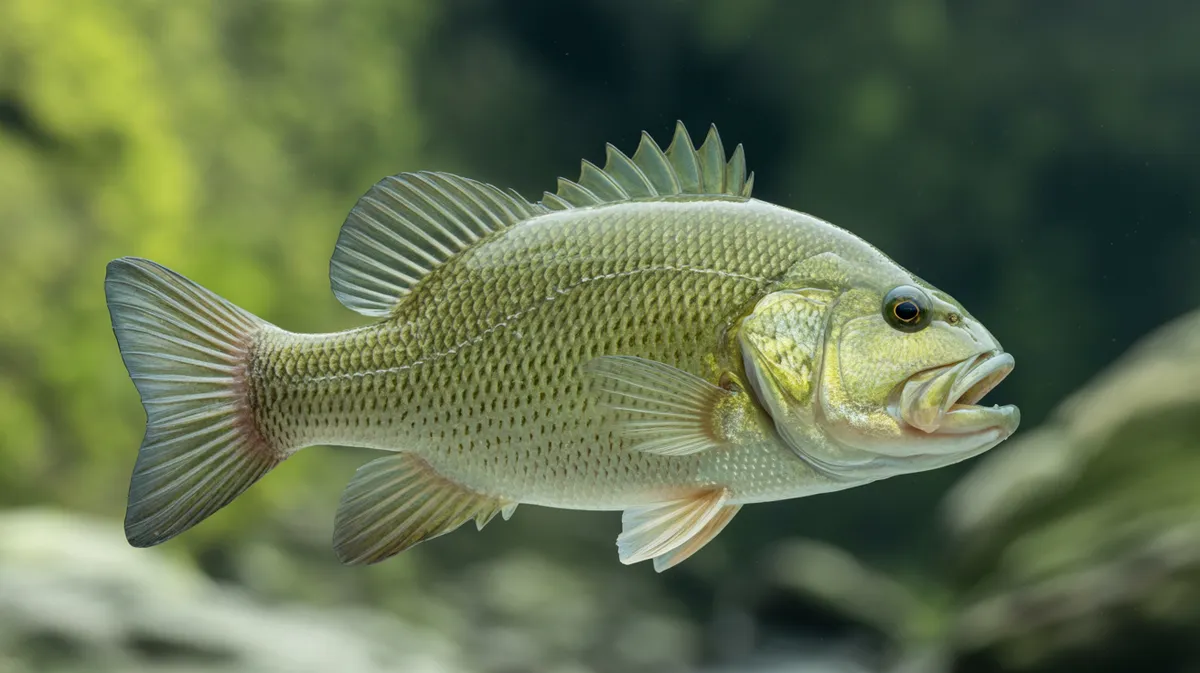
About the Shoal Bass
The Shoal Bass is a freshwater fish native to the southeastern United States, particularly the river systems of Georgia, Alabama, and Florida. Distinguished by its olive-green body covered in dark, vertical blotches and a distinct spot on the tail, this fish prefers swift, rocky streams and rivers. Closely related to other black bass species, the Shoal Bass is prized by anglers for its spirited fight and elusive nature. Due to habitat fragmentation and competition with introduced species, some populations have declined, making it a conservation concern in parts of its range.
Fascinating facts
Endemic Range
Shoal Bass are found almost exclusively in the Apalachicola-Chattahoochee-Flint River basin in the southeastern United States.
Habitat Specialist
Unlike many other bass, Shoal Bass require fast-flowing sections of rivers with rocky bottoms, known as shoals, for spawning and feeding.
Angler's Prize
Shoal Bass are highly sought after by sport fishers for their powerful fighting ability and are a key target for catch-and-release fishing in their native range.
Detailed description
The Shoal Bass (Micropterus cataractae) is a medium-sized, robust black bass species, typically reaching lengths of 30–45 cm (12–18 in) and weights of 1–2 kg (2–4.5 lbs), though trophy individuals can exceed 3 kg (6.6 lbs). Its streamlined body is olive-green to bronze along the back, fading to a lighter belly, with dark vertical blotches along the flanks and a prominent dark spot at the base of the tail (caudal peduncle). The mouth is large and terminal, extending to the rear margin of the eye, and the dorsal fin is continuous but deeply notched. Shoal Bass possess a rough patch of teeth on the tongue, distinguishing them from some related bass species. Adapted to fast-flowing, rocky habitats, they exhibit a muscular build and well-developed pectoral fins for maneuvering in strong currents. Juveniles display more pronounced vertical barring and may exhibit a bluish hue on the fins. Shoal Bass are primarily solitary but may aggregate in favorable feeding or spawning areas. Their diet is highly carnivorous, consisting of crayfish, aquatic insects, and smaller fish. They are highly territorial, especially during the breeding season, and display complex courtship and nest-guarding behaviors. The species is endemic to the Apalachicola-Chattahoochee-Flint (ACF) river basin, with its stronghold in the Flint River system. Shoal Bass are sensitive to environmental changes, particularly sedimentation and flow alteration, making them important bioindicators of riverine ecosystem health.
Did you know?
The Shoal Bass is the only black bass species that is truly endemic to the Apalachicola River system and does not naturally occur outside this watershed.
Research & sources
Behaviour & social structure
Shoal Bass are diurnal predators, most active during dawn and dusk (crepuscular periods). They utilize swift currents and rocky cover to ambush prey, relying on burst speed and camouflage. Feeding involves stalking or waiting in eddies behind rocks before striking at passing crayfish, minnows, or aquatic insects. Larger adults may consume small fish and even terrestrial insects that fall into the water. Shoal Bass are highly territorial, especially during spawning, and will aggressively defend prime feeding and nesting sites from conspecifics and other fish. Outside of the breeding season, individuals are generally solitary, though juveniles may form loose aggregations in shallow, protected areas. They exhibit site fidelity, often returning to the same feeding or spawning locations year after year. During hot summer months, they seek deeper pools or shaded areas to avoid thermal stress.
Reproduction & life cycle
Shoal Bass spawn in late spring to early summer, typically from April to June, when water temperatures reach 18–22°C (64–72°F). Males select and prepare nests in gravel or sand substrates, often in shallow, flowing water near rocky shoals. The male excavates a shallow depression using his tail and guards the site aggressively. Females lay between 2,000 and 8,000 adhesive eggs, depending on size and age, which are fertilized externally. After spawning, the male remains to guard the eggs and newly hatched fry from predators, fanning the nest with his fins to provide oxygenation and remove debris. Incubation lasts 5–10 days, depending on temperature. Parental care continues until fry become free-swimming and disperse. Hybridization with introduced Spotted Bass (Micropterus punctulatus) is a conservation concern, as it can reduce reproductive success and genetic integrity.
Adaptations & survival
Shoal Bass exhibit several adaptations for life in fast-flowing, rocky streams. Their streamlined, muscular bodies and enlarged pectoral fins allow them to maintain position and maneuver efficiently in strong currents. Camouflage coloration with mottled blotches provides concealment among rocks and submerged vegetation. The rough patch of teeth (basihyal tooth patch) on the tongue aids in gripping slippery prey such as crayfish. Behavioral adaptations include site fidelity to productive feeding and spawning habitats, and aggressive territoriality that ensures access to optimal resources. Their ability to exploit both aquatic and terrestrial prey demonstrates dietary flexibility, an important trait in variable riverine environments.
Cultural significance
While Shoal Bass do not have a prominent role in traditional folklore, they are highly valued by sport anglers for their fighting ability and rarity, especially in Georgia where they are the official state riverine sport fish. Catch-and-release practices are increasingly promoted to conserve populations. The species serves as a flagship for river conservation efforts in the southeastern United States, symbolizing the importance of preserving free-flowing, biodiverse river ecosystems.
Recent research
Recent genetic studies have clarified the distinctiveness of Shoal Bass from other black bass species, supporting their recognition as a separate species since 1999. Ongoing research focuses on population genetics, hybridization dynamics with Spotted Bass, and habitat requirements for successful spawning and recruitment. Telemetry studies have revealed strong site fidelity and limited movement among adult Shoal Bass, emphasizing the importance of localized habitat protection. Conservation biologists are also investigating the impacts of altered flow regimes and sedimentation on reproductive success. Restoration projects in the Flint River basin are being monitored to assess the effectiveness of habitat improvements and invasive species management.
Sources
Micropterus cataractae (Shoal Bass): Taxonomy, Distribution, and Conservation
Williams, J.D. & Burgess, G.H. (1999)
scientificMicropterus cataractae (Shoal Bass): Taxonomy, Distribution, and Conservation
Near, T.J., et al. (2003)
scientificMicropterus cataractae (Shoal Bass): Taxonomy, Distribution, and Conservation
Near, T.J., & Kim, D. (2021)
scientificVideos
Habitat
Fast-flowing freshwater rivers and streams with rocky shoals

Conservation
The Shoal Bass is currently classified as Near Threatened on the IUCN Red List.
Threats & challenges
Major threats to Shoal Bass include habitat fragmentation from dam construction, which disrupts natural river flow and connectivity, and increased sedimentation from agriculture and urban development, which degrades spawning and feeding habitats. Competition and hybridization with non-native Spotted Bass pose significant genetic and ecological risks, particularly in altered or degraded habitats. Water extraction, pollution, and climate change further stress populations by altering flow regimes and increasing water temperatures. Population trends indicate declines in many areas, with some river systems experiencing local extirpations. Conservation efforts focus on habitat restoration, removal of invasive species, and public education to reduce angler-induced hybridization.
Taxonomy
Scientific name
Micropterus cataractae
- Kingdom
- Animalia
- Phylum
- Chordata
- Class
- Actinopterygii
- Order
- Perciformes
- Family
- Centrarchidae
- Genus
- Micropterus
- Species
- cataractae
Community notes
Share your observations about the Shoal Bass.
No community notes yet. Be the first!
Discover more wildlife
More fascinating animals from the encyclopedia.