
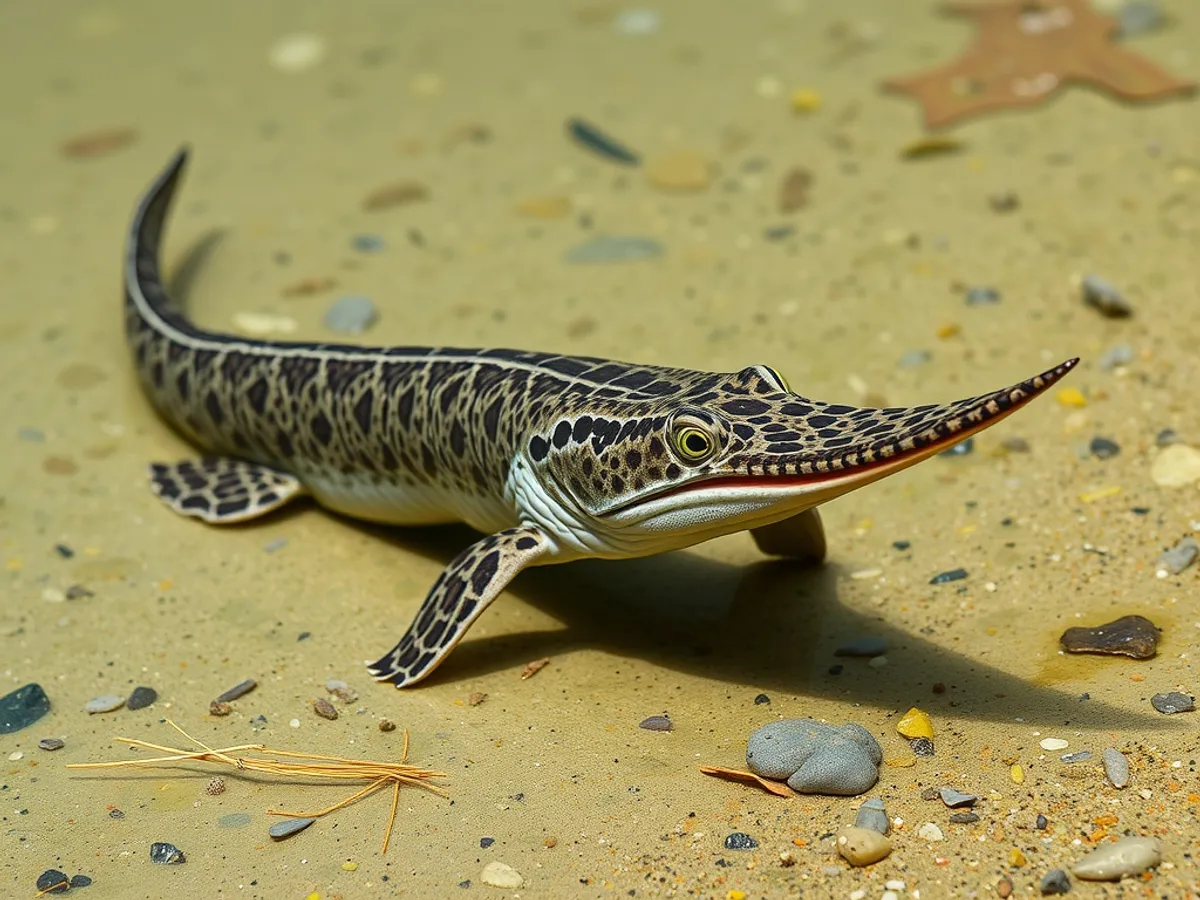
About the Shovelnose Sturgeon
The Shovelnose Sturgeon is a small, freshwater sturgeon native to the Mississippi and Missouri River basins of North America. Recognized by its elongated, flattened snout and bony scutes along its body, this fish is adapted to life in fast-flowing rivers with sandy or muddy bottoms. Unlike most sturgeons, it typically does not grow to large sizes, making it one of the smallest North American sturgeons. The species is valued for its roe, which is sometimes used as a caviar substitute, and it plays an important ecological role in riverine environments.
Fascinating facts
Smallest North American Sturgeon
Unlike most sturgeon species, the Shovelnose rarely grows longer than 1 meter (about 3 feet), making it the smallest sturgeon native to North America.
Bony Armor
Their bodies are covered with rows of hard, bony plates called scutes, which provide protection from predators and rough river substrates.
Strong Swimmers
Shovelnose Sturgeon are well adapted to strong river currents and can often be found in the swiftest parts of large rivers, using their flattened bodies to stay anchored.
Detailed description
The Shovelnose Sturgeon (Scaphirhynchus platorynchus) is a small, benthic sturgeon species distinguished by its long, flattened, shovel-shaped snout and a series of bony scutes running along its dorsal and lateral surfaces. Adults typically reach lengths of 50–85 cm (20–33 in) and rarely exceed 2.8 kg (6.2 lbs), making them the smallest sturgeon native to North America. Their bodies are streamlined and covered with tough, scale-like plates, providing protection from predators and abrasive river substrates. The mouth is ventral and protrusible, equipped with four sensory barbels that help detect prey in turbid waters. Shovelnose Sturgeon are highly adapted to life in large, fast-flowing rivers, where they dwell near the bottom and use their snouts to stir up sediments in search of food. They are long-lived, with lifespans commonly reaching 12–15 years, and some individuals documented at over 20 years. Their coloration is generally grayish-brown to yellowish dorsally, fading to a lighter ventral surface, which provides camouflage against sandy or muddy riverbeds. The species is notable for its tolerance of a wide range of water temperatures and turbidities, and it remains active year-round, even under ice in northern parts of its range. Shovelnose Sturgeon play a crucial ecological role as benthic predators and are considered indicators of riverine ecosystem health.
Did you know?
Despite looking ancient, the Shovelnose Sturgeon is one of the more recently evolved sturgeon species in North America.
Research & sources
Behaviour & social structure
Shovelnose Sturgeon are primarily solitary but may congregate in loose aggregations during spawning migrations or in areas with abundant food. They are crepuscular to nocturnal, most active during twilight and nighttime hours. Foraging involves slow, methodical movement along the riverbed, using their sensitive barbels to locate insect larvae, small crustaceans, and other invertebrates buried in the substrate. They feed by extending their protrusible mouths downward to vacuum up prey. Shovelnose Sturgeon are not territorial and exhibit little aggression toward conspecifics. They undertake seasonal migrations, often traveling considerable distances upstream to reach suitable spawning habitats. Daily routines are dictated by water temperature and flow, with activity levels peaking during moderate flows and temperatures.
Reproduction & life cycle
Shovelnose Sturgeon reach sexual maturity at 5–7 years for males and 7–10 years for females. Spawning occurs in late spring to early summer (April to June), triggered by rising water temperatures (typically 17–21°C/63–70°F) and increased river flows. Females undertake upstream migrations to gravel or coarse sand substrates in fast-flowing river sections, where they broadcast adhesive eggs over the substrate. Fecundity is high, with a single female producing 7,000–32,000 eggs per spawning event. There is no parental care; eggs are left to develop and hatch independently. Incubation lasts 5–10 days, depending on temperature. Larvae are initially planktonic and drift downstream before settling to the riverbed. Females typically spawn every 2–3 years, while males may spawn annually.
Adaptations & survival
Key adaptations include the flattened, shovel-like snout for probing and stirring sediment, and highly sensitive barbels for detecting prey in turbid, low-visibility environments. The ventral, protrusible mouth is specialized for suction feeding on benthic invertebrates. Bony scutes provide protection from predators and abrasive substrates. Their physiology allows them to tolerate a wide range of temperatures and low-oxygen conditions, an adaptation to the variable environments of large river systems. The species’ long lifespan and delayed maturity are typical of sturgeons and contribute to population resilience, though they also make recovery from overexploitation slow.
Cultural significance
Shovelnose Sturgeon have been historically important to commercial and recreational fisheries in the Mississippi and Missouri River basins. Their roe is valued as a less expensive alternative to true sturgeon caviar, supporting a small but significant caviar industry. In some Native American cultures, sturgeons are symbolic of longevity and resilience, though the Shovelnose is less prominent in folklore than larger sturgeon species. The species is sometimes used in educational programs to highlight river conservation and the importance of native fish.
Recent research
Recent research has focused on the impacts of river regulation and habitat fragmentation on Shovelnose Sturgeon migration and reproduction. Genetic studies have clarified population structure and hybridization with the endangered Pallid Sturgeon (Scaphirhynchus albus), raising concerns about genetic integrity. Telemetry studies have provided insights into movement patterns, habitat use, and the effects of altered flow regimes. Ongoing research aims to improve spawning habitat restoration and assess the sustainability of commercial harvests. The species is also used as a model for understanding sturgeon biology and riverine ecosystem health.
Sources
IUCN Red List of Threatened Species: Scaphirhynchus platorynchus
IUCN SSC Sturgeon Specialist Group
conservationScaphirhynchus platorynchus (Shovelnose Sturgeon): Species Account
U.S. Fish & Wildlife Service (2023)
scientificVideos
Habitat
Large, turbid rivers with sandy or muddy bottoms

Conservation
The Shovelnose Sturgeon is currently classified as Least Concern on the IUCN Red List.
Threats & challenges
While currently listed as Least Concern, Shovelnose Sturgeon face significant threats from habitat modification (dams, channelization, dredging), water pollution, and overharvest for their roe, which is marketed as 'hackleback' caviar. Dams impede migratory routes and alter natural flow regimes, reducing access to spawning habitats. Bycatch in commercial paddlefish fisheries is also a concern. Populations have declined in parts of their range, particularly in the upper Mississippi and Missouri Rivers, but remain stable elsewhere. Conservation challenges include enforcing harvest regulations, restoring river connectivity, and monitoring population trends.
Taxonomy
Scientific name
Scaphirhynchus platorynchus
- Kingdom
- Animalia
- Phylum
- Chordata
- Class
- Actinopterygii
- Order
- Acipenseriformes
- Family
- Acipenseridae
- Genus
- Scaphirhynchus
- Species
- platorynchus
Where to see a shovelnose sturgeon
1 zoo and aquarium in 1 country are recorded as keeping this species.

Community notes
Share your observations about the Shovelnose Sturgeon.
No community notes yet. Be the first!
Discover more wildlife
More fascinating animals from the encyclopedia.