
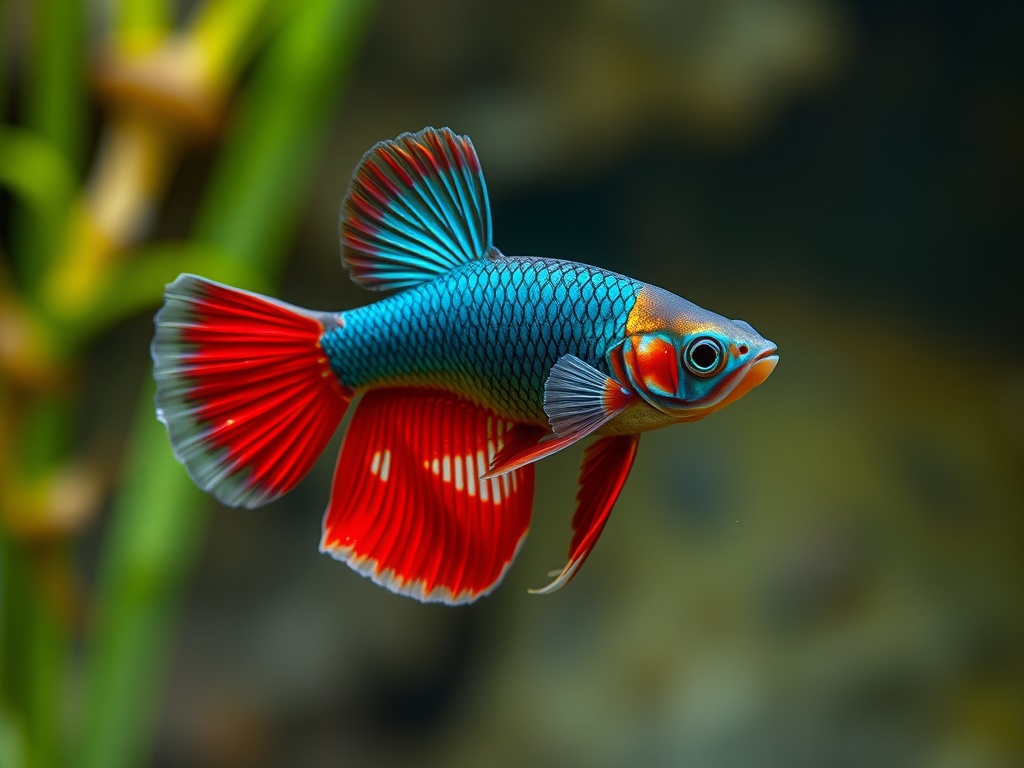
About the Siamese Fighting Fish
Everything eye-catching about the Siamese fighting fish (Betta splendens) is an artefact of human selection. The wild fish of central Thailand's rice paddies and marshes is a drab greenish-brown animal with short fins, and the veils, half-moons and metallic reds and blues of the aquarium trade are the product of roughly 700 years of breeding. Even the fighting is domesticated: Thai breeders originally selected not for beauty but for stamina in staged contests, where matches were decided by which fish gave up, not by death. The betta's key adaptation is the labyrinth organ, a folded, blood-rich structure above the gills that lets it breathe atmospheric air, which is why it survives in stagnant, oxygen-poor water where most fish would suffocate. This is often misused to justify keeping bettas in tiny unfiltered bowls; in reality wild bettas occupy large, warm, plant-choked shallows and captive fish kept in cold, foul water sicken quickly. Males build floating bubble nests bound with mucus, coax a female beneath it, wrap around her in an embrace that releases eggs, then catch the sinking eggs in their mouths and spit them into the nest, guarding them alone until the fry swim free. The wild species is now listed as Vulnerable, its floodplain habitat drained and built over.
Fascinating facts
Labyrinth Organ
Siamese fighting fish possess a labyrinth organ, allowing them to breathe air directly from the surface, enabling survival in low-oxygen waters.
Colorful Varieties
Through selective breeding, they now exist in a stunning array of colors and tail types, including veiltail, crowntail, and halfmoon.
Aggressive Nature
Male Bettas are highly territorial and will aggressively flare their fins and fight rivals, making them unsuitable for housing with other males.
Detailed description
The Siamese fighting fish (Betta splendens) is a small, laterally compressed freshwater fish, typically reaching 6–7 cm (2.4–2.8 in) in length, with males often displaying larger, more elaborate fins than females. Their coloration is highly variable, ranging from iridescent blues and greens to reds, purples, and even metallic hues, a result of both natural variation and extensive selective breeding. The species possesses a labyrinth organ, an accessory breathing structure that allows them to extract oxygen directly from air, enabling survival in hypoxic (low-oxygen) waters. Anatomically, Betta splendens have upturned mouths suited for surface feeding, and their bodies are covered in cycloid scales. In the wild, their coloration is generally more subdued, providing camouflage among aquatic vegetation. Males are renowned for their territorial aggression, especially towards other males, which is displayed through opercular flaring, fin spreading, and vivid color intensification. Socially, they are solitary and highly territorial, with complex dominance hierarchies forming only in forced group settings. Reproduction involves elaborate courtship displays and the construction of bubble nests by males, who also provide sole parental care. Their unique physiological and behavioral adaptations have enabled them to thrive in the fluctuating and sometimes harsh environments of Southeast Asia’s rice paddies, ditches, and floodplains.
Did you know?
Male Siamese fighting fish will fiercely fight other males, sometimes to the death, which is how they earned their name.
Research & sources
Wikipedia summary
The Siamese fighting fish, commonly known as the betta, is a freshwater fish native to Southeast Asia, namely Cambodia, Laos, Myanmar, Malaysia, Indonesia, Thailand, and Vietnam. It is one of 76 species of the genus Betta, but the only one eponymously called "betta", owing to its global popularity as a pet; Betta splendens are among the most popular aquarium fish in the world, due to their diverse and colorful morphology and relatively low maintenance.
Behaviour & social structure
Betta splendens are primarily crepuscular, showing peak activity at dawn and dusk. In the wild, they are opportunistic carnivores, feeding on zooplankton, insect larvae (notably mosquito larvae), small crustaceans, and occasionally plant matter. They employ a sit-and-wait hunting strategy, remaining motionless before lunging at prey. Males are highly territorial, aggressively defending their space from intruders through visual displays and, if necessary, physical combat. Flaring of the opercula, gill covers, and fins is a common threat display. Females are less aggressive but may establish minor territories. Social interactions are generally limited outside of breeding, with both sexes preferring solitude. In captivity, bettas can recognize their keepers and may display anticipatory feeding behaviors. They are known to rest on broad leaves or at the water’s surface, utilizing their labyrinth organ for air breathing.
Reproduction & life cycle
Breeding in Betta splendens is triggered by rising temperatures and increased daylight, mimicking the onset of the rainy season in their native habitat. Males construct bubble nests at the water’s surface using mucous-coated air bubbles. Courtship involves the male displaying to the female and leading her beneath the nest. Spawning is characterized by an 'embrace,' during which the male wraps around the female, inducing her to release eggs, which are then fertilized externally. The male collects the eggs in his mouth and places them in the bubble nest. Females typically lay 30–100 eggs per spawning event. After spawning, the male aggressively chases the female away and assumes sole responsibility for guarding and tending the nest, retrieving fallen eggs and maintaining the nest structure. Incubation lasts 24–36 hours, with fry becoming free-swimming after 3–4 days. Parental care ceases once fry are independent.
Adaptations & survival
Betta splendens exhibit several key adaptations for survival in variable and challenging environments. The labyrinth organ enables facultative air breathing, allowing them to inhabit stagnant, oxygen-poor waters where few competitors or predators exist. Their upturned mouths facilitate surface feeding. Males’ vivid coloration and elaborate fins serve as both sexual signals and deterrents in territorial disputes, though wild forms are more cryptically colored for camouflage. The ability to construct bubble nests ensures reproductive success in shallow, still waters prone to fluctuations in oxygen and temperature. Behavioral plasticity, including aggression modulation and environmental learning, further enhances their adaptability.
Cultural significance
Siamese fighting fish have been culturally significant in Southeast Asia for centuries. In Thailand, they were historically bred for competitive fighting, a practice with strict rules and deep social roots. The fish are symbols of perseverance, bravery, and beauty in Thai culture, and were designated the national aquatic animal of Thailand in 2019. In the West, bettas are popular ornamental fish, admired for their beauty and interactive behavior. They feature in art, literature, and as educational tools in biology. Traditional uses include their role in gambling and as diplomatic gifts.
Recent research
Recent research has focused on the genetics of coloration and fin morphology, with several studies identifying key genes involved in pigmentation and fin development. The species is a model organism for studying aggression, social behavior, and the evolution of parental care. Studies on the labyrinth organ have provided insights into the evolution of air-breathing in fishes. Conservation genetics research is ongoing to assess the impact of hybridization between wild and domesticated populations. Behavioral studies have also explored cognitive abilities, including spatial learning and individual recognition.
Videos
Habitat
Shallow freshwater environments such as rice paddies, ponds, and slow-moving streams

Conservation
The Siamese Fighting Fish is currently classified as Least Concern on the IUCN Red List.
Threats & challenges
Wild populations of Betta splendens are classified as Vulnerable by the IUCN, primarily due to habitat loss from agricultural expansion, urbanization, and pollution of wetlands and rice paddies. Hybridization with escaped domesticated bettas poses a genetic threat to wild stocks, potentially diluting native genetic diversity. Overharvesting for the aquarium trade, while less significant than habitat loss, can impact localized populations. Climate change and water management practices also threaten their natural habitats. Despite their abundance in captivity, wild populations are declining, and conservation efforts are focused on habitat protection and genetic preservation.
Taxonomy
Scientific name
Betta splendens
- Kingdom
- Animalia
- Phylum
- Chordata
- Class
- Actinopterygii
- Order
- Anabantiformes
- Family
- Osphronemidae
- Genus
- Betta
- Species
- splendens
Community notes
Share your observations about the Siamese Fighting Fish.
No community notes yet. Be the first!
Discover more wildlife
More fascinating animals from the encyclopedia.