
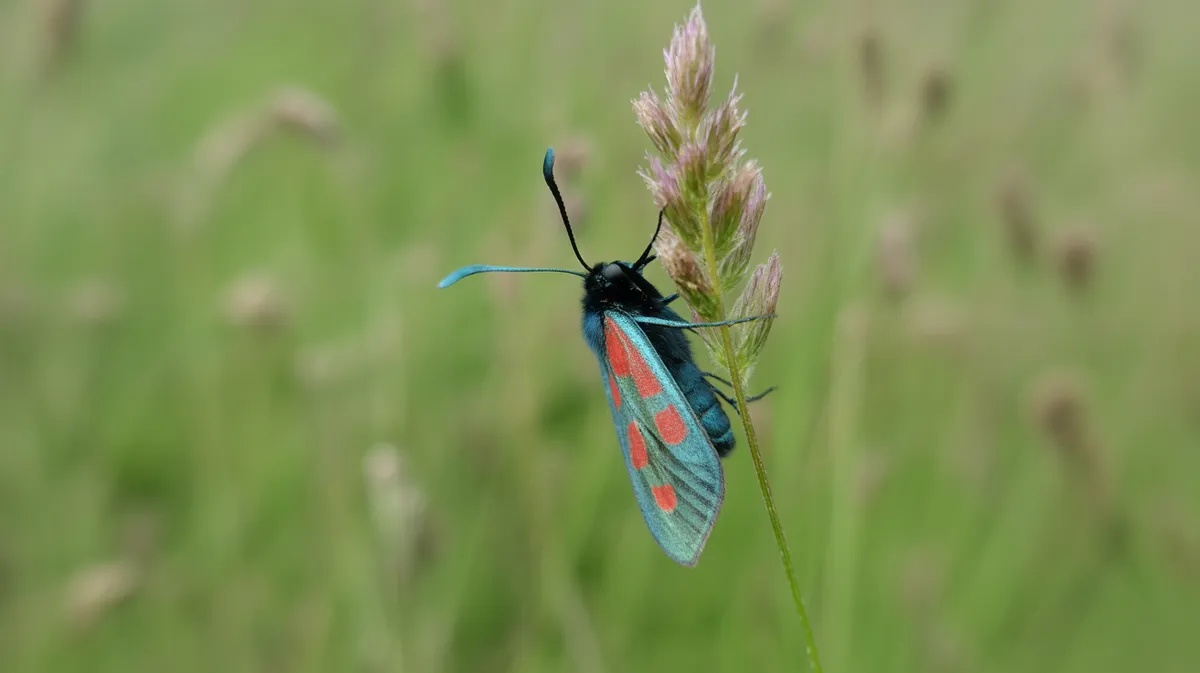
About the Six-spot Burnet Moth
The Six-spot Burnet Moth is a striking day-flying moth recognized by its metallic green-black wings adorned with six vivid red spots on each forewing. Found across Europe and parts of Asia, it thrives in sunny meadows, grasslands, and coastal areas. Adults are most active in the summer months, fluttering between wildflowers such as knapweed and thistles. Its caterpillars feed primarily on bird's-foot trefoil, and the species is well-known for its aposematic coloration, warning predators of its toxicity.
Fascinating facts
Daytime Flier
Unlike most moths, the Six-spot Burnet Moth is active during the day and is often mistaken for a butterfly.
Host Plant Specialist
Its caterpillars primarily feed on bird's-foot trefoil, but will also use clover and vetch species if available.
Chemical Defense
They contain cyanogenic compounds that deter predators, making them one of the few toxic European moths.
Detailed description
The Six-spot Burnet Moth (Zygaena filipendulae) is a medium-sized, robust day-flying moth with a wingspan typically ranging from 30 to 40 mm. Its forewings are a distinctive metallic blue-green to black, each marked with six vivid crimson spots, while the hindwings are bright red bordered with a narrow black margin. The moth's body is stout and covered in fine, dark hairs. Unlike most moths, it is diurnal, being most active during warm, sunny days. The antennae are clubbed, a characteristic feature of the Zygaenidae family, aiding in sensory perception. The moth's flight is slow and fluttering, often observed as it visits nectar-rich flowers. Larvae are plump, yellow-green with rows of black spots and feed openly on host plants. The species undergoes complete metamorphosis, with the pupal stage encased in a papery, spindle-shaped cocoon attached to grass stems. Adults possess specialized scales that produce cyanogenic glycosides, making them toxic and unpalatable to predators, a trait advertised by their striking coloration.
Did you know?
If attacked, the Six-spot Burnet Moth can excrete a yellow fluid containing cyanide compounds from its joints.
Research & sources
Behaviour & social structure
Six-spot Burnet Moths are solitary in their adult phase but may be found in loose aggregations where host plants and nectar sources are abundant. Adults are primarily nectar feeders, favoring knapweed, thistles, and scabious, and play a role in pollination. They exhibit aposematic (warning) behavior, often resting conspicuously on vegetation in full view of potential predators. When threatened, they may exude a yellowish liquid containing hydrogen cyanide from their leg joints, deterring predation. Larvae feed openly on leaves of bird's-foot trefoil and occasionally other legumes, often skeletonizing the foliage. Both larvae and adults are most active during the warmest part of the day, retreating to sheltered spots in inclement weather. There is little evidence of complex social behavior; interactions are limited to mating and occasional competition for food resources.
Reproduction & life cycle
Mating occurs shortly after adult emergence, usually from late June to early August, depending on latitude and altitude. Males locate females through pheromone cues, and copulation can last several hours. Females lay clusters of pale yellow eggs on the underside of host plant leaves. The incubation period is typically 7–14 days, after which larvae emerge and begin feeding. Larval development lasts 4–8 weeks, with growth rates influenced by temperature and food quality. Pupation occurs in a tough, silken cocoon attached to grass stems or leaves, where the pupa remains for 2–3 weeks before eclosion. There is usually one generation per year (univoltine), though partial second generations may occur in warmer regions. Parental care is absent; all life stages are independent after egg-laying.
Adaptations & survival
Zygaena filipendulae has evolved several notable adaptations. Its aposematic coloration and the ability to synthesize and sequester cyanogenic glycosides from host plants provide effective chemical defense against predators, particularly birds. The moth's clubbed antennae improve navigation and mate detection during the day. Larvae are also toxic and display warning coloration. The spindle-shaped, weather-resistant cocoon protects the pupa from desiccation and predation. Adults have a high tolerance for heat, allowing activity during midday when many predators are less active. Their slow, conspicuous flight is a form of honest signaling, advertising their toxicity rather than relying on escape.
Cultural significance
The Six-spot Burnet Moth is a familiar sight in European meadows and has become a symbol of healthy grassland ecosystems. Its striking appearance has inspired artists and naturalists, and it is sometimes featured in educational materials to illustrate aposematism and mimicry. In some regions, it is used as a bioindicator species for grassland conservation. There are no known traditional uses or significant roles in folklore, but its presence is often associated with summer and biodiversity.
Recent research
Recent studies have focused on the moth's chemical defense mechanisms, particularly the biosynthesis and ecological function of cyanogenic glycosides. Genetic research has explored population structure and phylogeography, revealing significant genetic diversity across its range. Ongoing research examines the impact of climate change on phenology and distribution, as well as the role of the species in pollination networks. Conservation studies highlight the importance of traditional meadow management for sustaining populations.
Videos
Habitat
Meadows and grasslands

Conservation
The Six-spot Burnet Moth is currently classified as Least Concern on the IUCN Red List.
Threats & challenges
While currently classified as Least Concern, Six-spot Burnet Moth populations are sensitive to habitat loss due to agricultural intensification, overgrazing, and the decline of wildflower meadows. Pesticide use and reduction in host plant abundance pose additional threats. Climate change may alter the timing of life cycle events and shift suitable habitats, potentially leading to local declines. Despite these challenges, the species remains widespread and locally abundant in many areas, but long-term monitoring is recommended to detect population trends.
Taxonomy
Scientific name
Zygaena filipendulae
- Kingdom
- Animalia
- Phylum
- Arthropoda
- Class
- Insecta
- Order
- Lepidoptera
- Family
- Zygaenidae
- Genus
- Zygaena
- Species
- filipendulae
Community notes
Share your observations about the Six-spot Burnet Moth.
No community notes yet. Be the first!
Discover more wildlife
More fascinating animals from the encyclopedia.