
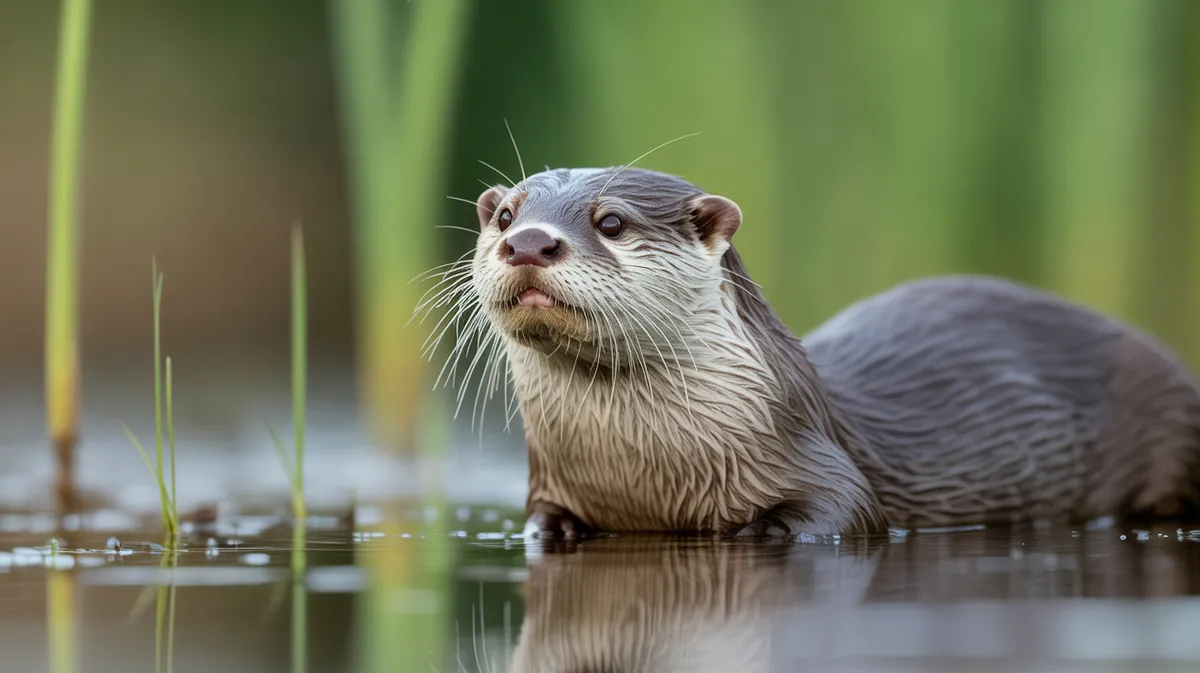
About the Asian Small-clawed Otter
The Asian Small-clawed Otter is the smallest otter species in the world, recognized by its short, dexterous claws that do not extend beyond the tips of its fingers and toes. Native to South and Southeast Asia, it inhabits wetlands, marshes, and mangrove swamps, often near slow-moving rivers and coastal areas. This otter is highly social, living in family groups and displaying complex vocal communications. Its diet mainly consists of crustaceans, mollusks, and small fish, which it skillfully manipulates with its nimble paws.
Fascinating facts
Smallest Otter
The Asian Small-clawed Otter is the tiniest otter species, measuring only 40–64 cm in body length excluding the tail.
Dexterous Paws
They have highly sensitive, partially webbed paws that allow them to expertly catch crustaceans and other small aquatic animals.
Family Groups
These otters live in tight-knit family groups of up to 12 individuals and work together to raise their young.
Detailed description
The Asian Small-clawed Otter (Aonyx cinereus) is the smallest extant otter species, with adults typically measuring 73–96 cm in total length, including a 25–35 cm tail, and weighing between 2.7 and 3.5 kg. Its fur is dense, velvety, and water-repellent, colored dark brown above and lighter on the underside, with a pale throat and cheeks. The species is distinguished by its extremely short, blunt claws, which do not extend beyond the digital pads, and partially webbed feet—an adaptation that enhances tactile sensitivity and dexterity. This otter possesses a broad, flattened head, small rounded ears, and a highly sensitive vibrissal (whisker) system for detecting prey in murky water. Socially, Asian Small-clawed Otters are highly gregarious, forming cohesive family groups of up to 15 individuals, often led by a dominant breeding pair. They communicate using a complex repertoire of vocalizations, scent markings, and body postures. Their home ranges are centered around freshwater wetlands, rice paddies, mangroves, and tidal pools, where they construct burrows (holts) with multiple entrances. The species is diurnal, with peak activity at dawn and dusk, and exhibits playful behaviors such as sliding, wrestling, and coordinated group foraging. Their diet is diverse but specialized towards hard-shelled invertebrates, which they skillfully manipulate and open using their forepaws.
Did you know?
Unlike most otters, Asian Small-clawed Otters rely more on their sense of touch than their mouth to catch and handle prey.
Research & sources
Wikipedia summary
The Asian small-clawed otter, also called oriental small-clawed otter and small-clawed otter, is an otter species native to South and Southeast Asia. It has short claws that do not extend beyond the pads of its webbed digits. With a total body length of 730 to 960 mm, and a maximum weight of 3.5 kg (7.7 lb), it is the smallest otter species.
Behaviour & social structure
Asian Small-clawed Otters display intricate social behaviors, including cooperative hunting, mutual grooming, and communal care of young. They are known for their intelligence and problem-solving abilities, often observed using stones or hard surfaces to break open mollusk shells. Foraging is typically conducted in shallow water or mudflats, where they probe with their sensitive paws to locate crabs, snails, and small fish. Group foraging enhances efficiency and may involve coordinated movements to flush out prey. Otters communicate through at least 12 distinct vocalizations, including whistles, chirps, and growls, which serve functions ranging from alarm calls to maintaining group cohesion. Scent marking with feces (spraint), urine, and glandular secretions is used to delineate territory and convey reproductive status. Daily routines include periods of active foraging interspersed with resting, grooming, and social play, which is essential for reinforcing social bonds.
Reproduction & life cycle
The species is monogamous, with dominant pairs maintaining long-term bonds. Breeding can occur year-round in tropical regions, but peaks are often observed during the dry season. After a gestation period of 60–64 days, females give birth to litters of 1–7 pups (typically 2–4) in a secure holt. Pups are born altricial—blind, toothless, and helpless—and remain in the den for the first 5–6 weeks. Both parents, along with older siblings, participate in rearing the young, providing food and protection. Pups are weaned at about 3 months and begin swimming lessons at 9–10 weeks, gradually integrating into group activities. Sexual maturity is reached at around 1 year of age, though dispersal from the natal group may be delayed until suitable territories become available.
Adaptations & survival
Asian Small-clawed Otters exhibit several evolutionary adaptations for their semi-aquatic lifestyle. Their partially webbed feet and highly dexterous digits allow precise manipulation of prey, a trait unique among otters. The reduced claws enhance tactile sensitivity, enabling them to extract invertebrates from crevices. Their dense, oily fur provides thermal insulation and buoyancy, while a streamlined body and muscular tail aid in agile swimming. The vibrissae are highly developed, detecting minute water movements generated by prey. Behaviorally, their social structure facilitates cooperative foraging and predator avoidance. Their ability to exploit a range of wetland habitats, including rice paddies and man-made canals, demonstrates ecological flexibility.
Cultural significance
In several Asian cultures, otters are regarded as symbols of playfulness, agility, and resourcefulness. In parts of India and Bangladesh, otters have been traditionally trained by fishermen to herd fish into nets, a practice known as 'otter fishing.' Folklore in Southeast Asia often depicts otters as clever tricksters or helpers, and their presence is sometimes considered an indicator of healthy wetlands. However, negative perceptions also exist, with otters occasionally blamed for raiding fish ponds or rice fields, leading to localized persecution.
Recent research
Recent research has focused on the species' genetic diversity, population structure, and adaptability to anthropogenic landscapes. Studies using camera traps and environmental DNA (eDNA) have improved detection and monitoring in fragmented habitats. Behavioral research has highlighted the otter's advanced problem-solving skills and tool use in captivity. Conservation genetics studies are underway to assess the impact of habitat fragmentation on gene flow. Ongoing projects by the IUCN Otter Specialist Group and regional NGOs aim to map distribution, assess threats, and develop community-based conservation strategies, including wetland restoration and anti-poaching initiatives.
Videos
Habitat
Wetlands, marshes, and mangroves near freshwater bodies


Conservation
The Asian Small-clawed Otter is currently classified as Vulnerable on the IUCN Red List.
Threats & challenges
Major threats to the Asian Small-clawed Otter include habitat loss and degradation due to wetland drainage, agricultural expansion, and urbanization. Pollution from pesticides and industrial runoff contaminates water sources and reduces prey availability. Illegal hunting and trapping for the pet trade and fur, as well as local use in traditional medicine, have caused significant population declines in some regions. Competition with other otter species and human disturbance further exacerbate pressures. The species is listed as Vulnerable by the IUCN, with populations believed to be declining across much of its range. Fragmentation of suitable habitats impedes gene flow and increases vulnerability to local extinctions.
Taxonomy
Scientific name
Aonyx cinereus
- Kingdom
- Animalia
- Phylum
- Chordata
- Class
- Mammalia
- Order
- Carnivora
- Family
- Mustelidae
- Genus
- Aonyx
- Species
- cinereus
Community notes
Share your observations about the Asian Small-clawed Otter.
No community notes yet. Be the first!
Discover more wildlife
More fascinating animals from the encyclopedia.