
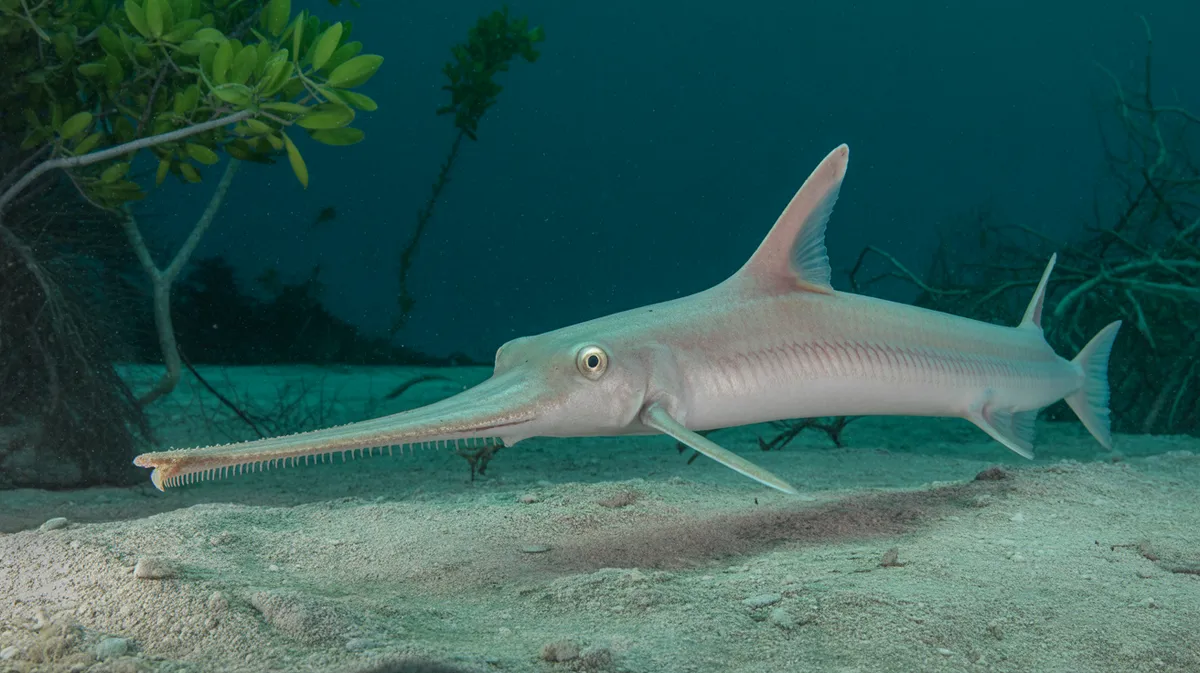
About the Smalltooth Sawfish
The sawfish is not a shark. It is a ray — its gills are on the underside, as a ray's are — and the "saw" is a rostrum, an extension of the snout studded along both edges with modified scales, not teeth in the true sense, which cannot be replaced if broken. The saw does two jobs at once. Its underside is densely covered with electroreceptors, so it works as a scanner, sweeping the water and detecting the faint electrical fields given off by fish hidden in the murk or buried in the mud. Then it becomes a weapon: the sawfish lashes it sideways with startling speed, striking a fish hard enough to stun or cut it in half, and it will also use it to pin prey against the bottom. That same elegant tool is the reason the animal is disappearing — a rostrum tangles catastrophically in any net it touches, so sawfish are caught as bycatch almost anywhere fishing happens, and the smalltooth sawfish is now critically endangered across most of its former range.
Fascinating facts
Saw-Like Rostrum
The Smalltooth Sawfish’s snout, or rostrum, is edged with 20-32 pairs of teeth on each side and is used to slash through schools of fish or unearth crustaceans from the sea floor.
Live Birth
Female sawfish give birth to live young, with litters ranging from 7 to 14 pups, and the young are born fully formed and independent.
Critically Endangered
Populations have declined by over 95% due to entanglement in fishing gear and loss of coastal habitats, making the Smalltooth Sawfish one of the world’s most endangered fish.
Detailed description
The Smalltooth Sawfish (Pristis pectinata) is a large elasmobranch, closely related to rays and skates, and is distinguished by its elongated, flattened rostrum lined with 20–32 pairs of sharp, tooth-like denticles on each side. Adults can reach lengths of up to 5.5 meters (18 feet), though most individuals encountered today are smaller due to population pressures. The body is dorsoventrally flattened, with pectoral fins fused to the head, and a grayish to brownish coloration that provides camouflage in murky, sediment-rich waters. The saw-like rostrum is highly sensitive, containing thousands of electroreceptors (ampullae of Lorenzini) that detect the weak electric fields produced by prey, even when buried under sand. Smalltooth Sawfish are generally solitary but may aggregate in nursery areas, especially juveniles. They are primarily nocturnal, spending daylight hours resting on the substrate and becoming more active at dusk. Their diet consists mainly of small fish and crustaceans, which they locate and incapacitate using rapid side-to-side slashes of the rostrum. Reproduction is ovoviviparous, with females giving birth to live young after internal fertilization. The species exhibits slow growth, late sexual maturity (typically at 7–12 years), and low reproductive output, with litters ranging from 7 to 14 pups. These life history traits, combined with habitat specificity, make them highly vulnerable to environmental changes and human impacts.
Did you know?
The Smalltooth Sawfish’s rostrum can make up nearly one-third of its total body length, sometimes exceeding 1.5 meters (5 feet) long.
Research & sources
Behaviour & social structure
Smalltooth Sawfish are predominantly solitary, except during the breeding season or in nursery areas where juveniles may be found in loose aggregations. They exhibit crepuscular and nocturnal activity patterns, foraging primarily at night or during low light conditions. Their hunting strategy involves using the rostrum to sense and strike at prey, stunning or impaling small fish and dislodging crustaceans from the substrate. They are known to exhibit site fidelity, especially in juveniles, which remain in shallow estuarine habitats for several years before moving to deeper coastal waters as adults. Sawfish are generally non-aggressive toward humans but can defend themselves vigorously if threatened. Social interactions are minimal, with little evidence of complex social structures beyond mother-offspring associations in nursery habitats.
Reproduction & life cycle
Smalltooth Sawfish are ovoviviparous, meaning embryos develop inside eggs that remain within the mother's body until hatching. Mating occurs in late spring to early summer, with males using modified claspers to internally fertilize females. Gestation lasts approximately 5 months, after which females give birth to litters of 7–14 fully formed pups, each measuring 60–90 cm (2–3 feet) at birth. Pups are born with a gelatinous sheath covering the rostral teeth to protect the mother during parturition; this sheath is shed soon after birth. There is no parental care post-birth, and juveniles are independent from the outset. Females reproduce biennially or triennially, contributing to the species' slow population growth. Sexual maturity is reached at around 7–12 years of age, with males maturing slightly earlier than females.
Adaptations & survival
The most striking adaptation of the Smalltooth Sawfish is its rostrum, which serves both as a sensory organ and a weapon. The rostrum's ampullae of Lorenzini detect minute electrical signals from hidden prey, while its robust structure allows for rapid, forceful slashing to stun or kill prey. Their flattened body and large pectoral fins enable them to maneuver efficiently along the bottom in shallow, complex habitats like mangroves and estuaries. Sawfish also have a high tolerance for varying salinities, allowing them to exploit both marine and freshwater environments. Their cryptic coloration provides camouflage in turbid waters, reducing predation risk, especially for juveniles.
Cultural significance
Sawfish rostra have been used historically as weapons, tools, and ceremonial objects in various cultures, particularly among indigenous peoples in Africa, Asia, and the Americas. In some traditions, the sawfish is seen as a symbol of strength or protection. The rostrum has also been used in folk medicine and as a curiosity item in the global wildlife trade. Today, sawfish are increasingly recognized as flagship species for coastal conservation, helping to raise awareness about the importance of mangrove and estuarine ecosystems.
Recent research
Recent research has focused on mapping critical habitats using acoustic telemetry, genetic studies to assess population structure and connectivity, and developing non-lethal survey techniques such as environmental DNA (eDNA) sampling. Notably, studies have demonstrated the importance of mangrove-lined estuaries in Florida as essential nursery habitats. Ongoing research is investigating the physiological tolerance of sawfish to changing salinity and temperature regimes, with implications for climate change resilience. Conservation genetics has revealed low genetic diversity in remnant populations, underscoring the urgency of recovery efforts. There is also interest in understanding the sensory biology of the rostrum and its role in prey detection and navigation.
Sources
Pristis pectinata: The IUCN Red List of Threatened Species 2020
IUCN SSC Shark Specialist Group
conservationPristis pectinata (Smalltooth Sawfish): Biology, Ecology, and Conservation
Simpfendorfer, C.A., Poulakis, G.R., Wiley, T.R., et al. (2016)
scientificPristis pectinata: The IUCN Red List of Threatened Species 2020
International Union for Conservation of Nature (IUCN)
conservationVideos
Habitat
Coastal marine and estuarine waters, often in shallow bays, river mouths, and mangroves


Conservation
The Smalltooth Sawfish is currently classified as Critically Endangered on the IUCN Red List.
Threats & challenges
The primary threats to Smalltooth Sawfish are overfishing (both targeted and as bycatch in gillnets, trawls, and longlines), habitat loss due to coastal development, and degradation of critical nursery habitats such as mangroves and estuaries. Their rostrum makes them particularly susceptible to entanglement in fishing gear. Historical population declines have exceeded 95% in some regions, with current populations fragmented and largely restricted to parts of southern Florida and the Bahamas. Illegal trade in sawfish parts, especially rostra, persists despite international protections. Their slow reproductive rate and late maturity further hinder recovery. Conservation challenges include enforcing fishing bans, restoring habitats, and increasing public awareness.
Taxonomy
Scientific name
Pristis pectinata
- Kingdom
- Animalia
- Phylum
- Chordata
- Class
- Chondrichthyes
- Order
- Rhinopristiformes
- Family
- Pristidae
- Genus
- Pristis
- Species
- pectinata
Community notes
Share your observations about the Smalltooth Sawfish.
No community notes yet. Be the first!
Discover more wildlife
More fascinating animals from the encyclopedia.