
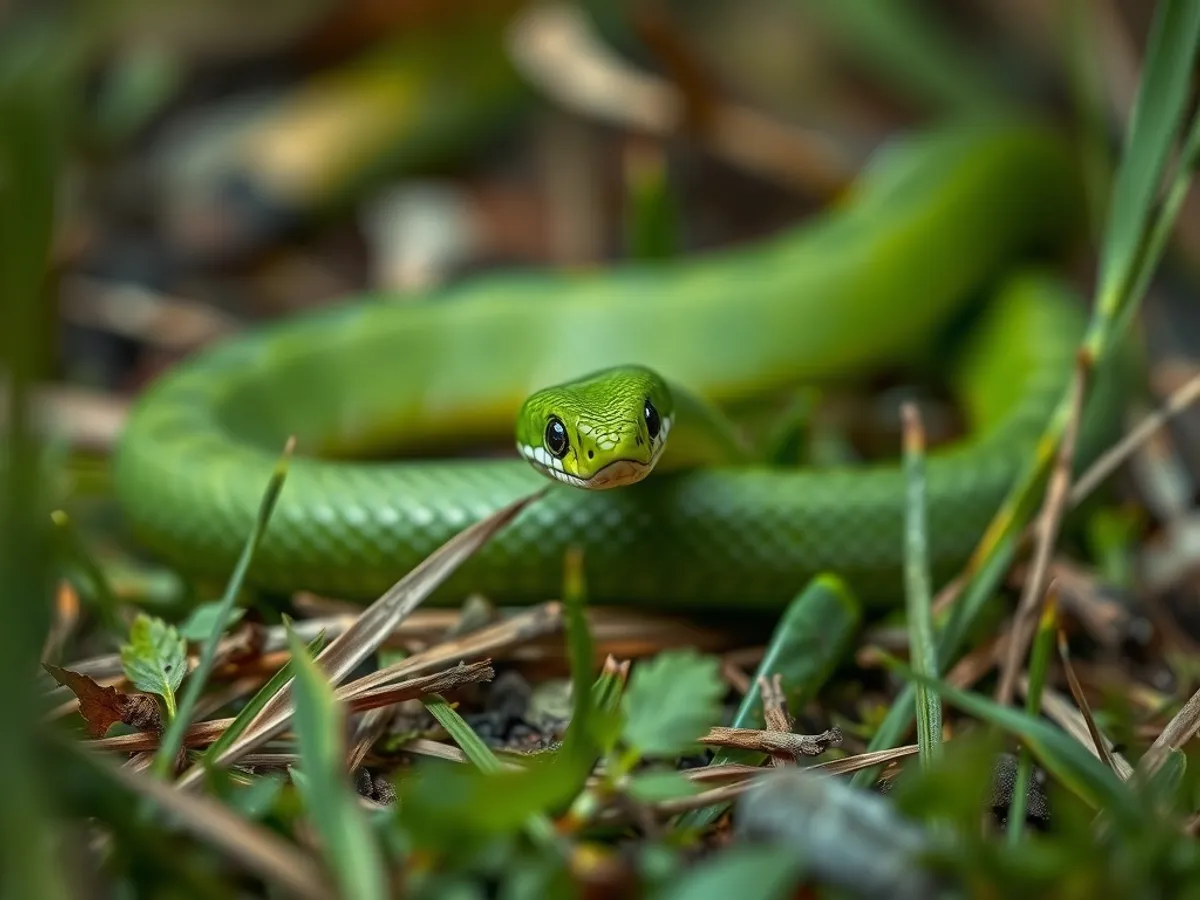
About the Smooth Green Snake
The Smooth Green Snake is a slender, small, non-venomous snake known for its vivid, grass-green coloration that helps it blend seamlessly into its grassy habitats. This species is native to North America, ranging from southeastern Canada through the northeastern and midwestern United States. Its smooth, unkeeled scales give it a silky texture, distinguishing it from the similar rough green snake. The Smooth Green Snake is generally shy and secretive, often hiding among dense vegetation, making it a challenge to spot in the wild. Its gentle nature and insectivorous diet make it an important contributor to local ecosystems.
Fascinating facts
Distinctive Color
Their bright green coloration helps them camouflage effectively in grassy habitats, making them nearly invisible to predators and humans alike.
Egg-Laying
Smooth Green Snakes are oviparous, laying clutches of 3-13 eggs in rotting logs or under leaf litter during the summer.
Insect-Eater
Their diet consists mainly of insects and spiders, making them beneficial for natural pest control in their ecosystems.
Detailed description
The Smooth Green Snake (Opheodrys vernalis) is a slender, medium-small colubrid, typically measuring 36–51 cm (14–20 in) in total length, with rare individuals reaching up to 66 cm (26 in). Its dorsal coloration is a vivid, uniform emerald or grass-green, while the ventral surface is pale yellow, cream, or occasionally white. The scales are smooth and unkeeled, giving the snake a glossy, almost silky appearance and feel—a key distinction from the similar Rough Green Snake (Opheodrys aestivus), which has keeled scales. The head is slightly wider than the neck, with large eyes and round pupils, adapted for diurnal activity. Juveniles are born with a duller olive or bluish-gray hue, gradually acquiring their characteristic green as they mature. This species is highly secretive and cryptic, relying on its coloration for camouflage among grasses and low vegetation. It is primarily terrestrial but is also capable of limited climbing in low shrubs. The Smooth Green Snake is nonvenomous and poses no threat to humans; when threatened, it prefers to flee or remain motionless, blending into its surroundings. Its slender build and agility allow it to navigate dense ground cover with ease, and it is most often encountered in undisturbed, moist habitats rich in insect prey.
Did you know?
The Smooth Green Snake has a vital role in controlling insect populations, particularly pests such as crickets, spiders, and caterpillars.
Research & sources
Wikipedia summary
The smooth green snake is a species of North American nonvenomous snake in the family Colubridae. The species is also referred to as the grass snake. It is a slender, "small medium" snake that measures 36–51 cm (14–20 in) as an adult. It gets its common name from its smooth dorsal scales, as opposed to the rough green snake, which has keeled dorsal scales. The smooth green snake is found in marshes, meadows, open woods, and along stream edges, and is native to regions of Canada, the United States, and northern Mexico. A non-aggressive snake, it seldom bites and usually flees when threatened. It mates in late spring to summer, and females lay their eggs from June to September. The smooth green snake will often bob its head in order to mimic vegetation blowing in the wind.
Behaviour & social structure
Smooth Green Snakes are diurnal, being most active during daylight hours, especially in the morning and late afternoon. They are solitary for most of the year, with the exception of brief interactions during the breeding season. Their primary hunting strategy is active foraging: they move slowly and deliberately through grasses and low vegetation, using visual cues to locate prey. The diet consists mainly of soft-bodied invertebrates, such as crickets, spiders, caterpillars, grasshoppers, and occasionally small snails or slugs. They rarely consume vertebrate prey. When capturing food, they use a quick strike-and-grasp method, swallowing prey alive. Smooth Green Snakes are generally non-aggressive and rarely bite, even when handled. Defensive behaviors include rapid escape, remaining motionless to rely on camouflage, and occasionally a head-bobbing motion that mimics the swaying of grass in the wind. They may hibernate communally in rodent burrows or beneath logs and rocks during the winter months, particularly in northern parts of their range.
Reproduction & life cycle
Breeding occurs from late spring through summer (May to August), triggered by rising temperatures and increased daylight. Males locate females by following pheromone trails. Courtship involves tactile stimulation and body alignment. Females lay a single clutch of 3–13 elongated, leathery eggs (average 4–6) in concealed, moist locations such as under logs, in rotting wood, or within decaying leaf litter. Communal nesting has been observed, with multiple females depositing eggs in the same site. Incubation lasts 4–6 weeks, depending on ambient temperature, with eggs hatching from late July through September. Hatchlings measure 10–18 cm (4–7 in) and are independent from birth, receiving no parental care. Sexual maturity is reached at 2–3 years of age. Reproductive output and timing can vary with latitude and local environmental conditions.
Adaptations & survival
The Smooth Green Snake exhibits several adaptations for survival in its grassland and meadow habitats. Its bright green coloration provides exceptional camouflage among vegetation, reducing predation risk from birds and mammals. The smooth, unkeeled scales minimize friction, enabling swift, silent movement through dense grasses. Its slender body allows access to narrow spaces and efficient pursuit of small invertebrate prey. The species’ head-bobbing behavior is a form of cryptic mimicry, making it less conspicuous to predators by resembling wind-blown foliage. Diurnal vision is well-developed, supporting its reliance on sight for hunting. Communal hibernation in frost-free refuges helps conserve heat and moisture during cold winters. The ability to tolerate a range of moist habitats, from marshes to open woods, reflects ecological flexibility.
Cultural significance
The Smooth Green Snake has limited direct cultural significance but is sometimes referenced in regional folklore as a harmless 'grass snake.' Its striking appearance and gentle nature have made it a favored species among naturalists and educators, often used to promote awareness of native reptiles and the importance of insectivorous species in ecosystem health. In some indigenous North American traditions, green snakes are associated with fertility, renewal, or the coming of spring, though specific references to Opheodrys vernalis are rare. The species is occasionally kept as a pet, though it is considered challenging due to its specialized diet and sensitivity to environmental changes.
Recent research
Recent research has focused on the Smooth Green Snake’s population genetics, revealing significant regional variation and possible cryptic subspecies, particularly in isolated populations. Studies on pesticide exposure have highlighted the species’ vulnerability to neonicotinoids and other agricultural chemicals, with sublethal effects on behavior and reproduction. Ongoing monitoring programs in the Midwest and Northeast United States are tracking population trends in response to habitat restoration efforts. Ecological studies have examined the snake’s role in controlling pest insect populations, underscoring its value in integrated pest management. There is also interest in the species’ overwintering ecology, with communal hibernacula being mapped and characterized for conservation planning.
Videos
Habitat
Moist meadows, grassy fields, open woodlands, and edges of forests
 Various Continental Regions
Grassland
Open areas dominated by grasses rather than trees, supporting numerous herbivores and their predators.
 Global
Forest
Wooded areas with significant tree cover and diverse plant and animal communities.
 Global
Freshwater
Lakes, rivers, and wetlands with diverse aquatic ecosystems.
Conservation
The Smooth Green Snake is currently classified as Least Concern on the IUCN Red List.
Threats & challenges
Although currently listed as Least Concern by the IUCN, Smooth Green Snake populations are declining in parts of their range due to habitat loss, fragmentation, and degradation. Conversion of native grasslands to agriculture, urban development, and pesticide use are significant threats, as these snakes are highly sensitive to environmental toxins, particularly insecticides that reduce their prey base and can cause direct mortality. Road mortality is a localized concern, especially in fragmented habitats. Invasive species, such as domestic cats, may also contribute to predation pressure. Climate change poses potential long-term risks by altering habitat suitability and hibernation patterns. Conservation efforts focus on habitat protection, restoration of native meadows, and reduction of pesticide application.
Taxonomy
Scientific name
Opheodrys vernalis
- Kingdom
- Animalia
- Phylum
- Chordata
- Class
- Reptilia
- Order
- Squamata
- Family
- Colubridae
- Genus
- Opheodrys
- Species
- vernalis
Community notes
Share your observations about the Smooth Green Snake.
No community notes yet. Be the first!
Discover more wildlife
More fascinating animals from the encyclopedia.