
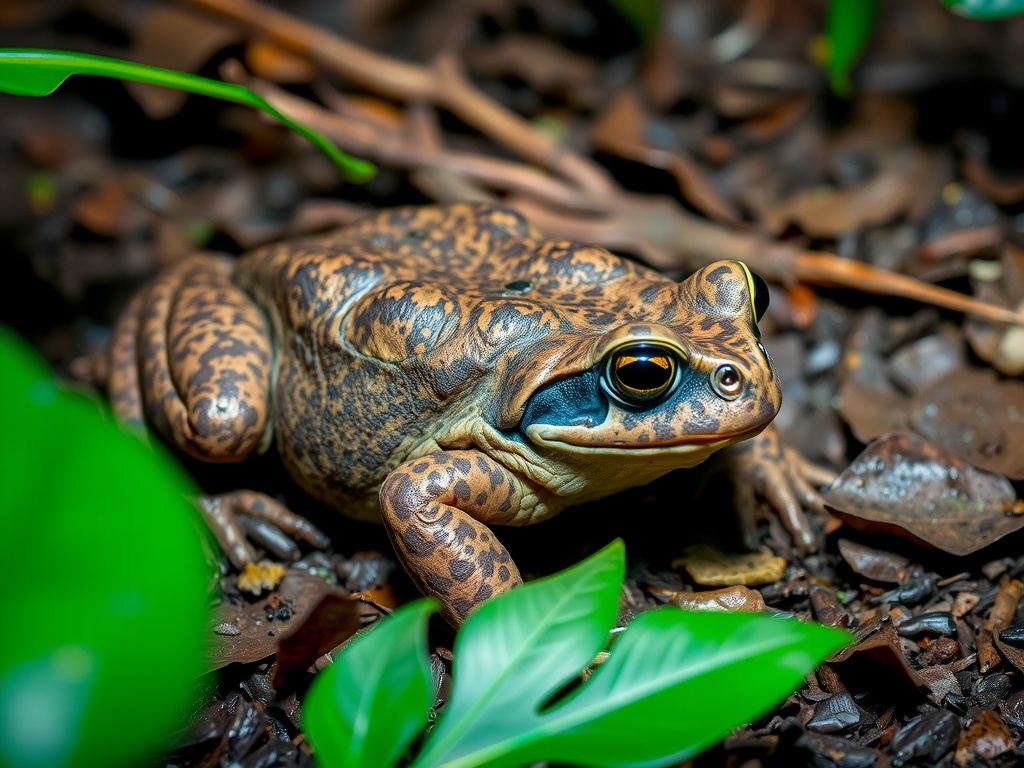
About the Smooth-sided Toad
The Smooth-sided Toad is a large, terrestrial amphibian native to the tropical rainforests of northern South America. Recognized by its smooth skin and robust body, this toad can reach impressive sizes, making it one of the largest true toads in its range. It is primarily nocturnal and spends much of its life on the forest floor, blending into the leaf litter to avoid predators. Its skin secretes potent toxins as a defense mechanism, which can deter many would-be threats.
Fascinating facts
Toxic Defense
The Smooth-sided Toad produces bufotoxin, a defensive chemical that can cause severe irritation or illness in predators.
Nocturnal Lifestyle
This toad is mainly active at night, relying on its camouflage and toxic secretions for protection.
Rainforest Resident
The Smooth-sided Toad inhabits humid tropical rainforests and is often found near slow-moving streams or standing water.
Detailed description
The Smooth-sided Toad (Rhaebo guttatus) is a robust, terrestrial amphibian notable for its considerable size, with adults typically ranging from 10 to 17 cm in snout-vent length, and some females reaching up to 20 cm, making it one of the largest toads in South America. Its skin is characteristically smooth and moist, lacking the prominent warts seen in many other toad species, and is generally brown to reddish-brown, providing effective camouflage among leaf litter. The parotoid glands, located behind the eyes, are well-developed and produce potent bufotoxins as a defense against predators. The head is broad with a blunt snout, and the limbs are sturdy, adapted for terrestrial locomotion rather than jumping. Eyes are relatively large with horizontal pupils, aiding nocturnal vision. Rhaebo guttatus is primarily nocturnal, emerging at dusk to forage, and spends daylight hours hidden under logs or debris. It is a solitary species outside of the breeding season, with minimal social interaction. During reproduction, males emit low-pitched calls near temporary pools or slow-moving streams to attract females. Eggs are laid in long gelatinous strings, and the aquatic larvae (tadpoles) develop rapidly in ephemeral water bodies, minimizing predation risk. The species is highly adapted to humid, lowland rainforests but can also be found in secondary forests and occasionally near human settlements.
Did you know?
The toxins secreted by the Smooth-sided Toad are so potent that they have been studied for potential medical applications.
Research & sources
Behaviour & social structure
Rhaebo guttatus is predominantly nocturnal, remaining inactive and concealed during the day to avoid desiccation and predation. At night, it becomes active, foraging for a variety of invertebrates including insects, spiders, and occasionally small vertebrates such as other amphibians. It employs a sit-and-wait hunting strategy, relying on its cryptic coloration to ambush prey. The species is generally solitary, with individuals maintaining loose territories, especially during the non-breeding season. Aggressive encounters are rare but may occur between males during the breeding season. The toad exhibits a defensive posture when threatened, inflating its body and secreting toxins from its parotoid glands. Vocalizations are infrequent outside the breeding season, and communication is primarily limited to mating calls.
Reproduction & life cycle
Breeding in Rhaebo guttatus is closely tied to the onset of the rainy season, typically occurring from November to March, depending on local climate. Males congregate near temporary pools or slow-moving streams and produce a low, guttural call to attract females. Amplexus is axillary, with the male grasping the female behind her forelimbs. Females lay between 3,000 and 8,000 eggs in long, gelatinous strings that are attached to submerged vegetation or debris. The eggs hatch within 2–5 days, depending on temperature and humidity. Tadpoles are aquatic, feeding on detritus and algae, and undergo metamorphosis within 4–8 weeks. There is no parental care post-oviposition, and survival rates are highly dependent on the persistence of breeding pools and predation pressure.
Adaptations & survival
The Smooth-sided Toad has evolved several key adaptations for survival in the rainforest. Its smooth, cryptically colored skin provides camouflage against the forest floor, while the secretion of potent bufotoxins from its parotoid glands deters most predators, including mammals and snakes. The large body size reduces vulnerability to smaller predators and allows for greater energy reserves during periods of food scarcity. Nocturnal activity patterns help minimize water loss and exposure to diurnal predators. The species' reproductive strategy—laying large numbers of eggs in ephemeral pools—maximizes offspring survival in unpredictable environments. The rapid development of tadpoles is an adaptation to the transient nature of breeding sites.
Cultural significance
Rhaebo guttatus does not have significant documented roles in indigenous folklore or traditional medicine compared to some other South American toads. However, its striking appearance and potent toxins have led to occasional mention in local stories as a creature to be avoided. The species is sometimes kept in captivity by amphibian enthusiasts, but it is not widely traded or utilized in traditional practices. Its ecological role as both predator and prey is more significant than its cultural impact.
Recent research
Recent studies on Rhaebo guttatus have focused on the composition and pharmacological properties of its skin secretions, which contain bufadienolides with potential biomedical applications. Ongoing research is also examining the species' response to habitat fragmentation and environmental pollutants, with preliminary data suggesting some resilience to moderate disturbance. Genetic studies have clarified its phylogenetic placement within the Bufonidae, supporting its separation from the genus Bufo. There is increasing interest in the species as a bioindicator for rainforest ecosystem health due to its sensitivity to environmental changes.
Sources
Amphibian Species of the World: Rhaebo guttatus
Frost, D.R., American Museum of Natural History (2024)
scientificRhaebo guttatus: The IUCN Red List of Threatened Species 2020
IUCN SSC Amphibian Specialist Group
conservationVideos
Habitat
Tropical rainforest floor
 Tropical Regions
Rainforest
Dense, wet forests with the highest biodiversity on Earth, containing more than half of the world's plant and animal species.
 Global
Forest
Wooded areas with significant tree cover and diverse plant and animal communities.
 Global
Freshwater
Lakes, rivers, and wetlands with diverse aquatic ecosystems.
Conservation
The Smooth-sided Toad is currently classified as Least Concern on the IUCN Red List.
Threats & challenges
Although currently listed as Least Concern by the IUCN, Rhaebo guttatus faces localized threats from habitat loss due to deforestation, agricultural expansion, and infrastructure development in the Amazon and Guiana Shield regions. Pollution of breeding sites from pesticides and other agrochemicals can negatively impact egg and larval survival. The species is occasionally collected for the pet trade, but this is not considered a major threat at present. Climate change poses a potential long-term risk by altering rainfall patterns and reducing the availability of suitable breeding habitats. Population trends are believed to be stable across much of its range, but ongoing habitat destruction could lead to future declines.
Taxonomy
Scientific name
Rhaebo guttatus
- Kingdom
- Animalia
- Phylum
- Chordata
- Class
- Amphibia
- Order
- Anura
- Family
- Bufonidae
- Genus
- Rhaebo
- Species
- guttatus
Community notes
Share your observations about the Smooth-sided Toad.
No community notes yet. Be the first!
Discover more wildlife
More fascinating animals from the encyclopedia.