
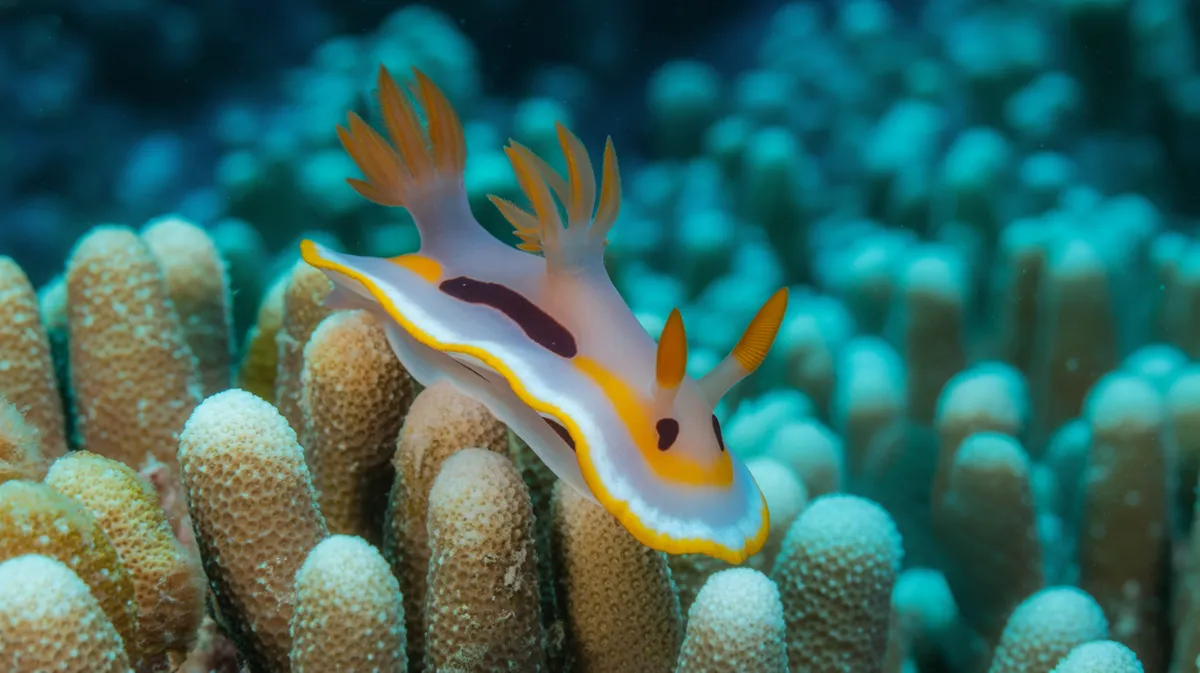
About the Nudibranch (Spanish dancer)
The Spanish dancer is a strikingly colorful nudibranch, recognizable by its large, flattened, and bright red or orange body with white or yellow markings. Named for its undulating swimming motion that resembles the skirt of a flamenco dancer, this sea slug can reach impressive lengths up to 60 cm, making it one of the largest nudibranchs in the world. It is a soft-bodied, shell-less mollusk found mainly in tropical Indo-Pacific coral reefs, where it leads a slow-moving, nocturnal lifestyle. The Spanish dancer is well known for its chemical defenses and vivid coloration, which warn predators of its toxicity.
Fascinating facts
Graceful Swimmer
Unlike most nudibranchs that crawl, the Spanish dancer can swim freely by undulating its body, resembling a flamenco dancer’s skirt.
Shrimp Houseguest
Small emperor shrimps often live on the Spanish dancer’s body, gaining protection and food scraps while causing no harm to their host.
Toxic Defense
This nudibranch accumulates toxins from its sponge diet, making it distasteful or even poisonous to potential predators.
Detailed description
Hexabranchus sanguineus, commonly known as the Spanish dancer, is a large and visually striking dorid nudibranch belonging to the family Hexabranchidae. Its elongated, dorsoventrally flattened body can reach lengths of up to 60 cm, though most individuals are between 20 and 40 cm. The mantle is bright red to orange, often adorned with irregular white, yellow, or pink patches, and is edged with a ruffled margin that undulates when the animal swims. The dorsal surface is smooth, while the ventral side features a broad foot used for crawling. At the posterior end, a cluster of feathery gills forms a rosette, which is retractable for protection. The rhinophores, located on the head, are lamellate and function as chemosensory organs, aiding in the detection of prey and mates. Hexabranchus sanguineus is primarily nocturnal, sheltering under rocks or coral during the day and emerging at night to feed. Its vivid coloration serves as aposematic warning to potential predators, signaling the presence of potent chemical defenses derived from its prey. Unlike most nudibranchs, the Spanish dancer is capable of swimming by vigorous lateral flexions of its body, a behavior typically employed to evade predators. This species is solitary and exhibits little social interaction outside of mating. It is distributed widely across the Indo-Pacific region, from the Red Sea and East Africa to Hawaii and Japan, inhabiting coral reefs at depths ranging from 1 to 50 meters.
Did you know?
Despite its flamboyant appearance, the Spanish dancer is actually a hermaphrodite, possessing both male and female reproductive organs.
Research & sources
Behaviour & social structure
The Spanish dancer is a slow-moving, primarily nocturnal organism, spending daylight hours concealed beneath rocks or within crevices to avoid predation. At night, it becomes active, crawling across the reef in search of prey, which mainly consists of sponges (particularly those in the family Halichondriidae) and occasionally tunicates. Feeding involves the use of a radula, a ribbon-like structure lined with chitinous teeth, to rasp off sponge tissue. When threatened by predators such as fish or crustaceans, Hexabranchus sanguineus exhibits a distinctive escape response: it detaches from the substrate and swims by undulating its mantle margins, creating a graceful, wave-like motion reminiscent of a flamenco dancer’s skirt. This swimming is energetically costly and generally reserved for acute danger. Social interactions are minimal, as individuals are solitary except during mating periods. The species is not territorial and does not display aggression toward conspecifics.
Reproduction & life cycle
Hexabranchus sanguineus is a simultaneous hermaphrodite, possessing both male and female reproductive organs. Mating typically occurs during the warmer months, coinciding with increased food availability. During copulation, two individuals align their right sides to exchange sperm reciprocally. Fertilization is internal, and shortly after mating, each nudibranch deposits a large, bright pink to red, ribbon-like egg mass on a hard substrate, often in a spiral or rosette shape. Each egg ribbon can contain hundreds of thousands of eggs. Embryonic development is planktotrophic, with larvae (veligers) hatching after several days to weeks, depending on water temperature. The larvae are free-swimming and part of the plankton before settling to metamorphose into juvenile nudibranchs. There is no parental care beyond the initial egg deposition.
Adaptations & survival
The Spanish dancer exhibits several remarkable adaptations for survival. Its vivid aposematic coloration warns potential predators of its chemical defenses, which are sequestered from toxic compounds found in its sponge prey. These secondary metabolites, including macrolides and terpenoids, can deter or even poison would-be predators. The ability to swim by undulating the mantle is a rare trait among nudibranchs, providing a rapid escape mechanism. The retractable gill plume reduces vulnerability during rest or when threatened. Chemosensory rhinophores are highly developed, allowing the animal to detect chemical cues from prey, predators, or potential mates over considerable distances. Its large size also reduces the number of potential predators capable of consuming it.
Cultural significance
The Spanish dancer is renowned among divers and underwater photographers for its size, beauty, and spectacular swimming display. It has become an iconic species in marine ecotourism, often featured in documentaries and educational materials about coral reefs. While it does not have a significant role in traditional folklore or mythology, its common name is derived from the resemblance of its swimming motion to the swirling skirts of Spanish flamenco dancers. The species serves as a flagship for reef biodiversity and conservation awareness.
Recent research
Recent research has focused on the chemical ecology of Hexabranchus sanguineus, particularly its ability to sequester and modify toxic compounds from its sponge diet for use in its own defense. Studies have identified several unique metabolites with potential pharmaceutical applications, including cytotoxic and antimicrobial properties. Molecular phylogenetic analyses have clarified the evolutionary relationships within Hexabranchidae and among other dorid nudibranchs. Ongoing research is investigating the effects of environmental stressors, such as ocean warming and acidification, on nudibranch development and distribution. Additionally, the Spanish dancer’s reproductive strategies and larval dispersal are subjects of interest for understanding connectivity among Indo-Pacific reef populations.
Sources
Hexabranchus sanguineus (Spanish Dancer): Taxonomy, Distribution, and Chemical Ecology
Rudman, W.B. & Gosliner, T.M. (2004)
scientificHexabranchus sanguineus (Spanish Dancer): A Review of Its Biology and Ecology
Rudman, W.B. (2000)
scientificChemical defense in Hexabranchus sanguineus: sequestration of sponge metabolites
Faulkner, D.J., Ghiselin, M.T. (1983)
scientificHexabranchus sanguineus (Spanish Dancer): A Review of Its Biology and Chemical Ecology
Faulkner, D.J. & Ghiselin, M.T. (1983)
scientificVideos
Habitat
Coral reefs in tropical and subtropical ocean waters

Conservation
The Nudibranch (Spanish dancer) is currently classified as Least Concern on the IUCN Red List.
Threats & challenges
Currently, Hexabranchus sanguineus is classified as Least Concern, with no major widespread threats identified. However, localized challenges include habitat degradation due to coral reef destruction, pollution, and climate change, which can affect both the nudibranch and its sponge prey. Overcollection for the aquarium trade is minimal due to the species’ specialized diet and short lifespan in captivity. Ocean acidification and rising sea temperatures may impact larval development and reef health in the future. Population trends are stable across most of its range, but ongoing monitoring is recommended due to the sensitivity of coral reef ecosystems.
Taxonomy
Scientific name
Hexabranchus sanguineus
- Kingdom
- Animalia
- Phylum
- Mollusca
- Class
- Gastropoda
- Order
- Nudibranchia
- Family
- Hexabranchidae
- Genus
- Hexabranchus
- Species
- sanguineus
Community notes
Share your observations about the Nudibranch (Spanish dancer).
No community notes yet. Be the first!
Discover more wildlife
More fascinating animals from the encyclopedia.