
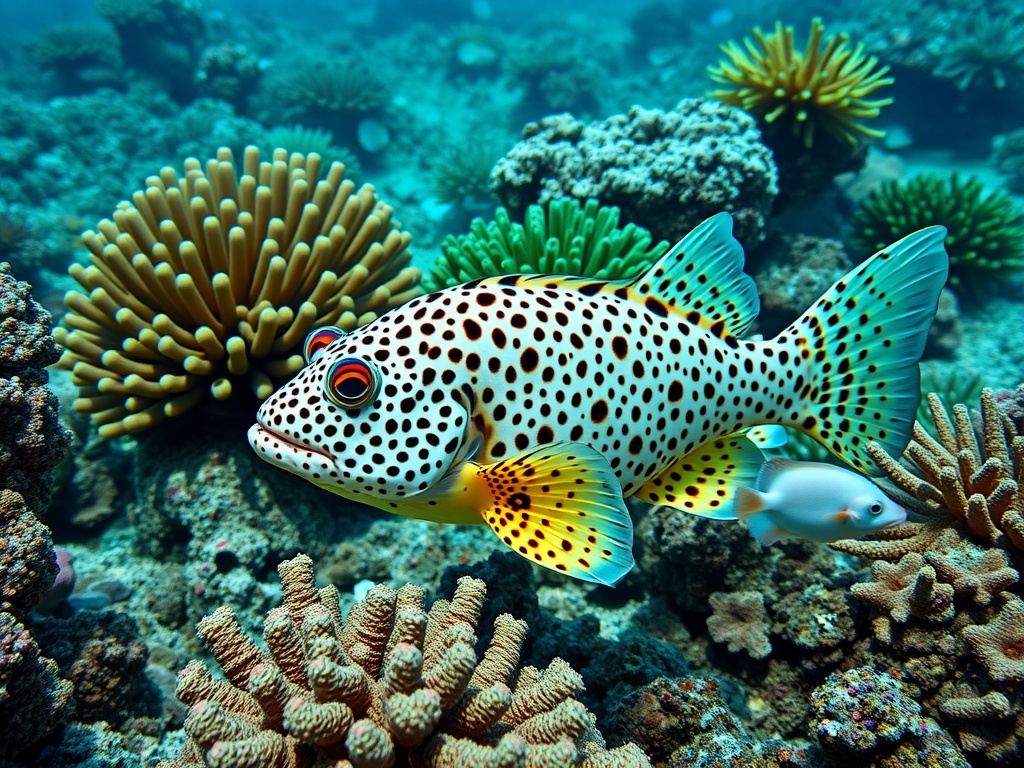
About the Spotted boxfish
The spotted boxfish is a small, distinctive marine fish recognized by its boxy, angular body and striking pattern of white or yellow spots on a dark background. Males and females are sexually dimorphic, with males displaying more vivid coloration than females. This species inhabits coral reefs and lagoons, where it grazes on algae, sponges, and small invertebrates. Its body is encased in a hard, bony carapace, making it a slow but well-protected swimmer. The spotted boxfish also secretes a toxic mucus when threatened, deterring potential predators.
Fascinating facts
Colorful Patterns
Males and females have distinctly different patterns and colors, making them easy to differentiate underwater.
Bony Armor
Their bodies are covered in hard, fused bony plates, forming a box-like shell for protection.
Toxic Defense
When threatened, the spotted boxfish can release a toxic mucus that deters predators and can be deadly in confined aquarium spaces.
Detailed description
The spotted boxfish (Ostracion meleagris) is a medium-sized marine fish notable for its rigid, box-like carapace formed by fused bony plates, which encase most of its body and restrict its flexibility but provide significant protection from predators. Adults typically reach lengths of up to 25 cm, with a deep, angular body and a small, protruding mouth suited for grazing. The species exhibits pronounced sexual dimorphism: males display a striking pattern of white spots on a dark dorsal background, with iridescent blue sides and vivid yellow bands and spots, while females and juveniles are more uniformly dark brown to black with white spots. The eyes are large and set high on the head, providing a wide field of vision. Fins are small and rounded, contributing to a slow, deliberate swimming style powered primarily by undulating the dorsal, anal, and pectoral fins rather than the tail. The skin is covered in a layer of toxic mucus containing ostracitoxin, which can be released as a defense mechanism. Internally, the digestive system is adapted for a varied omnivorous diet, including a muscular pharyngeal jaw apparatus for crushing hard-shelled prey. The species is diurnal, spending daylight hours actively foraging among coral heads and rocky crevices, and seeks shelter within the reef structure at night.
Did you know?
Unlike most fish, the spotted boxfish cannot curve its body to swim; its armored shell keeps it rigid and inflexible.
Research & sources
Wikipedia summary
The spotted boxfish, also known as the black boxfish, ornate boxfish or white-spotted boxfish, is a species of marine ray-finned fish belonging to the family Ostraciidae, the boxfishes. This species is found in the Indian and Pacific Oceans. It occurs on reefs at depths of from 1 to 30 metres. This species grows to a length of 25 centimetres. Males and females differ in colour: males are blackish on the back with white spots, and have bluish sides with bright yellowish bands and spots. Females and juveniles are dark brown to blackish with white spots. As with other species of boxfish, the spotted boxfish's bony carapace gives it a distinctly angular appearance; it has been described as resembling an ottoman.
Behaviour & social structure
Spotted boxfish are generally solitary or found in small, loose aggregations, especially during the breeding season. They are slow-moving and methodical, using their protruding snout to probe crevices for food. Their diet consists of benthic invertebrates such as sponges, tunicates, mollusks, polychaete worms, crustaceans, and small amounts of algae. Feeding involves picking or blowing jets of water to uncover prey hidden in sand or coral. The species is known for its docile temperament and lack of territorial aggression, though males may display to one another during courtship or when defending access to females. Daily activity peaks during the morning and late afternoon, with individuals retreating to sheltered areas at night to avoid nocturnal predators. When threatened, the boxfish may adopt a rigid posture and secrete toxic mucus, deterring most would-be predators.
Reproduction & life cycle
Ostracion meleagris exhibits a polygynous mating system, with males establishing temporary territories during the breeding season, which typically coincides with warmer months (spring to early summer) in most parts of its range. Courtship involves elaborate displays, including color intensification and circling behaviors. Spawning usually occurs at dusk, with pairs ascending into the water column to release eggs and sperm simultaneously. Fertilization is external, and the buoyant eggs drift with the current. There is no parental care; larvae are planktonic for several weeks before settling onto the reef as juveniles. Sexual maturity is reached at approximately 12–15 cm in length, and the species is believed to have a lifespan of up to 8–10 years in the wild.
Adaptations & survival
The most distinctive adaptation of the spotted boxfish is its rigid, bony carapace, which acts as an effective armor against predation but limits body flexibility and speed. To compensate, the species employs a unique mode of locomotion called ostraciiform swimming, relying on rapid undulations of the dorsal, anal, and pectoral fins for precise maneuvering in complex reef environments. The secretion of ostracitoxin in the skin mucus is a potent chemical defense, capable of deterring large predators and even causing mortality in confined aquarium settings. The small, terminal mouth and strong pharyngeal teeth are specialized for extracting and crushing hard-shelled prey. The cryptic coloration of females and juveniles provides camouflage among coral rubble, while the vivid patterning of males may play a role in mate attraction and species recognition.
Cultural significance
While the spotted boxfish does not have major significance in traditional fisheries due to its toxicity, it is sometimes featured in local folklore as a symbol of protection or resilience, owing to its armored appearance. In the aquarium trade, it is admired for its unique shape and striking coloration, though its care is challenging. In some Pacific cultures, boxfish are referenced in art and as motifs representing the reef environment. There are no known traditional medicinal or culinary uses, as the flesh can be toxic to humans and other animals.
Recent research
Recent studies have focused on the biochemical properties of ostracitoxin and its ecological role in deterring predation and limiting parasite loads. Genetic analyses have clarified the relationships among Indo-Pacific boxfish species, revealing cryptic diversity and potential hybridization zones. Research on locomotion mechanics has provided insights into the evolution of boxfish morphology and its implications for bio-inspired robotics. Ongoing monitoring of population genetics and distribution is being conducted in response to reef habitat changes and climate impacts. The species is also used as a model for studying chemical defense mechanisms in marine fishes.
Sources
Ostracion meleagris: The IUCN Red List of Threatened Species 2024
Stiefel, K.M. & Williams, J.T. (2024)
conservationBoxfish (Ostraciidae) chemical defenses and their ecological implications
Randall, J.E. & Carlson, B.A. (1997)
scientificVideos
Habitat
Coral reefs and lagoons

Conservation
The Spotted boxfish is currently classified as Least Concern on the IUCN Red List.
Threats & challenges
Currently assessed as Least Concern by the IUCN, the spotted boxfish faces relatively few direct threats due to its wide distribution and chemical defenses. However, localized declines may occur due to habitat degradation, particularly the loss of coral reefs from climate change, ocean acidification, and destructive fishing practices. The species is occasionally collected for the marine aquarium trade, but its toxicity and specialized care requirements limit its popularity. Pollution and sedimentation can also negatively impact larval survival and reef health. There is no evidence of significant population decline at present, but ongoing monitoring is recommended given the vulnerability of coral reef ecosystems.
Taxonomy
Scientific name
Ostracion meleagris
- Kingdom
- Animalia
- Phylum
- Chordata
- Class
- Actinopterygii
- Order
- Tetraodontiformes
- Family
- Ostraciidae
- Genus
- Ostracion
- Species
- meleagris
Community notes
Share your observations about the Spotted boxfish.
No community notes yet. Be the first!
Discover more wildlife
More fascinating animals from the encyclopedia.