
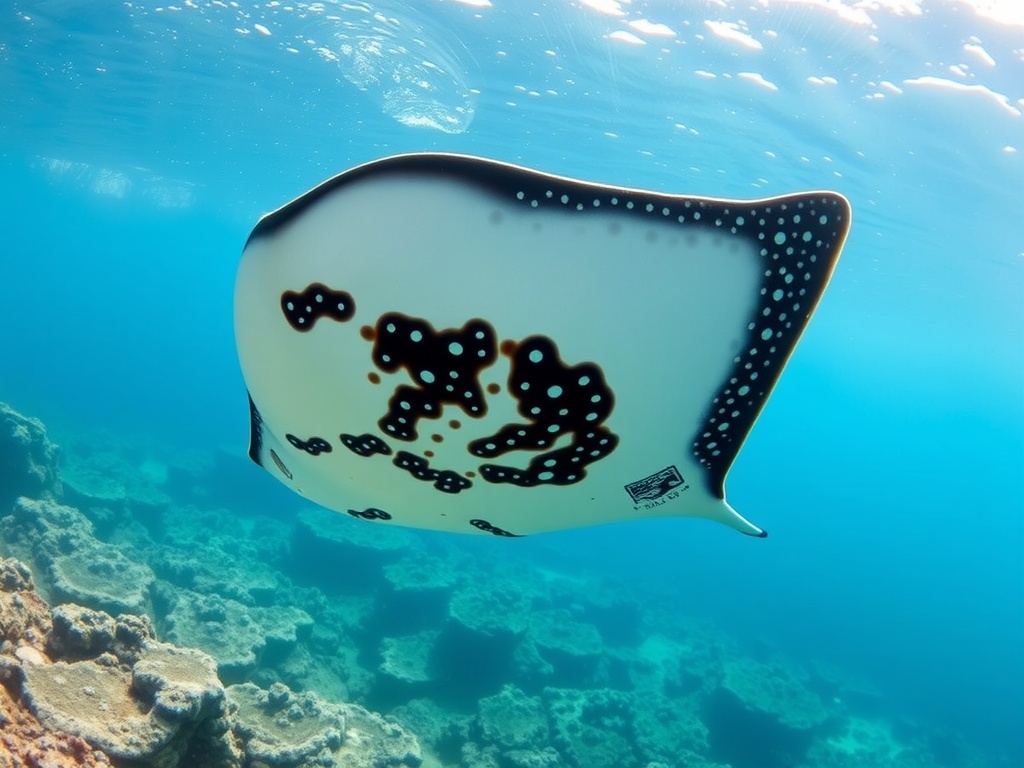
About the Spotted eagle ray
The spotted eagle ray (Aetobatus narinari) is a large, white-spotted ray with a wingspan reaching around 3 metres and a whip-like tail that can be twice the length of the body. Its snout is drawn out into a flattened, duck-like shovel, which it drives into sand to root out buried clams, and the mouth behind holds not the small teeth of most rays but a set of fused, plate-like tooth rows, a flat pavement on top and bottom that acts as a nutcracker. It crushes the shells and then, remarkably, sorts the fragments inside its mouth, spitting out the shell and swallowing the flesh, a separation researchers have shown depends on papillae on the mouth floor. Near the base of the tail sit two to six venomous barbed spines, used defensively and dangerous mainly to fishermen handling a netted animal. Spotted eagle rays are strong swimmers that flap the pectoral fins like wings rather than undulating them, cruise in loose schools, and leap clear of the water, sometimes several times in succession, for reasons that remain unresolved. They are aplacental viviparous: the embryos exhaust the yolk and are then fed on a nutritive uterine secretion, histotroph, and a female produces only a handful of pups after roughly a year of gestation.
Fascinating facts
Graceful Swimmers
Spotted eagle rays use their large, wing-like pectoral fins to glide effortlessly through the water, making them one of the most elegant swimmers in the ocean.
Specialized Dentition
They have interlocking dental plates designed to crush the shells of clams, oysters, and crabs, their favorite foods.
Live Birth
Female spotted eagle rays are ovoviviparous, meaning they give birth to live young after the eggs hatch inside their bodies.
Detailed description
The spotted eagle ray (Aetobatus narinari) is a large, charismatic cartilaginous fish characterized by a dorsoventrally flattened body, broad triangular pectoral fins, and a prominent, rounded snout resembling a duck’s bill. Adults typically reach disc widths of 1.5–3 meters (5–10 ft), with some individuals exceeding 3.3 meters (11 ft), and can weigh up to 230 kg (507 lbs). The dorsal surface is strikingly marked with numerous white or yellowish spots on a dark bluish-black background, while the ventral side is pale. Its tail is exceptionally long and whip-like, often several times the body length, and may bear one to five venomous spines near the base. The mouth, located on the underside, is equipped with flat, interlocking dental plates adapted for crushing hard-shelled prey. Spotted eagle rays are powerful swimmers, capable of leaping clear of the water in spectacular displays. Their large spiracles, positioned behind the eyes, facilitate respiration while resting on the seafloor. The species is generally solitary but may form loose aggregations, especially during feeding or migration. Their keen sense of electroreception, mediated by the ampullae of Lorenzini, allows them to detect buried prey. As ovoviviparous animals, females give birth to live young, which are born fully formed and independent.
Did you know?
Unlike most rays, the spotted eagle ray gives birth to live young instead of laying eggs.
Research & sources
Wikipedia summary
The spotted eagle ray is a cartilaginous fish of the eagle ray family, Aetobatidae. As traditionally recognized, it is found globally in tropical regions, including the Atlantic, Pacific and Indian Oceans. Recent authorities have restricted it to the Atlantic with other populations recognized as the ocellated eagle ray and Pacific white-spotted eagle ray. Spotted eagle rays are most commonly seen alone, but occasionally swim in groups. They are ovoviviparous, the female retaining the eggs then releasing the young as miniature versions of the parent.
Behaviour & social structure
Spotted eagle rays are primarily diurnal, spending daylight hours foraging over sandy flats, seagrass beds, and coral reefs. They exhibit a distinctive undulating swimming motion, using their pectoral fins to 'fly' gracefully through the water. While often solitary, they are occasionally observed in groups, particularly during mating season or when abundant food is available. Their diet consists mainly of benthic invertebrates such as mollusks (clams, oysters), crustaceans, and occasionally small fish. They use their specialized snouts to dig in the substrate and their powerful jaws to crush shells. Spotted eagle rays are known to leap out of the water, possibly as a form of communication, parasite removal, or predator evasion. They are generally non-aggressive toward humans but can defend themselves with their venomous tail spines if threatened.
Reproduction & life cycle
Aetobatus narinari is ovoviviparous, with internal fertilization. Courtship involves males following and biting the female’s pectoral fin before copulation. Mating typically occurs in late spring or early summer, though timing may vary regionally. Females retain fertilized eggs internally, where embryos develop nourished by yolk sacs. Gestation lasts approximately 12 months, after which 1–4 pups are born per litter. Newborns measure about 17–35 cm (7–14 in) across the disc and are miniature replicas of adults, immediately capable of independent survival. There is no parental care post-birth. Sexual maturity is reached at 4–6 years of age, with females maturing at slightly larger sizes than males.
Adaptations & survival
Spotted eagle rays possess several evolutionary adaptations for their benthic, predatory lifestyle. Their flattened bodies and large pectoral fins enable efficient gliding and maneuverability over complex reef habitats. The duckbill-shaped snout and electroreceptive organs allow them to locate and extract prey hidden beneath the substrate. Robust dental plates are specialized for crushing hard shells, a rare adaptation among rays. Their long, flexible tails serve both as a deterrent to predators and as a means of defense via venomous spines. Camouflage provided by their spotted dorsal pattern helps break up their outline against the dappled light of shallow waters. High metabolic rates and large spiracles facilitate active foraging and respiration.
Cultural significance
Spotted eagle rays are admired for their beauty and grace, frequently featured in marine art, ecotourism, and public aquaria. In some cultures, rays are symbols of freedom and agility. In the Caribbean and parts of the Indo-Pacific, they appear in local folklore and are sometimes harvested for food, though not as commonly as other rays. Their presence in healthy reef ecosystems is often seen as an indicator of environmental quality, making them important ambassadors for marine conservation.
Recent research
Recent genetic and morphological studies have led to the splitting of Aetobatus narinari into multiple species, with the true spotted eagle ray now considered largely restricted to the Atlantic Ocean. Ongoing research focuses on population structure, migratory patterns (using satellite tagging), and the ecological role of eagle rays in controlling benthic invertebrate populations. Studies on their sensory biology have revealed advanced electroreception and chemoreception abilities. Conservation research is increasingly urgent due to their low reproductive output and habitat threats, with several regions implementing protective measures and monitoring programs.
Videos
Habitat
Coastal and reef-associated marine waters

Conservation
The Spotted eagle ray is currently classified as Near Threatened on the IUCN Red List.
Threats & challenges
Major threats to spotted eagle rays include targeted and bycatch fisheries (for meat, cartilage, and aquarium trade), habitat degradation (especially of coral reefs and seagrass beds), and pollution. Their slow reproductive rate and low fecundity make populations particularly vulnerable to overexploitation. Coastal development and climate change further threaten critical habitats. Although globally listed as Near Threatened by the IUCN, regional populations may be at greater risk, and recent taxonomic revisions suggest that what was once considered a single widespread species is actually several, each with a more restricted range and potentially higher conservation concern. Population trends are poorly documented due to identification challenges and lack of long-term monitoring.
Taxonomy
Scientific name
Aetobatus narinari
- Kingdom
- Animalia
- Phylum
- Chordata
- Class
- Chondrichthyes
- Order
- Myliobatiformes
- Family
- Myliobatidae
- Genus
- Aetobatus
- Species
- narinari
Where to see a spotted eagle ray
2 zoos and aquariums in 1 country are recorded as keeping this species.


Community notes
Share your observations about the Spotted eagle ray.
No community notes yet. Be the first!
Discover more wildlife
More fascinating animals from the encyclopedia.