
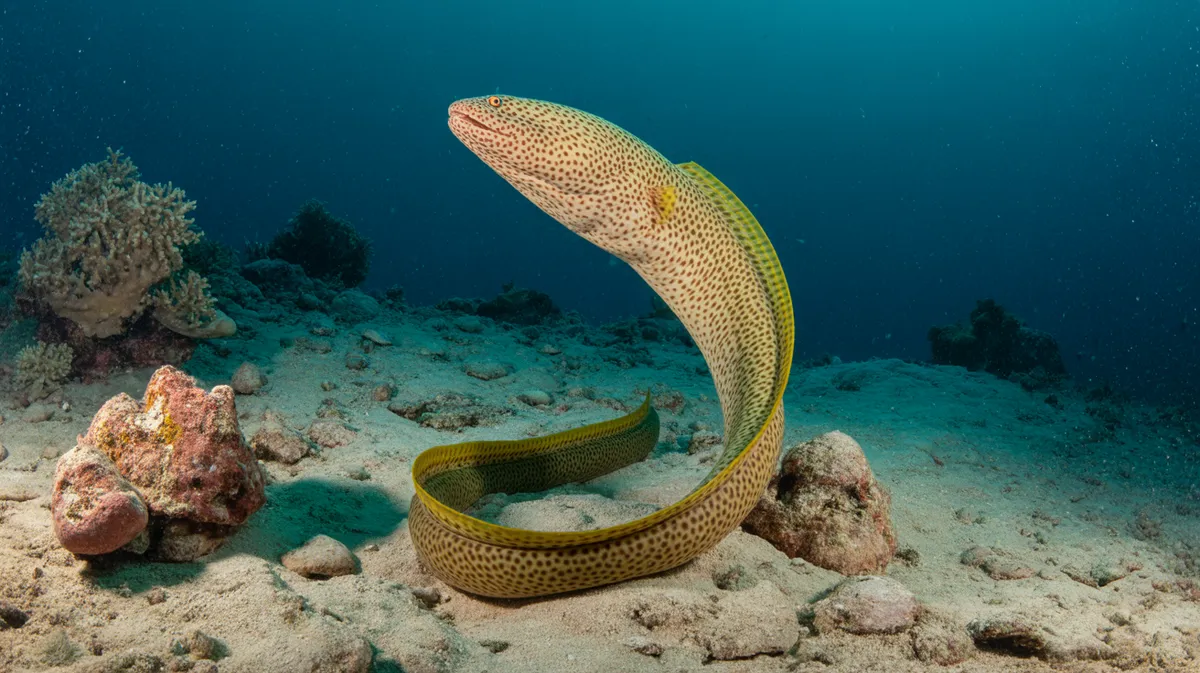
About the Spotted garden eel
The spotted garden eel is a slender, tube-dwelling marine fish recognizable by its pale body covered in numerous black spots. It spends most of its life partially buried in sandy substrates, with only its head and upper body protruding to feed on plankton drifting by in the current. Found in colonies that can number in the hundreds, these eels create a mesmerizing underwater spectacle that resembles a field of waving grasses. Spotted garden eels are shy and will retreat into their burrows at the slightest hint of danger.
Fascinating facts
Burrow Life
Spotted garden eels spend nearly their entire lives in burrows, poking out just enough to feed on passing zooplankton.
Colony Dwellers
They live in large colonies that can number in the hundreds, creating a unique 'garden' effect on sandy reef slopes.
Shy Nature
These eels are extremely sensitive to movement and will quickly retract their bodies into burrows when approached by predators or divers.
Detailed description
The spotted garden eel (Heteroconger hassi) is a small, slender marine fish reaching lengths of up to 40 cm, though most adults measure between 30 and 35 cm. Its elongated, cylindrical body is pale cream to white, adorned with numerous small black spots and three distinctive larger black patches: one below the gill opening, one at mid-body, and one near the tail. The head is blunt with large, expressive eyes and a small, terminal mouth adapted for planktivory. Spotted garden eels are highly specialized for a burrowing lifestyle, spending nearly their entire lives with their bodies anchored in vertical burrows constructed in sandy substrates of tropical coral reef slopes and flats, typically at depths of 7–45 meters. Colonies can contain hundreds to thousands of individuals, each spaced a few centimeters apart, creating a striking visual effect reminiscent of a field of swaying grass. The species is diurnal, emerging from their burrows during daylight hours to feed and retracting rapidly at signs of danger. Their skin secretes mucus, which lines the burrow walls and helps maintain its structure. Unlike many eels, they rarely leave their burrows except during spawning events. Their social structure is loosely organized, with individuals maintaining personal territories but benefiting from the safety of numbers in large colonies.
Did you know?
Despite living in large groups, spotted garden eels maintain strict personal space and will fiercely defend the area around their burrow.
Research & sources
Wikipedia summary
The spotted garden eel is a species of heteroconger belonging to the family Congridae. It is native to the Indo-Pacific.
Behaviour & social structure
Spotted garden eels exhibit highly specialized feeding behavior, positioning themselves vertically in their burrows with only the head and upper body exposed to intercept planktonic prey drifting in the current. They use rapid, darting movements to snatch zooplankton, primarily copepods and other small crustaceans, from the water column. Each eel maintains a fixed territory around its burrow, defending it from immediate neighbors with subtle body posturing and, occasionally, brief physical contact. Social interactions are generally limited to visual displays and minor territorial disputes, but during the breeding season, males may become more aggressive. Daily routines are closely tied to light levels; eels emerge at dawn, remain active throughout the day, and retreat at dusk or when threatened by predators such as larger fish or cephalopods. Their cryptic behavior and rapid withdrawal into burrows are primary anti-predator strategies.
Reproduction & life cycle
Reproduction in Heteroconger hassi is synchronized with lunar cycles and seasonal plankton blooms, typically peaking during warmer months. During spawning, males and females extend further from their burrows and align their bodies side by side, often intertwining their upper bodies above the sand. Fertilization is external; both sexes release gametes into the water column, where fertilization occurs. There is no parental care—eggs and subsequent larvae are planktonic, drifting with ocean currents for several weeks as leptocephalus larvae before settling to the substrate and metamorphosing into juvenile eels. This pelagic larval stage facilitates wide dispersal and gene flow among populations. Sexual maturity is reached at approximately 2–3 years of age.
Adaptations & survival
Spotted garden eels possess several unique adaptations for their burrowing and planktivorous lifestyle. Their elongated, flexible bodies allow them to maneuver within narrow burrows, while reduced pectoral fins and a pointed tail aid in digging and anchoring. The skin secretes a copious mucus layer, which not only lines and stabilizes the burrow but also protects against abrasion and parasites. Their large, upward-facing eyes are highly sensitive to movement, enabling them to detect both prey and predators efficiently. The mouth is small and terminal, ideal for snatching tiny planktonic organisms. Behaviorally, their tendency to form dense colonies enhances predator detection and may reduce individual predation risk through the 'many eyes' effect.
Cultural significance
While not a major figure in traditional folklore, the spotted garden eel has become an iconic species in public aquaria worldwide, admired for its unusual appearance and communal behavior. In Japan, garden eels are celebrated on 'Garden Eel Day' (November 11th), and their image is often used in marine-themed art and merchandise. Their unique lifestyle has made them a symbol of the hidden diversity and complexity of coral reef ecosystems.
Recent research
Recent research has focused on the genetic diversity and population connectivity of Heteroconger hassi across the Indo-Pacific, revealing high gene flow facilitated by their long pelagic larval stage. Studies using underwater video and time-lapse photography have provided insights into their social spacing, feeding rates, and predator avoidance strategies. Ongoing work is investigating the impact of environmental changes on colony health and reproductive success, as well as the potential effects of microplastic ingestion due to their planktonic diet. Advances in aquarium husbandry have improved our understanding of their nutritional requirements and stress responses.
Videos
Habitat
Sandy slopes and flats of tropical coral reefs

Conservation
The Spotted garden eel is currently classified as Least Concern on the IUCN Red List.
Threats & challenges
Currently assessed as Least Concern by the IUCN, the spotted garden eel faces relatively few direct threats due to its wide distribution and stable populations. However, localized threats include habitat degradation from coastal development, destructive fishing practices (such as trawling and dynamite fishing), and sedimentation that can smother sandy habitats. Climate change poses a long-term risk through coral reef decline and altered ocean currents, which may affect larval dispersal and food availability. Collection for the aquarium trade occurs but is not considered a major threat at present. Ongoing monitoring is recommended to detect any future population declines.
Taxonomy
Scientific name
Heteroconger hassi
- Kingdom
- Animalia
- Phylum
- Chordata
- Class
- Actinopterygii
- Order
- Anguilliformes
- Family
- Congridae
- Genus
- Heteroconger
- Species
- hassi
Where to see a spotted garden eel
2 zoos and aquariums in 1 country are recorded as keeping this species.

Community notes
Share your observations about the Spotted garden eel.
No community notes yet. Be the first!
Discover more wildlife
More fascinating animals from the encyclopedia.