
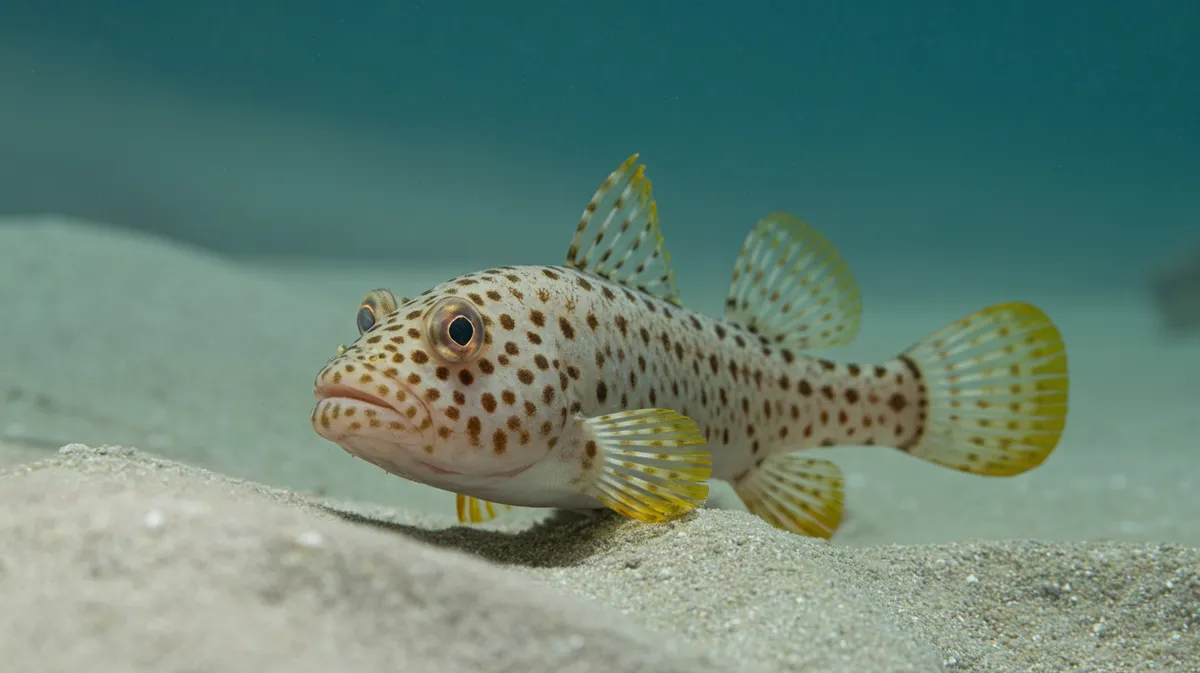
About the Spotted Handfish
The spotted handfish (Brachionichthys hirsutus) is a small, slow anglerfish relative that does not swim so much as walk, using arm-like modified pectoral and pelvic fins with fleshy "hands" to pace across the silty bottom of the Derwent Estuary in Tasmania. It is one of the most restricted marine fish on Earth, confined to a handful of small colonies in that one estuary and its immediate surroundings, and in 1996 it became the first marine fish anywhere listed as Critically Endangered. Its predicament comes down to reproduction. The female lays a relatively small clutch of 80 to 250 large eggs and wraps them around a vertical structure, in nature typically the stalked sea squirt Sycozoa, then guards them for seven to eight weeks. There is no drifting larval stage: the young hatch as miniature adults and walk away, which means the fish cannot recolonise anywhere it disappears from. When the introduced Northern Pacific seastar, Asterias amurensis, arrived in the Derwent and stripped out the sea squirts, the handfish lost its spawning furniture. Divers have responded by planting fields of small ceramic and plastic "artificial spawning stalks" on the seabed, which the fish have accepted and used. Captive breeding at Australian institutions has produced eggs, and the species survives on a knife edge.
Fascinating facts
Hand-like Fins
The Spotted Handfish's pectoral fins resemble hands, allowing it to walk rather than swim across the sea floor.
Unique Egg-laying
Females lay eggs in clusters attached to stalked marine invertebrates and fiercely guard them until they hatch.
Conservation Crisis
Invasive species like the Northern Pacific seastar and habitat degradation have pushed the Spotted Handfish to the brink of extinction.
Detailed description
The Spotted Handfish (Brachionichthys hirsutus) is a small, benthic anglerfish distinguished by its modified pectoral fins, which resemble hands and are used for walking along the substrate rather than swimming. Adults typically measure between 8 and 15 cm in length, with a robust, slightly compressed body and a large, upturned mouth. The skin is covered in small dermal spinules, giving it a rough texture. Its coloration is highly variable but generally consists of a pale cream, yellow, or whitish background marked by prominent brown, orange, or black spots and blotches, which provide camouflage among sandy and silty seabeds. The dorsal fin is reduced, and the first dorsal spine is modified into a small, fleshy lure (illicium), though it is less pronounced than in other anglerfish. Spotted Handfish have relatively large, forward-facing eyes, aiding in the detection of prey and predators. They are sedentary, preferring to 'walk' rather than swim, and are most commonly found at depths of 2–30 meters in estuarine and sheltered coastal environments. Their unique morphology and locomotion are considered evolutionary adaptations to their benthic lifestyle. The species is solitary outside of the breeding season and exhibits site fidelity, often remaining within a small home range for extended periods.
Did you know?
The Spotted Handfish is so rare that it was once believed to be extinct before being rediscovered in the 1990s.
Research & sources
Wikipedia summary
The spotted handfish is a rare Australian fish in the handfish family, Brachionichthyidae, classified as critically endangered on the IUCN Red List 2020. It has a highly restricted range, being found only in the estuary of Derwent River, Tasmania, and nearby areas, with the main threat to its existence being an invasive species, the Northern Pacific seastar.
Behaviour & social structure
Spotted Handfish are primarily solitary and exhibit strong site fidelity, rarely venturing far from their chosen patch of substrate. They are diurnal, with peak activity during daylight hours, and spend much of their time resting motionless or slowly 'walking' across the seafloor using their hand-like fins. Their feeding behavior is characterized by ambush predation: they remain still and use their cryptic coloration to blend into the substrate, striking quickly at small invertebrates such as amphipods, polychaete worms, and small crustaceans. They do not actively pursue prey over long distances. Social interactions are minimal outside of the breeding season, and individuals may display territorial behavior if approached by conspecifics. There is no evidence of complex social structures or group living.
Reproduction & life cycle
Spotted Handfish have a unique reproductive strategy among marine fishes. Breeding occurs from September to October (austral spring), when females lay between 80 and 250 large, adhesive eggs in clusters on vertical objects such as sea squirts, sponges, or small stalked invertebrates. The eggs are attached by filaments and guarded by the female, who fans and protects them from predators and sedimentation for a period of 7–8 weeks until hatching. There is no larval dispersal stage; instead, juveniles hatch as miniature adults and settle immediately to the benthos. This direct development, while reducing predation risk during the planktonic stage, limits the species' dispersal ability and contributes to its highly restricted range. Parental care is limited to egg guarding by the female; after hatching, juveniles are independent.
Adaptations & survival
The Spotted Handfish exhibits several notable adaptations for its benthic lifestyle. The most distinctive are its modified pectoral and pelvic fins, which function as 'hands' for walking and maneuvering along the substrate, allowing precise movement in complex habitats. Its cryptic coloration and patterning provide effective camouflage against sandy and silty backgrounds, aiding in both predator avoidance and ambush predation. The reduced swim bladder and robust body minimize buoyancy, facilitating a sedentary existence close to the seafloor. The species' direct development (lack of a pelagic larval stage) is an evolutionary specialization that reduces larval mortality but severely limits dispersal and recolonization potential. Sensory adaptations include large eyes for detecting prey and predators in low-light estuarine environments.
Cultural significance
The Spotted Handfish holds symbolic significance as one of the world's first marine species to be classified as critically endangered and is an emblem of marine conservation efforts in Tasmania. It has become a flagship species for habitat protection and invasive species management in Australian coastal waters. While it has no known traditional uses or roles in Indigenous culture, its unusual appearance and rarity have made it a subject of public interest, educational campaigns, and scientific outreach. The species is sometimes featured in art and local conservation branding.
Recent research
Recent research has focused on the species' reproductive biology, genetic diversity, and habitat requirements, with the aim of informing conservation strategies. Notably, captive breeding programs have been initiated to supplement wild populations and investigate larval development. Genetic studies indicate low genetic diversity, raising concerns about inbreeding and adaptive potential. Ongoing monitoring using underwater visual census and environmental DNA (eDNA) techniques is improving population estimates and detection of remnant populations. Research into the control of the Northern Pacific seastar and restoration of critical spawning habitats remains a priority. The Spotted Handfish Recovery Plan, coordinated by the Australian government, is a key framework guiding current research and management.
Videos
Habitat
Coastal estuaries and sandy seabeds

Conservation
The Spotted Handfish is currently classified as Critically Endangered on the IUCN Red List.
Threats & challenges
The Spotted Handfish faces numerous threats, the most significant being habitat degradation and predation by the invasive Northern Pacific seastar (Asterias amurensis), which preys on benthic invertebrates and competes for habitat. Additional threats include pollution, siltation, and disturbance from dredging and boating activities in the Derwent estuary and adjacent waters. The species' limited distribution and low reproductive output make it particularly vulnerable to stochastic events and environmental changes. Population surveys indicate a dramatic decline since the 1990s, with current estimates suggesting fewer than 3,000 mature individuals remaining in the wild. Conservation efforts are hindered by the species' cryptic nature and the challenges of restoring degraded habitats.
Taxonomy
Scientific name
Brachionichthys hirsutus
- Kingdom
- Animalia
- Phylum
- Chordata
- Class
- Actinopterygii
- Order
- Lophiiformes
- Family
- Brachionichthyidae
- Genus
- Brachionichthys
- Species
- hirsutus
Community notes
Share your observations about the Spotted Handfish.
No community notes yet. Be the first!
Discover more wildlife
More fascinating animals from the encyclopedia.