
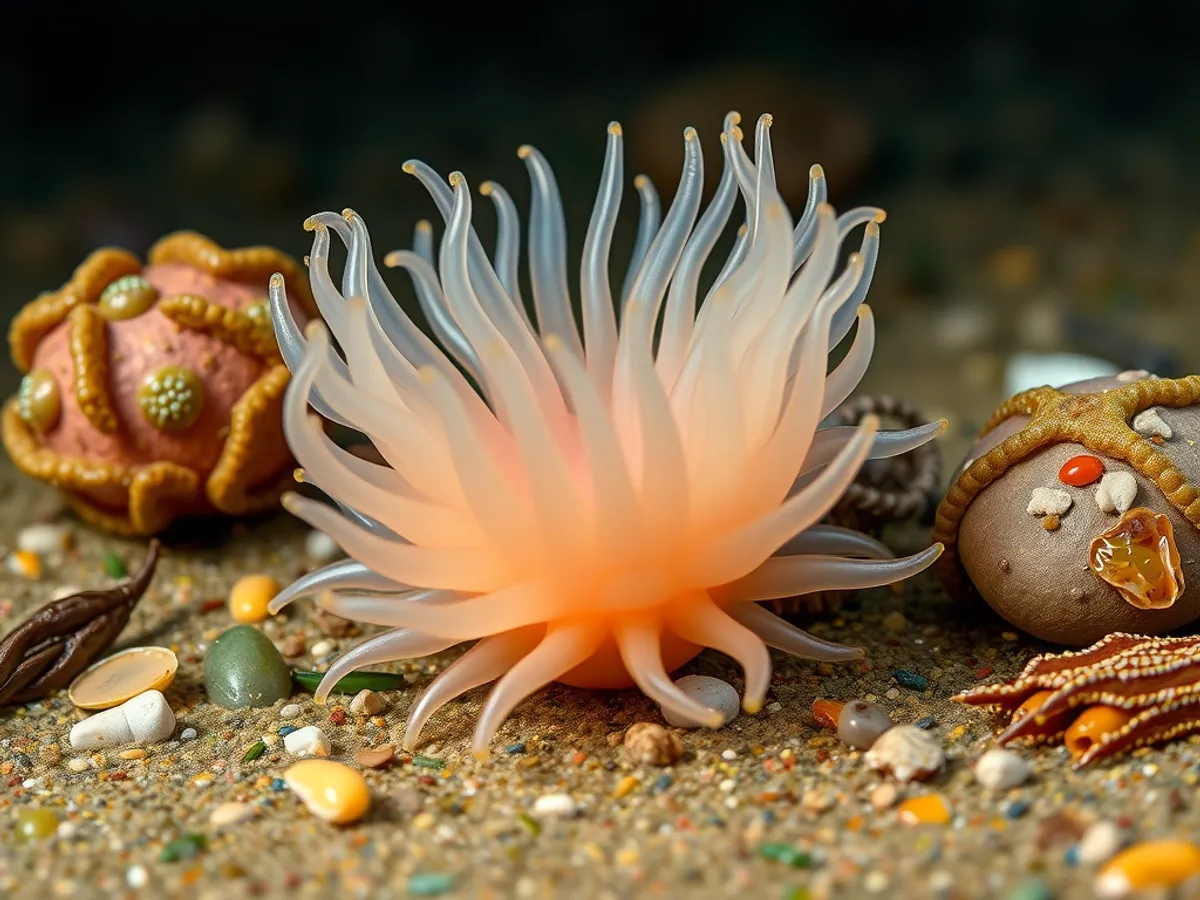
About the Starlet Sea Anemone
The starlet sea anemone (Nematostella vectensis) is a small, pale, burrowing anemone of brackish coastal lagoons and salt marshes in North America and Europe, and it is one of the most important animals in modern evolutionary biology. When its genome was published in 2007 the result was a shock: the gene content was far more like a vertebrate's than anyone expected, with a similar gene number, many of the same gene families, and even intron positions largely shared with humans. Cnidarians and bilaterians last shared an ancestor over 600 million years ago, so this meant that ancestor was already genetically complex, and that fast-evolving models such as fruit flies and nematodes had lost genes rather than that anemones had never had them. Nematostella is easy to keep, spawns on cue when given a light and temperature signal, is transparent, and can be genetically manipulated, so it has become the standard cnidarian laboratory animal. It also regenerates completely, rebuilding a whole animal from a fragment, and it can reproduce asexually by physically pinching itself in two. Despite the radial look of an anemone, its internal anatomy is bilaterally organised along a second, "directive" axis, which has fuelled long-running arguments about whether bilateral symmetry is older than the bilaterians.
Fascinating facts
Regenerative Powers
The Starlet Sea Anemone can regenerate lost tentacles and even reform its entire body from only a small piece of tissue.
Model Organism
Due to its simple genome and transparent body, scientists use this anemone extensively in genetic and developmental research.
Estuarine Specialist
This species thrives in brackish waters of estuaries and coastal marshes, tolerating wide fluctuations in salinity.
Detailed description
The Starlet Sea Anemone (Nematostella vectensis) is a small, translucent cnidarian, typically measuring 10–40 mm in length when fully extended, with a slender, elongated body column that is often pale cream to light brown in color. Its body is cylindrical, with a basal end that anchors into soft sediment and an oral disc surrounded by 12–20 fine, tapering tentacles that are used for prey capture and environmental sensing. The tentacles are equipped with specialized stinging cells called nematocysts, which immobilize small prey such as copepods, amphipods, and other microinvertebrates. N. vectensis exhibits remarkable regenerative abilities, capable of regrowing lost or damaged tissues, including tentacles and even parts of the body column, making it a model for regenerative biology. The species is predominantly solitary, but individuals may be found in high densities in suitable habitats, particularly in brackish tidal pools, salt marshes, and estuarine mudflats. Its simple body plan comprises two tissue layers (diploblastic), a central gastrovascular cavity, and a nerve net instead of a centralized nervous system. N. vectensis is primarily nocturnal, extending its tentacles at night to feed and retracting them during the day to avoid desiccation and predation. Reproduction is both sexual and asexual, with individuals capable of spawning gametes or reproducing by transverse fission. The species' tolerance for fluctuating salinity and temperature enables it to thrive in dynamic estuarine environments, but it remains sensitive to habitat disturbance and pollution.
Did you know?
Despite its tiny size, the Starlet Sea Anemone has become a crucial model organism for studying the evolution of animal development and regeneration.
Research & sources
Wikipedia summary
The starlet sea anemone is a species of small sea anemone in the family Edwardsiidae native to the east coast of the United States, with introduced populations along the coast of southeast England and the west coast of the United States. Populations have also been located in Nova Scotia, Canada. This sea anemone is found in the shallow brackish water of coastal lagoons and salt marshes where its slender column is usually buried in the mud and its tentacles exposed. Its genome has been sequenced and it is cultivated in the laboratory as a model organism, but the IUCN has listed it as being a "Vulnerable species" in the wild.
Behaviour & social structure
Nematostella vectensis is generally sedentary, spending most of its life partially buried in mud or sand with only its tentacles exposed. It is an opportunistic ambush predator, using its tentacles to detect and capture small invertebrates that come within reach. The nematocysts on its tentacles deliver toxins to immobilize prey, which are then transported to the mouth for ingestion. Feeding activity peaks at night, coinciding with higher prey availability and reduced predation risk. While not social in the traditional sense, N. vectensis can form dense aggregations in optimal habitats, likely due to favorable environmental conditions rather than active social behavior. The anemone exhibits limited movement, occasionally relocating by slow, creeping motions or by detaching and drifting to new locations, especially in response to environmental stressors.
Reproduction & life cycle
N. vectensis is dioecious, with separate male and female individuals. Sexual reproduction involves external fertilization: during spawning events, females release eggs and males release sperm into the water column, where fertilization occurs. Spawning is often synchronized with environmental cues such as temperature changes, lunar cycles, and tidal rhythms, typically occurring in spring and summer. The fertilized eggs develop into planula larvae, which are planktonic for several days before settling and metamorphosing into juvenile polyps. In addition to sexual reproduction, N. vectensis can reproduce asexually by transverse fission, where the body splits and regenerates missing parts, or by budding. There is no parental care; offspring are independent from the earliest stages.
Adaptations & survival
The Starlet Sea Anemone is highly adapted to the variable conditions of estuarine and salt marsh habitats. Its tolerance for wide salinity (1–40 ppt) and temperature ranges (4–30°C) allows it to survive in environments subject to frequent and rapid changes. The ability to retract tentacles and body into the substrate provides protection from desiccation, predation, and environmental extremes. Its regenerative capacity is among the most advanced in cnidarians, allowing recovery from injury and contributing to population resilience. The presence of nematocysts enables efficient prey capture and defense. Additionally, N. vectensis can enter a state of reduced metabolic activity during unfavorable conditions, enhancing survival during periods of stress.
Cultural significance
Nematostella vectensis does not have significant traditional or mythological roles in human culture, likely due to its small size and cryptic lifestyle. However, it has gained prominence in scientific and educational contexts as a model organism. Its use in developmental biology, genomics, and evolutionary studies has made it an important species for understanding animal development, regeneration, and the evolution of multicellularity. The sequencing of its genome has provided valuable insights into the genetic basis of cnidarian biology and the early evolution of animals.
Recent research
N. vectensis is a key model organism in evolutionary developmental biology ('evo-devo') due to its phylogenetic position as a basal metazoan and its simple body plan. The complete genome, sequenced in 2007, revealed unexpected genetic complexity and conservation of developmental genes shared with vertebrates. Recent studies focus on its remarkable regenerative abilities, gene regulatory networks, and responses to environmental stressors such as salinity and temperature fluctuations. Ongoing research includes investigations into its microbiome, immune responses, and the molecular mechanisms underlying its tolerance to environmental change. N. vectensis is also used to study the evolution of nervous systems, as its nerve net represents an early form of animal neural organization.
Sources
Nematostella vectensis Stephenson, 1935
Fautin, Daphne; World Register of Marine Species (WoRMS) (2013)
scientificNematostella vectensis: The IUCN Red List of Threatened Species 1996
World Conservation Monitoring Centre
conservationVideos
Habitat
Brackish estuaries, tidal mudflats, and salt marshes

Conservation
The Starlet Sea Anemone is currently classified as Vulnerable on the IUCN Red List.
Threats & challenges
Major threats to N. vectensis include habitat loss and degradation due to coastal development, pollution (especially nutrient and chemical runoff), and hydrological alterations that affect estuarine salinity and sediment composition. Invasive species and climate change pose additional risks by altering habitat structure and environmental stability. The species is listed as Vulnerable by the IUCN due to its fragmented and declining populations, particularly in its native range. While laboratory populations are stable and widely used in research, wild populations remain at risk from ongoing anthropogenic pressures and habitat fragmentation.
Taxonomy
Scientific name
Nematostella vectensis
- Kingdom
- Animalia
- Phylum
- Cnidaria
- Class
- Anthozoa
- Order
- Actiniaria
- Family
- Edwardsiidae
- Genus
- Nematostella
- Species
- vectensis
Community notes
Share your observations about the Starlet Sea Anemone.
No community notes yet. Be the first!
Discover more wildlife
More fascinating animals from the encyclopedia.