
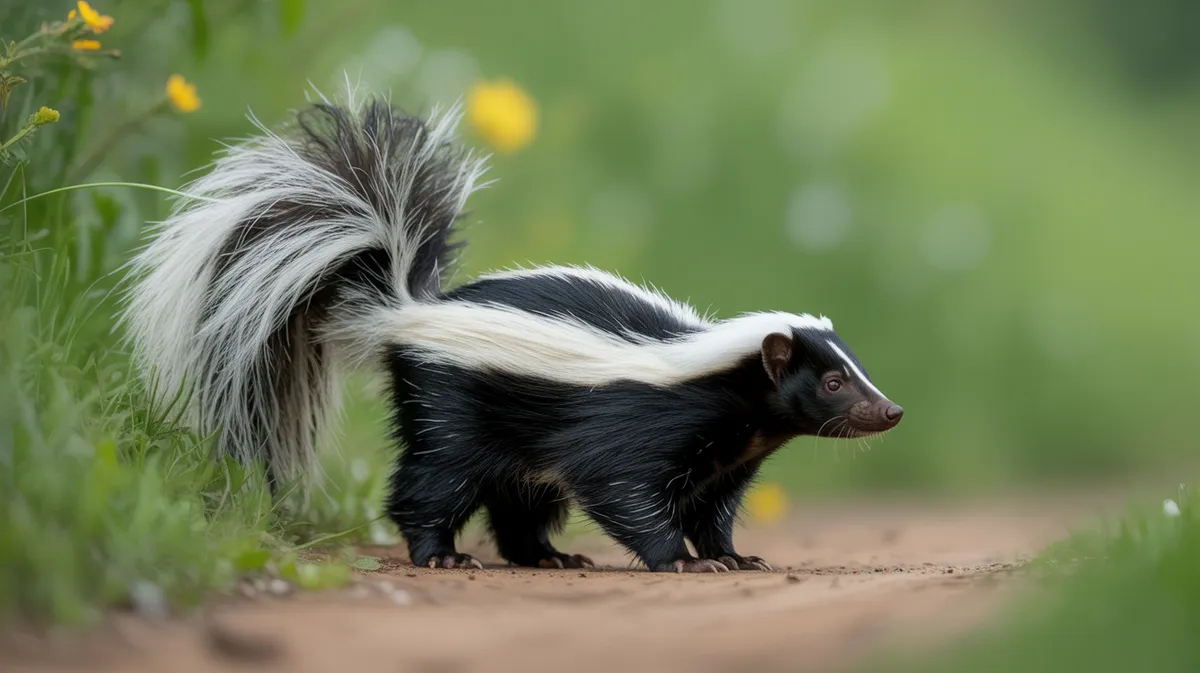
About the Striped Skunk
The striped skunk's defence is chemical, and it is a last resort. The spray is a mixture of sulphur-bearing thiols produced in two glands beside the anus, which the animal aims with real accuracy over several metres. Before firing it gives a graded warning — stamping its front feet, hissing, raising and fanning the tail — and that ritual works precisely because its bold black-and-white pattern is aposematic, advertising the threat so unmistakably that most predators need only one lesson. The restraint is not manners: the glands hold just a handful of charges and take over a week to refill, so a skunk that wastes its spray is genuinely defenceless. Its most persistent predator is the great horned owl, which is largely unbothered — birds have a poor sense of smell. Skunks are omnivores, and are among the few animals that habitually raid bee nests, protected from stings by dense fur. Despite the old classification, they are not mustelids; they sit in their own family, Mephitidae.
Fascinating facts
Famous Defense
Striped skunks possess specialized anal glands that produce a strong-smelling chemical spray used to deter predators.
Nocturnal Lifestyle
They are primarily active at night and spend their days resting in underground burrows or hidden dens.
Diverse Diet
Their omnivorous diet includes insects, small mammals, fruits, plants, and even human garbage when living near people.
Detailed description
The striped skunk (Mephitis mephitis) is a robust, medium-sized mammal typically weighing between 1.8 and 4.5 kg (4–10 lbs) and measuring 54–77 cm (21–30 in) in total length, including its bushy tail. Its most distinctive feature is the bold white stripe or pair of stripes running from the head down the back, set against glossy black fur, though the pattern can vary among individuals. The head is small with a pointed snout, short rounded ears, and dark eyes adapted for nocturnal activity. The forelimbs are strong and equipped with long, curved claws specialized for digging. Striped skunks possess well-developed anal scent glands capable of ejecting a noxious, sulfur-based spray up to 5 meters (16 ft), a highly effective deterrent against predators. They are primarily nocturnal and solitary, using their acute sense of smell and hearing to locate food. Skunks are opportunistic omnivores, consuming a varied diet that shifts seasonally and includes insects, small vertebrates, fruits, seeds, and human refuse. In colder regions, they may enter a state of torpor during winter, sheltering in dens and reducing activity, but do not truly hibernate. Their adaptability to diverse habitats, including urban and suburban environments, has contributed to their widespread distribution across North America.
Did you know?
Striped skunks are important natural pest controllers, consuming large quantities of insects and rodents.
Research & sources
Wikipedia summary
The striped skunk is a skunk of the genus Mephitis that occurs across much of North America, including southern Canada, the United States, and northern Mexico. It is currently listed as least concern by the IUCN on account of its wide range and ability to adapt to human-modified environments.
Behaviour & social structure
Striped skunks are predominantly solitary outside the breeding season, though females may den communally in winter for warmth. They are crepuscular to nocturnal, emerging at dusk to forage and returning to dens before sunrise. Skunks are slow-moving but deliberate, relying on their aposematic coloration and defensive spray rather than speed or stealth. Foraging behavior is characterized by methodical digging and probing with the snout, especially for insect larvae and grubs. They are also known to raid bird nests for eggs and chicks, and will scavenge carrion or garbage in human-dominated landscapes. Skunks communicate through a range of vocalizations (growls, hisses, squeals) and body language, especially tail-raising and foot-stamping as warnings before spraying. Home ranges are typically 1–5 km² (0.4–2 mi²), with males occupying larger territories than females, particularly during the breeding season.
Reproduction & life cycle
Breeding occurs once annually, typically from February to April. Males may travel extensively in search of receptive females, leading to increased road mortality during this period. After mating, delayed implantation may occur, with actual gestation lasting about 59–77 days. Litters of 2–10 kits (average 5–7) are born blind and nearly hairless in late spring or early summer. Kits develop fur and open their eyes at about three weeks. The mother provides all parental care, nursing the young in a secure den and aggressively defending them. Kits begin to accompany the mother on foraging trips at 6–8 weeks and are weaned by two months. Dispersal occurs in late summer or early fall, with males leaving first; females may remain near the natal area.
Adaptations & survival
The striped skunk's most notable adaptation is its highly specialized anal scent glands, which produce a volatile, oily secretion containing thiols and thioacetates. This spray can cause temporary blindness and intense irritation in predators, and the warning coloration (black and white stripes) serves as an aposematic signal. Skunks have robust forelimbs for digging and accessing subterranean prey. Their omnivorous diet and flexible foraging strategies allow them to exploit a wide range of food sources. Physiologically, they can enter torpor in cold climates, reducing metabolic rate and conserving energy. Their ability to use abandoned burrows or human structures as dens further enhances survival in variable environments.
Cultural significance
The striped skunk has a prominent place in North American folklore and popular culture, often symbolizing caution or warning due to its defensive abilities. Native American traditions sometimes regard the skunk as a symbol of respect or self-assurance. In rural communities, skunks are both reviled for their odor and appreciated for their role in controlling insect pests. The animal has appeared in literature, cartoons (notably as the character Pepé Le Pew), and as a motif in art. Historically, skunk pelts were used in the fur trade, and their scent glands have been used in traditional medicine and perfumery, though such uses are rare today.
Recent research
Recent research has focused on the ecological role of striped skunks in controlling insect and rodent populations, their adaptability to urban environments, and their role as reservoirs for rabies and other zoonotic diseases. Studies using radio telemetry have elucidated home range sizes, denning behavior, and movement patterns. Genetic analyses have clarified relationships within the Mephitidae family and population structure across their range. Ongoing research includes the effects of urbanization on skunk behavior and health, and the development of non-lethal management strategies to reduce human-wildlife conflict.
Videos
Habitat
Mixed woodlands, grasslands, agricultural areas, and suburban environments


Conservation
The Striped Skunk is currently classified as Least Concern on the IUCN Red List.
Threats & challenges
While the striped skunk is currently classified as Least Concern, it faces localized threats including habitat loss, road mortality (especially during breeding dispersal), disease (notably rabies and canine distemper), and persecution due to its odor and potential for poultry predation. Urbanization has increased encounters with humans, leading to both increased food opportunities and risks (e.g., vehicle collisions, trapping). Population trends are generally stable, but outbreaks of disease can cause significant local declines. Pesticide use may reduce insect prey availability in agricultural areas.
Taxonomy
Scientific name
Mephitis mephitis
- Kingdom
- Animalia
- Phylum
- Chordata
- Class
- Mammalia
- Order
- Carnivora
- Family
- Mephitidae
- Genus
- Mephitis
- Species
- mephitis
Where to see a striped skunk
8 zoos and aquariums in 3 countries are recorded as keeping this species.
 Honolulu Zoo🇺🇸 Honolulu, United States
- 🦁The Maryland Zoo in Baltimore🇺🇸 Baltimore, United States
- 🦁Big Bear Alpine Zoo🇺🇸 Big Bear Lake, United States
- 🦁Topeka Zoo🇺🇸 Topeka, United States
 Birmingham Zoo🇺🇸 United States
Community notes
Share your observations about the Striped Skunk.
No community notes yet. Be the first!
Discover more wildlife
More fascinating animals from the encyclopedia.