
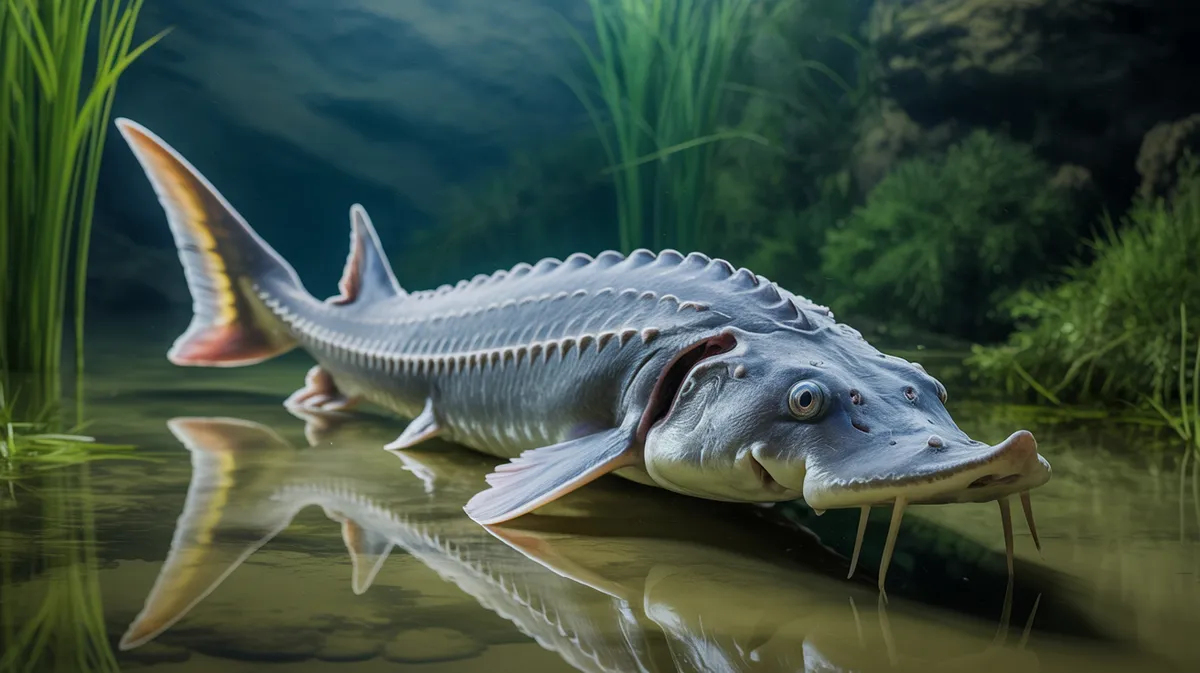
About the Sturgeon
Sturgeons are ancient, large-bodied fish known for their elongated bodies and distinctive bony scutes along their backs. They primarily inhabit temperate rivers, lakes, and coastal environments in the Northern Hemisphere, with some species migrating between freshwater and the sea. Sturgeons are famous for producing caviar, making them highly valued but also heavily exploited. Many species are slow-growing and can live for decades, maturing late and spawning infrequently. Due to overfishing, habitat loss, and pollution, most sturgeon species are now considered threatened or endangered.
Fascinating facts
Ancient Survivors
Sturgeons have changed little in appearance for over 200 million years, earning them the nickname 'living fossils.'
Caviar Producers
Sturgeon eggs are harvested to make caviar, leading to intense fishing pressure and endangerment of many species.
Migratory Fish
Many sturgeon species are anadromous, meaning they migrate from the sea into freshwater rivers to spawn.
Detailed description
Sturgeons (family Acipenseridae) are among the most ancient extant ray-finned fishes, with a fossil record dating back over 100 million years. They are characterized by their elongated, torpedo-shaped bodies, heterocercal (asymmetrical) tails, and five distinct rows of bony scutes (modified ganoid scales) running along their bodies, providing protection and structural support. Adult sturgeons can range in size from the relatively small Scaphirhynchus species (rarely exceeding 1 meter) to the massive beluga sturgeon (Huso huso), which can exceed 6 meters in length and weigh over 1,000 kg. Their mouths are ventrally located and protrusible, lacking teeth in adults, and are accompanied by sensitive barbels used to detect prey on river and lake bottoms. Sturgeons possess a cartilaginous endoskeleton, a primitive feature among bony fishes, and have spiracles behind their eyes for respiration. Most species are anadromous, migrating from marine or brackish environments into freshwater rivers to spawn, though some are entirely freshwater. They are generally slow-moving, benthic feeders, relying on tactile and chemosensory cues to locate invertebrates, small fish, and other prey. Sturgeons are long-lived, with some individuals documented to live over 100 years, and exhibit delayed sexual maturity, often not spawning until 10-20 years of age. Their reproductive output is low, with females producing thousands to millions of eggs per spawning event but only at infrequent intervals. These life history traits, combined with their ecological roles as benthic foragers and migratory species, make sturgeons particularly vulnerable to environmental changes and human exploitation.
Did you know?
The beluga sturgeon (Huso huso) can grow over 7 meters (23 feet) long, making it one of the largest freshwater fish in the world.
Research & sources
Wikipedia summary
Sturgeon is the common name for the 27 species of fish belonging to the family Acipenseridae. The earliest sturgeon fossils date to the Late Cretaceous, and are descended from other, earlier acipenseriform fish, which date back to the Early Jurassic period, some 174 to 201 million years ago. They are one of two living families of the Acipenseriformes alongside paddlefish (Polyodontidae). The family is grouped into five genera: Acipenser, Huso, Scaphirhynchus, Sinosturio, and Pseudoscaphirhynchus. Two species may be extinct in the wild, and one may be entirely extinct. Sturgeons are native to subtropical, temperate and sub-Arctic rivers, lakes and coastlines of Eurasia and North America. A Maastrichtian-age fossil found in Morocco shows that they also once lived in northern Africa during the Cretaceous.
Behaviour & social structure
Sturgeons are primarily solitary or loosely aggregating fish, spending much of their time near the substrate of rivers, lakes, or estuaries. They exhibit crepuscular or nocturnal activity patterns, foraging mostly at dusk and night. Using their sensitive barbels, they probe soft sediments to detect prey, which they suck into their mouths by rapidly protruding their jaws. Their diet consists mainly of benthic invertebrates (e.g., mollusks, crustaceans, insect larvae), small fish, and occasionally plant material. Sturgeons are not aggressive and generally avoid confrontation, though some species may form temporary groups during migration or in feeding areas. During spawning migrations, sturgeons can travel hundreds or even thousands of kilometers, navigating complex river systems. Juvenile sturgeons exhibit more cryptic behavior, remaining in shallow, vegetated areas to avoid predation. Communication is limited, relying primarily on tactile and chemical cues rather than visual or auditory signals.
Reproduction & life cycle
Sturgeons are iteroparous, returning multiple times to spawn over their long lifespans, but with significant intervals (2-7 years) between spawning events. Spawning typically occurs in spring or early summer, triggered by rising water temperatures (generally 10-20°C) and increased river flow. Adults migrate upstream to gravel or rocky substrates in fast-flowing river sections, where females release large numbers of adhesive eggs (ranging from 100,000 to over 3 million, depending on species and size). Fertilization is external. There is no parental care after spawning; eggs adhere to substrate and hatch within 7-14 days. Larvae are initially photophobic and drift downstream to nursery habitats, where they grow rapidly. Sexual maturity is delayed, with males maturing at 8-15 years and females at 12-25 years, depending on species and environmental conditions. The long generation time and infrequent spawning contribute to their vulnerability to population declines.
Adaptations & survival
Sturgeons exhibit several unique adaptations for benthic life and long-distance migration. Their ventrally located, protrusible mouths and sensitive barbels allow them to efficiently detect and consume prey buried in sediment. The bony scutes provide protection against predators and abrasive substrates. Their cartilaginous skeleton, a primitive trait, confers flexibility and buoyancy advantages in large-bodied fish. Sturgeons possess a well-developed lateral line system for detecting water movement and vibrations. Many species are highly tolerant of varying salinities, enabling them to move between marine, brackish, and freshwater environments. Their ability to undertake long migrations is supported by strong swimming muscles and efficient energy storage. Physiologically, sturgeons can withstand low oxygen conditions, an adaptation to turbid or hypoxic waters.
Cultural significance
Sturgeons have held significant cultural and economic value for millennia. They are renowned for their roe, processed as caviar, a luxury delicacy highly prized worldwide. In ancient civilizations such as those of the Black Sea and Caspian regions, sturgeons were symbols of wealth and power, often featured in royal banquets and ceremonies. In Russian, Persian, and Central Asian folklore, sturgeons are associated with abundance and longevity. Their images appear in art, heraldry, and mythology. Traditional fishing communities developed specialized gear and rituals around sturgeon harvest. However, the high value of caviar has also driven unsustainable exploitation, leading to international regulation and trade bans under CITES.
Recent research
Recent research has focused on sturgeon genetics and phylogeny, revealing complex patterns of polyploidy (multiple sets of chromosomes) and hybridization among species. Conservation genetics studies are guiding captive breeding and reintroduction programs, such as those for the European and Chinese sturgeons. Advances in telemetry and tagging have improved understanding of migration routes and habitat use, informing river management and dam mitigation strategies. Studies on sturgeon physiology have uncovered remarkable adaptations to hypoxia and salinity changes. Ongoing research addresses the impacts of endocrine-disrupting pollutants on sturgeon reproduction and development. There is also growing interest in developing sustainable aquaculture techniques to reduce pressure on wild populations and supply the caviar market.
Videos
Habitat
Freshwater rivers, lakes, and coastal waters

Conservation
The Sturgeon is currently classified as Critically Endangered (many species) on the IUCN Red List.
Threats & challenges
Sturgeons face severe threats from overfishing (especially for caviar and meat), habitat fragmentation (due to dams and river regulation), pollution (including heavy metals and endocrine disruptors), and illegal trade. Many populations have experienced drastic declines; for example, the European sturgeon (Acipenser sturio) is now critically endangered, with only a few remnant populations. Habitat loss, especially the loss of spawning grounds due to dam construction, is a major challenge, as sturgeons require long, unobstructed river stretches for migration. Bycatch in commercial fisheries and poaching for caviar further exacerbate declines. Climate change, altering river flow and temperature regimes, poses additional risks. Conservation efforts are complicated by their slow growth, late maturity, and complex life cycles. Most species are now listed as threatened or endangered by the IUCN, with several considered extinct in the wild.
Taxonomy
Scientific name
Acipenser sturio
- Kingdom
- Animalia
- Phylum
- Chordata
- Class
- Actinopterygii
- Order
- Acipenseriformes
- Family
- Acipenseridae
- Genus
- Acipenser
- Species
- sturio (example: European sturgeon)
Community notes
Share your observations about the Sturgeon.
No community notes yet. Be the first!
Discover more wildlife
More fascinating animals from the encyclopedia.