
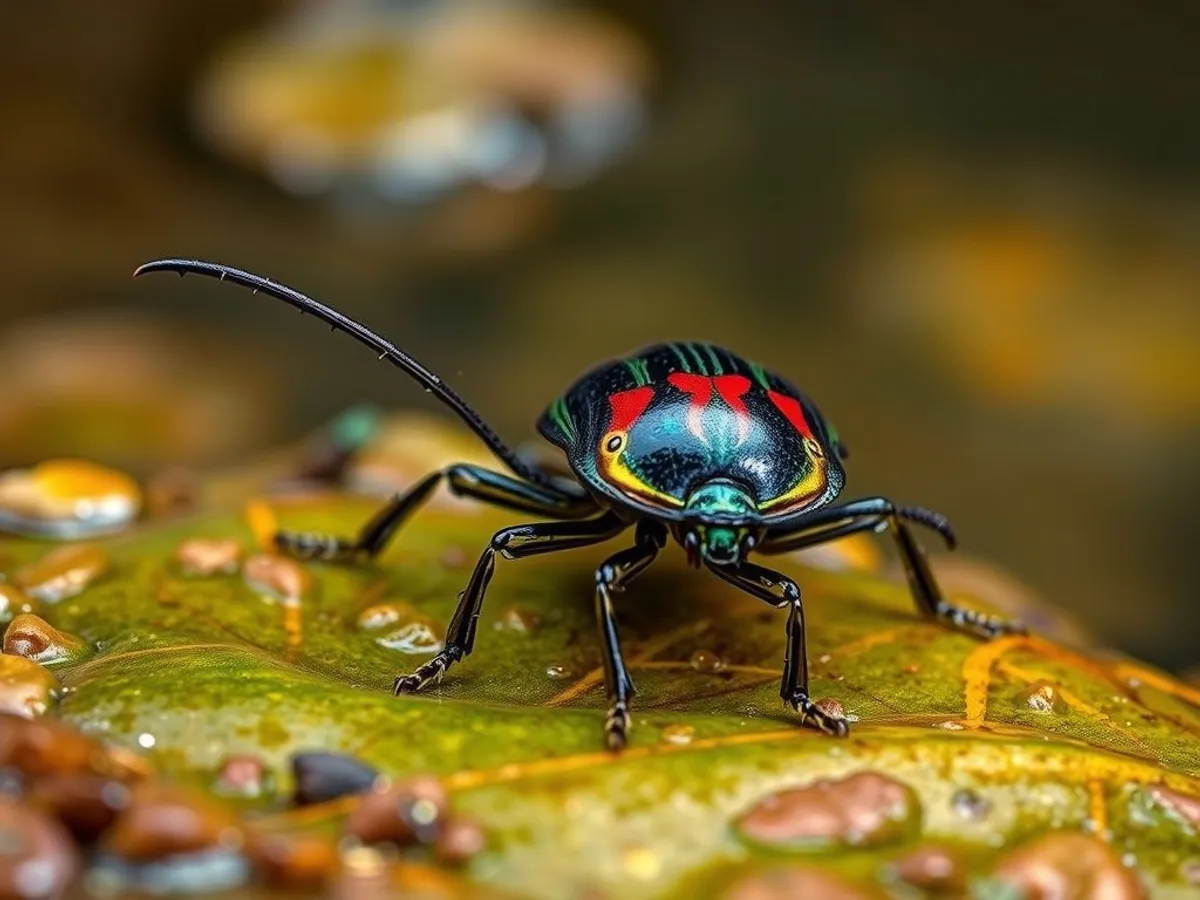
About the Sunburst diving beetle
The Sunburst diving beetle is a striking aquatic insect known for its vivid yellow spots and marble-like patterning on a dark, oval body. This beetle is adept at swimming and is found primarily in freshwater ponds, slow-moving streams, and other still water bodies in the southwestern United States and northern Mexico. Equipped with powerful hind legs fringed with hairs, it propels itself quickly through water both to hunt and evade predators. Sunburst diving beetles are voracious predators, feeding on other aquatic invertebrates and sometimes small fish or tadpoles. Their adaptability and unique coloration make them an intriguing subject for aquatic entomologists and hobbyists alike.
Fascinating facts
Aquatic Acrobat
Sunburst diving beetles use their hairy hind legs like oars, making them agile swimmers capable of rapid turns and bursts of speed.
Warning Colors
Their bright yellow spots and marbled patterns act as aposematic signals, warning predators that they taste bad or may be toxic.
Predatory Larvae
The larvae, often called 'water tigers,' have large jaws and are formidable hunters, preying on other aquatic insects and even small vertebrates.
Detailed description
The Sunburst diving beetle (Thermonectus marmoratus) is a medium-sized aquatic beetle, typically measuring 10–12 mm in length. Its most distinctive feature is its elytra (wing covers), which are glossy black or dark brown adorned with irregular, bright yellow spots that resemble a sunburst or marbled pattern, providing effective camouflage among aquatic vegetation and dappled sunlight. The beetle's body is streamlined and oval-shaped, facilitating efficient movement through water. Its hind legs are long, flattened, and fringed with stiff swimming hairs (setae), acting as powerful paddles for rapid propulsion and agile maneuvering. The beetle possesses well-developed compound eyes and short, clubbed antennae used for detecting prey and navigating its environment. Thermonectus marmoratus is an adept diver, capable of carrying a bubble of air under its elytra, which it uses for respiration while submerged. Adults are primarily solitary and highly territorial, aggressively defending their hunting grounds. The larvae, known as 'water tigers,' are elongated, with sickle-shaped mandibles used to grasp and inject digestive enzymes into prey. Both life stages are predatory, feeding on a variety of aquatic invertebrates and occasionally small vertebrates. Reproduction occurs in water, with females laying eggs on submerged vegetation. The species is well adapted to ephemeral water bodies, exhibiting remarkable tolerance to fluctuating temperatures and oxygen levels.
Did you know?
Sunburst diving beetles can sense vibrations and changes in water pressure, helping them hunt prey and avoid danger even in murky conditions.
Research & sources
Wikipedia summary
Thermonectus marmoratus is a relatively colorful North American species of diving beetle known by the common names sunburst diving beetle and yellow-spotted diving beetle. The behavior of this diving beetle has been compared to a scuba diver, since it carries with it a bubble of air as it dives down into the water. Its aquatic larval stage was the first ever recorded use of bifocals in the animal world. The beetle uses in its principal eyes two retinas and two distinct focal planes that are substantially separated, in the manner of bifocals to switch their vision from up-close to distance, for easy and efficient capture of their prey.
Behaviour & social structure
Sunburst diving beetles are diurnal, most active during daylight hours when they hunt and patrol their territories. Adults are opportunistic predators, ambushing or actively chasing prey such as aquatic insect larvae, small crustaceans, tadpoles, and even small fish fry. They use their sensitive antennae and excellent vision to detect movement in the water. When threatened, they can dive rapidly, using their hind legs for powerful bursts of speed, and will cling to submerged vegetation or debris. To breathe underwater, they periodically surface to trap an air bubble beneath their elytra, which also serves as a physical gill, allowing for gas exchange. Social interactions are limited, with individuals displaying aggression towards conspecifics, especially during feeding or mating periods. Larvae are solitary and voracious, often outcompeting other aquatic predators in their habitat. Both adults and larvae exhibit sit-and-wait as well as active pursuit hunting strategies, depending on prey availability.
Reproduction & life cycle
Breeding typically occurs in late spring to early summer, coinciding with optimal water temperatures and food abundance. Males court females through tactile and chemical cues, often engaging in brief, vigorous mating bouts. Females lay clusters of eggs on or near submerged aquatic plants, ensuring emerging larvae have immediate access to prey. The eggs hatch after 5–10 days, depending on temperature. Larvae undergo three instars, growing rapidly as they consume prey. After several weeks, mature larvae leave the water to pupate in moist soil or under debris near the water's edge. The pupal stage lasts 7–14 days, after which adults emerge and return to the water. There is typically one generation per year, though in warmer climates, partial second generations may occur. Parental care is absent; survival of offspring depends on suitable microhabitat and prey availability.
Adaptations & survival
Thermonectus marmoratus exhibits several specialized adaptations for aquatic life. Its hydrodynamic body shape and fringed hind legs enable swift swimming and agile turns. The ability to carry an air bubble beneath the elytra allows extended dives and survival in low-oxygen environments. The beetle's coloration provides disruptive camouflage against predators and prey. Notably, larvae possess bifocal eyes, a unique adaptation among insects: each principal eye contains two retinas with distinct focal planes, allowing simultaneous focus on near and distant objects—an evolutionary innovation that enhances prey detection and capture efficiency. Adults can also secrete defensive chemicals from abdominal glands to deter fish and other predators. The species tolerates a wide range of water conditions, including temporary pools, by entering a state of reduced activity or seeking refuge in moist substrate during drought.
Cultural significance
The Sunburst diving beetle has limited direct significance in human culture but is occasionally featured in educational programs and public aquaria due to its striking appearance and fascinating behaviors. Its unique larval vision system has attracted scientific and popular interest, inspiring biomimetic research in optics and robotics. In some indigenous North American traditions, aquatic beetles are symbolic of adaptability and transformation, though specific references to Thermonectus marmoratus are rare.
Recent research
Recent research has focused on the bifocal visual system of Thermonectus marmoratus larvae, revealing unprecedented complexity in insect vision and potential applications in artificial visual systems (Stowasser et al., 2010). Ongoing studies are examining the beetle's role in aquatic food webs, its physiological responses to hypoxia, and the genetic basis of its distinctive coloration. There is also interest in its chemical defenses and potential resistance to pollutants. The species serves as a model organism for studying predator-prey dynamics and the evolution of sensory adaptations in aquatic insects.
Videos
Habitat
Freshwater ponds and slow streams

Conservation
The Sunburst diving beetle is currently classified as Least Concern on the IUCN Red List.
Threats & challenges
Currently classified as Least Concern, Thermonectus marmoratus faces localized threats from habitat loss due to wetland drainage, pollution (especially pesticides and heavy metals), and the introduction of non-native fish that prey on beetles and larvae. Climate change poses a potential long-term threat by altering the hydroperiod of breeding sites. Despite these challenges, the species' broad distribution and adaptability to disturbed habitats have allowed populations to remain stable in most areas. Monitoring is recommended in regions experiencing rapid urbanization or agricultural expansion.
Taxonomy
Scientific name
Thermonectus marmoratus
- Kingdom
- Animalia
- Phylum
- Arthropoda
- Class
- Insecta
- Order
- Coleoptera
- Family
- Dytiscidae
- Genus
- Thermonectus
- Species
- marmoratus
Where to see a sunburst diving beetle
1 zoo and aquarium in 1 country are recorded as keeping this species.

Community notes
Share your observations about the Sunburst diving beetle.
No community notes yet. Be the first!
Discover more wildlife
More fascinating animals from the encyclopedia.