
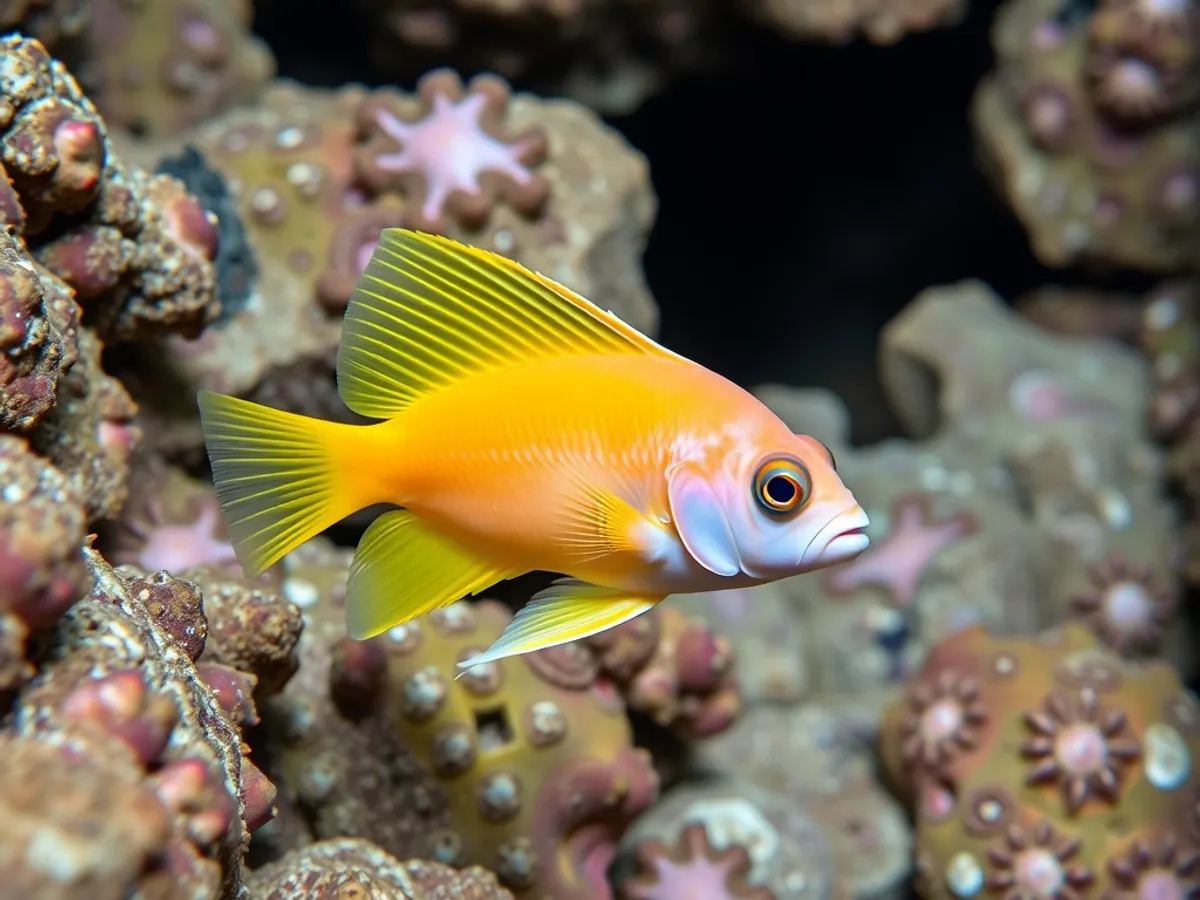
About the Swallowtail Seaperch
The swallowtail seaperch, also known as the Mediterranean anthias, is a colorful marine fish found primarily in the eastern Atlantic Ocean and the Mediterranean Sea. This species is recognized for its vibrant pinkish-orange coloration and deeply forked, swallow-like tail, which gives it its common name. Swallowtail seaperch inhabit rocky reefs and underwater caves, often forming small groups above the seabed. They are most active during the day and seek shelter in crevices at night.
Fascinating facts
Colorful Appearance
Swallowtail seaperch are easily identified by their striking pinkish-orange coloration and a deeply forked tail resembling a swallow’s tail.
Habitat Specialists
They prefer rocky reefs and caves at depths ranging from 15 to over 200 meters, making them less commonly seen in shallow waters.
Sex Change Behavior
These fish are protogynous hermaphrodites, meaning females can change into males if the dominant male is removed from a group.
Detailed description
The swallowtail seaperch (Anthias anthias) is a strikingly colored marine fish, typically reaching lengths of 13–16 cm, with some individuals growing up to 27 cm. Its body is laterally compressed and adorned with vibrant hues ranging from pinkish-orange to reddish-violet, with males often displaying more intense coloration and elongated fin rays, especially on the dorsal and caudal fins. The species is named for its deeply forked, swallow-like caudal fin, which aids in agile swimming among rocky crevices and reefs. The head is relatively small, with a large mouth adapted for catching zooplankton and small invertebrates. Swallowtail seaperch possess large eyes, an adaptation for their often dimly lit, deeper reef habitats. They are diurnal, spending daylight hours actively swimming in midwater schools above rocky substrates, while retreating to caves and crevices at night for protection. Socially, they form complex harems, with a dominant male overseeing a group of females. This species is a protogynous hermaphrodite, meaning individuals start life as females and can transition to males if the dominant male is lost. Their scales are small and smooth, providing hydrodynamic efficiency and protection from abrasion. The species is long-lived for a small fish, with lifespans of up to 5–7 years recorded in the wild.
Did you know?
Despite their vivid appearance, swallowtail seaperch can be quite shy and are often overlooked by divers due to their preference for deeper, shadowy habitats.
Research & sources
Wikipedia summary
Anthias anthias, the swallowtail sea perch or marine goldfish, is a species of marine ray-finned fish from the family Anthiadidae. It is native to the eastern Atlantic Ocean and the Mediterranean Sea where it is associated with reefs. It is found in the aquarium trade.
Behaviour & social structure
Swallowtail seaperch are highly social, forming aggregations that can range from a few individuals to several dozen, especially in areas with abundant shelter. These groups are structured as harems, with one dominant male and multiple females. The male patrols the territory, displaying vibrant colors and fin extensions to assert dominance and attract mates. Feeding occurs primarily in the water column, where they pick off zooplankton, copepods, amphipods, and small crustaceans with quick, upward lunges. They exhibit a crepuscular peak in activity, with feeding most intense during early morning and late afternoon. At night, the group disperses into crevices and caves to avoid nocturnal predators. Swallowtail seaperch communicate through body postures and rapid color changes, especially during courtship and social interactions. Subordinate females and juveniles may display more subdued coloration to avoid aggression from the dominant male.
Reproduction & life cycle
Anthias anthias exhibits protogynous hermaphroditism, where all individuals are born female and the largest, most dominant female may transform into a male if the harem loses its male. Spawning typically occurs from late spring to early summer, though timing can vary with local water temperatures. Courtship involves elaborate displays by the male, including fin flaring and rapid swimming loops. Females release pelagic eggs into the water column, which are externally fertilized by the male. The eggs are buoyant and drift with currents, hatching after 2–4 days depending on temperature. Larvae are planktonic for several weeks, feeding on microzooplankton before settling onto reefs as juveniles. There is no parental care; survival depends on the dispersal and abundance of suitable nursery habitats.
Adaptations & survival
Swallowtail seaperch have evolved several adaptations for life in complex reef environments. Their laterally compressed bodies and deeply forked tails enable rapid maneuvering among rocks and crevices, aiding both in predator avoidance and efficient foraging. Large eyes enhance vision in low-light conditions typical of deeper reefs and caves. Their social and reproductive system—protogynous hermaphroditism—maximizes reproductive success in environments where mate encounters can be unpredictable. The ability to change sex allows for rapid replacement of lost males, maintaining harem stability. Their bright coloration serves both as a means of intra-species communication and as camouflage among the colorful reef backgrounds.
Cultural significance
The swallowtail seaperch is admired by divers and aquarists for its vivid coloration and graceful swimming, making it a popular subject in underwater photography and marine displays. In Mediterranean folklore, colorful reef fish like Anthias anthias are sometimes associated with good luck or beauty, though the species does not have significant roles in mythology or traditional fisheries. Its presence in public aquaria helps raise awareness of Mediterranean marine biodiversity and the importance of reef conservation.
Recent research
Recent studies have focused on the reproductive biology and social structure of Anthias anthias, particularly the mechanisms and triggers of sex change within harems. Genetic research has clarified its relationships within the Anthiadidae family and its evolutionary history. Ecological studies have examined its role as a mid-level predator in reef food webs and its responses to environmental changes, such as shifts in prey availability due to climate change. Ongoing research is assessing the impact of aquarium trade collection on wild populations and exploring the potential for captive breeding to reduce wild harvest.
Videos
Habitat
Rocky reef and cave systems in coastal marine environments

Conservation
The Swallowtail Seaperch is currently classified as Least Concern on the IUCN Red List.
Threats & challenges
Currently, Anthias anthias is listed as Least Concern by the IUCN, with stable populations across its range. However, localized threats include overfishing for the aquarium trade, habitat degradation from coastal development, and the impacts of climate change such as ocean warming and acidification, which can affect reef structure and prey availability. In some regions, destructive fishing practices and pollution pose additional risks. While not a primary target for fisheries, bycatch and collection for ornamental purposes can impact local populations if not managed sustainably. Ongoing monitoring is necessary to detect any future declines, especially as Mediterranean and eastern Atlantic reefs face increasing anthropogenic pressures.
Taxonomy
Scientific name
Anthias anthias
- Kingdom
- Animalia
- Phylum
- Chordata
- Class
- Actinopterygii
- Order
- Perciformes
- Family
- Serranidae
- Genus
- Anthias
- Species
- anthias
Community notes
Share your observations about the Swallowtail Seaperch.
No community notes yet. Be the first!
Discover more wildlife
More fascinating animals from the encyclopedia.