
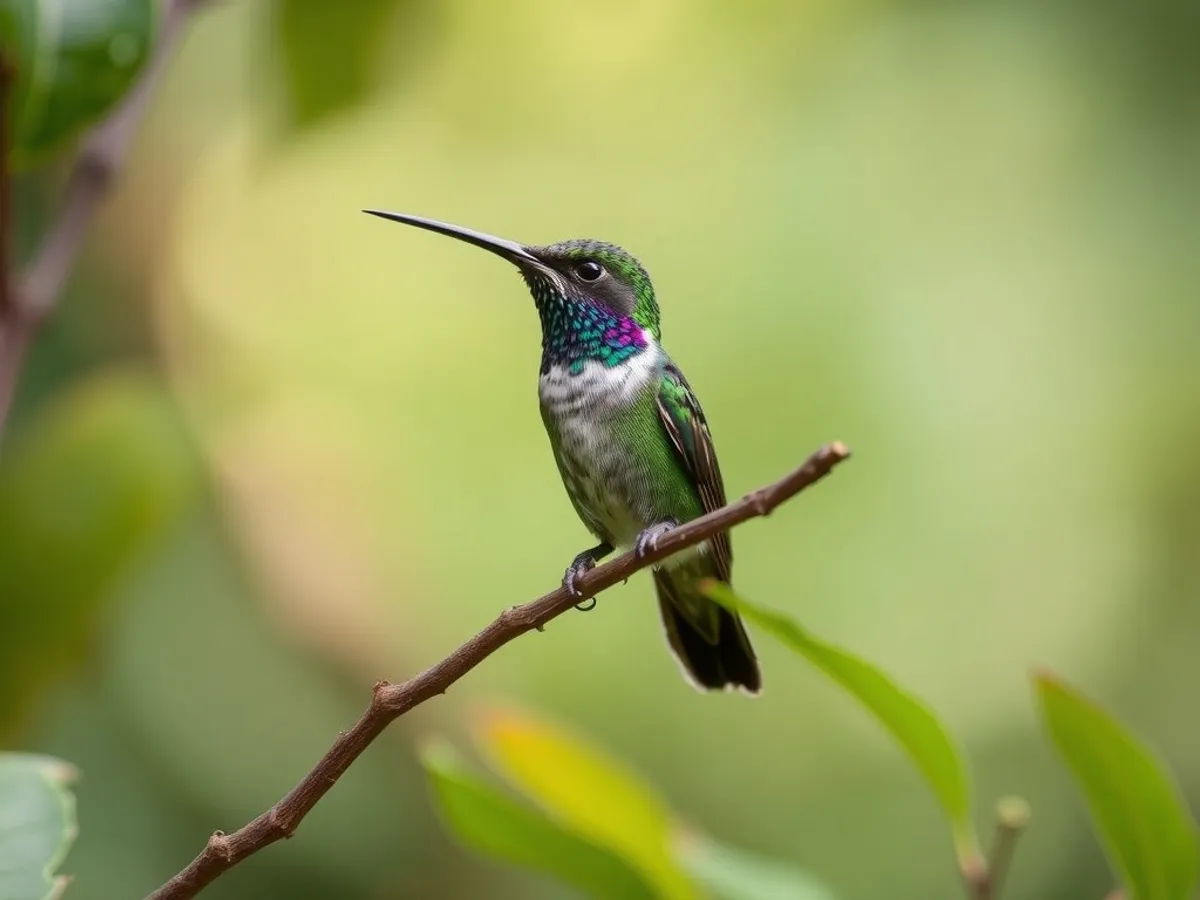
About the Sword-billed Hummingbird
The sword-billed hummingbird (Ensifera ensifera) of the high Andes is the only bird in the world whose bill is longer than the rest of its body, excluding the tail. The bill can reach 11 centimetres on a bird whose body is about 10, and the entire skeleton has been rearranged to carry it: the skull is modified and the tongue, correspondingly enormous, is coiled around inside the head when retracted. The reason is a coevolutionary arms race with a handful of Andean plants, above all the passionflower Passiflora mixta and certain Datura and Brugmansia, whose corolla tubes are so long that no other pollinator can reach the nectar at the bottom. Plant and bird have driven each other to extremes, and each is now largely dependent on the other. The costs are real. The sword-bill cannot preen with its bill, so it is the only hummingbird that grooms itself with its feet, and it perches with the bill held almost vertically upward to take the weight off its neck muscles, which is how you spot one at rest. It also cannot easily reach a normal flower, and so it is excluded from most of the nectar in its own habitat. It lives between roughly 1,700 and 3,500 metres in cloud forest on both slopes of the Andes.
Fascinating facts
Specialized Pollinator
The Sword-billed Hummingbird can feed from and pollinate tubular flowers that other hummingbirds cannot access due to its bill length.
Unique Anatomy
Its bill can reach up to 10-12 centimeters, exceeding the length of its body—an adaptation found in no other bird species.
High-Altitude Resident
This species thrives in the cool, humid environments of the Andes, usually at elevations above 1,700 meters.
Detailed description
The Sword-billed Hummingbird (Ensifera ensifera) is a strikingly unique member of the Trochilidae family, distinguished by its extraordinary bill, which can reach up to 10–12 cm in length—often exceeding the length of its 8–10 cm body (excluding tail). This bill is straight, slender, and perfectly adapted for accessing nectar from deep, tubular flowers, particularly those of Passiflora species. The plumage is predominantly iridescent green on the upperparts with bronzy or golden hues, while the underparts are paler with a subtle grayish wash. Males and females are similar in coloration, though females may have slightly shorter bills and more pronounced white spots behind the eyes. The wings are long and narrow, facilitating rapid, agile flight, and the tail is relatively short and slightly notched. The tongue is long and bifurcated, specialized for nectar extraction. Unlike most hummingbirds, the sword-billed hummingbird cannot use its bill for preening and instead relies on its feet, a rare adaptation among birds. Its zygodactyl feet (two toes forward, two back) are strong and dexterous for this purpose. The species is solitary and highly territorial, especially around favored feeding sites. Its vocalizations are high-pitched and insect-like, used primarily for territory defense. The sword-billed hummingbird is an essential pollinator in Andean ecosystems, forming mutualistic relationships with several endemic plant species.
Did you know?
Sword-billed Hummingbirds must perch with their heads tilted upward because the sheer length of their bills makes it difficult to balance otherwise.
Research & sources
Wikipedia summary
The sword-billed hummingbird, also known as the swordbill, is a neotropical species of hummingbird from the Andean regions of South America. It is the only member in the genus Ensifera. Among the largest species of hummingbird, it is characterized by its unusually long bill, being the only bird to have a beak longer than the rest of its body, excluding the tail. It uses its bill to drink nectar from flowers with long corollas and has coevolved with the species Passiflora mixta. While most hummingbirds preen using their bills, the sword-billed hummingbird uses its feet to scratch and preen due to its bill being so long.
Behaviour & social structure
Sword-billed Hummingbirds are diurnal and exhibit classic hummingbird hovering and darting flight, enabled by rapid wingbeats (up to 15–20 beats per second). They are solitary outside of the breeding season and fiercely territorial, defending feeding territories from conspecifics and other nectarivores. Feeding occurs throughout the day, with peak activity at dawn and dusk. Their diet consists almost exclusively of nectar from long-tubed flowers, though they also consume small arthropods for protein. The birds display traplining behavior, visiting a circuit of flowering plants in a predictable sequence. They use their elongated bills to probe flowers while hovering, rarely perching to feed. Social interactions are limited to aggressive chases and vocal displays during territorial disputes. Roosting occurs on sheltered branches, typically at night. Preening is performed with the feet, and bathing may occur in rain or dew.
Reproduction & life cycle
Breeding occurs during the local wet season, which varies by latitude but generally spans from October to March. Males perform aerial displays and vocalizations to attract females, often involving rapid ascents and dives. There is no evidence of pair bonding; the species is believed to be polygynous. Females alone construct the nest, a small cup made of plant fibers, moss, and spider silk, placed on a horizontal branch or in a sheltered fork 2–5 meters above ground. Clutch size is typically two white eggs. Incubation lasts about 15–19 days, with the female solely responsible for incubation and feeding the chicks. Fledging occurs after 20–26 days. Juveniles are dependent on the mother for several days post-fledging before dispersing.
Adaptations & survival
The most notable adaptation is the extremely elongated bill, a result of coevolution with long-tubed Andean flowers, especially Passiflora mixta. This specialization allows access to nectar sources unavailable to other pollinators, reducing competition. The tongue is equally long and extensible, with brush-tipped ends for efficient nectar extraction. Strong, zygodactyl feet compensate for the inability to use the bill for preening. High metabolic rates and efficient oxygen utilization are essential for survival at high altitudes. The iridescent plumage may play a role in mate attraction and camouflage among dappled forest light. Behavioral adaptations include traplining and territoriality, optimizing energy expenditure in resource-scarce environments.
Cultural significance
In Andean folklore, the sword-billed hummingbird is often seen as a symbol of agility and uniqueness. Its remarkable bill has inspired indigenous myths, sometimes portrayed as a messenger between worlds due to its ability to access hidden nectar. The bird is occasionally featured in local art and handicrafts. While not traditionally hunted or used for ornamentation, its presence is valued by ecotourism and birdwatching communities, contributing to local conservation awareness.
Recent research
Recent studies have focused on the coevolutionary dynamics between E. ensifera and long-tubed flowers, providing a model for plant-pollinator specialization. Genetic analyses have clarified its phylogenetic placement as the sole member of the genus Ensifera. Ongoing research investigates the impact of climate change on its altitudinal range and the phenology of its preferred flowers. Biomechanical studies have examined the limits of bill length relative to feeding efficiency and flight energetics. Citizen science projects are contributing valuable data on distribution and seasonal movements.
Videos
Habitat
Cloud forest and montane forest


Conservation
The Sword-billed Hummingbird is currently classified as Least Concern on the IUCN Red List.
Threats & challenges
Currently listed as Least Concern by the IUCN, the Sword-billed Hummingbird faces localized threats from habitat loss due to deforestation, agricultural expansion, and climate change, which may alter the distribution of its specialized floral resources. Fragmentation of cloud forests can reduce available nesting and feeding sites. Pesticide use may impact insect prey availability. However, the species' broad range and adaptability to secondary habitats mitigate immediate extinction risk. Long-term climate shifts pose a potential threat by disrupting plant-pollinator synchrony.
Taxonomy
Scientific name
Ensifera ensifera
- Kingdom
- Animalia
- Phylum
- Chordata
- Class
- Aves
- Order
- Apodiformes
- Family
- Trochilidae
- Genus
- Ensifera
- Species
- ensifera
Community notes
Share your observations about the Sword-billed Hummingbird.
No community notes yet. Be the first!
Discover more wildlife
More fascinating animals from the encyclopedia.