
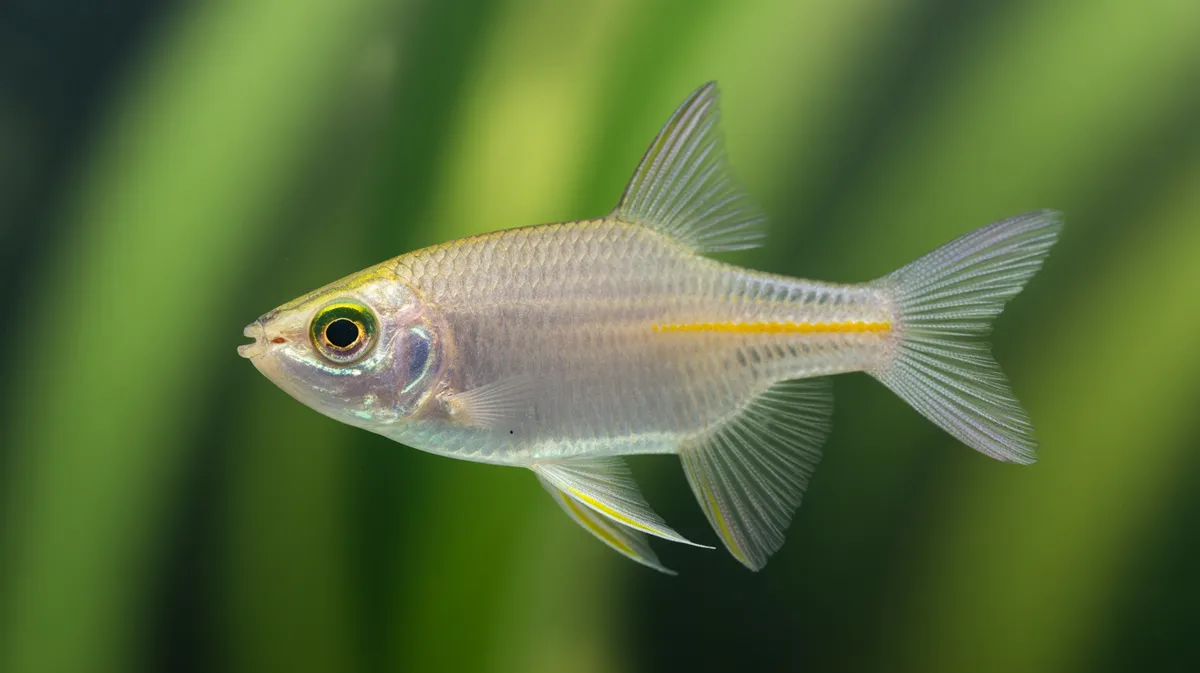
About the Threadfin Rainbowfish
The Threadfin Rainbowfish is a small, delicate freshwater fish renowned for its elongated, thread-like fins and shimmering, iridescent body colors. Native to slow-moving streams and swamps of northern Australia and New Guinea, this species displays remarkable sexual dimorphism, with males featuring especially long and ornate fin extensions. Highly social and peaceful, Threadfin Rainbowfish are often found swimming in schools near the water's surface among dense aquatic vegetation. Due to their striking appearance and gentle nature, they are popular in the aquarium trade but require pristine water conditions and a well-planted environment to thrive.
Fascinating facts
Shimmering Colors
Their bodies reflect iridescent hues, ranging from silver to gold, often with a rainbow-like shimmer under natural light.
Threadlike Fins
Male Threadfin Rainbowfish have elongated dorsal and anal fins that can be nearly as long as their bodies, giving them a delicate, ornate appearance.
Schooling Behavior
They are highly social and prefer to live in groups, which helps reduce stress and encourages natural behaviors.
Detailed description
The Threadfin Rainbowfish (Iriatherina werneri) is a diminutive, laterally compressed freshwater fish, typically reaching an adult standard length of 4–5 cm, with males occasionally attaining up to 5.5 cm. Its most striking feature is the elaborate, filamentous extensions of the dorsal, anal, and caudal fins, especially pronounced in males, which can more than double the fish’s body length. The body exhibits a translucent silver to pale gold base coloration, overlaid with iridescent hues that shift between blue, green, and pink under varying light conditions. Males display more intense coloration and longer fin rays, serving both as sexual signals and for intraspecific display. The eyes are large and set high on the head, aiding in surface-oriented foraging. This species is highly gregarious, forming loose shoals of up to several dozen individuals, which enhances predator avoidance and foraging efficiency. Threadfin Rainbowfish inhabit slow-moving, tannin-stained waters with dense aquatic vegetation, often in shaded forest streams, swamps, and floodplain lagoons. Their delicate build and elongated fins make them vulnerable to injury and predation, but also facilitate complex courtship displays. The species is adapted to low-nutrient, acidic environments, and is highly sensitive to water quality changes, which is reflected in their preference for pristine habitats.
Did you know?
Despite their fragile appearance, Threadfin Rainbowfish can adapt to a wide range of water conditions as long as the environment is clean and stable.
Research & sources
Wikipedia summary
The threadfin rainbowfish or featherfin rainbowfish is a rainbowfish, the only species in the genus Iriatherina. It is characterized by long beautiful fins, and is among the most attractive of the rainbowfishes.
Behaviour & social structure
Threadfin Rainbowfish are diurnal, spending daylight hours actively foraging near the water’s surface and among submerged vegetation. Their omnivorous diet consists primarily of small aquatic invertebrates, insect larvae, zooplankton, and filamentous algae. Feeding is accomplished via rapid, darting movements to capture prey items suspended in the water column. Socially, they exhibit pronounced shoaling behavior, with individuals maintaining close proximity to conspecifics for safety and social interaction. Males are territorial during the breeding season, displaying their elongated fins and vibrant colors in ritualized courtship dances to attract females and deter rivals. Agonistic interactions between males are generally non-injurious, consisting of lateral displays and fin flaring. Outside of breeding, aggression is minimal, and the species is noted for its peaceful temperament. At night, Threadfin Rainbowfish seek shelter among dense plants or submerged roots to avoid nocturnal predators.
Reproduction & life cycle
Reproduction in Iriatherina werneri is oviparous, with spawning typically occurring during the wet season when water levels rise and food is abundant. Males establish small territories among fine-leaved aquatic plants, which serve as spawning sites. Courtship involves elaborate fin displays and rapid, fluttering movements to entice females. Females deposit adhesive eggs singly or in small clusters on submerged vegetation. Fecundity is relatively low, with females laying a few eggs daily over several weeks rather than in a single batch. There is no parental care; eggs are left attached to plants and hatch after 7–10 days, depending on water temperature (optimal range: 24–28°C). The free-swimming larvae are planktonic and feed on microzooplankton until they are large enough to consume larger prey. Sexual maturity is reached at approximately 4–6 months of age under optimal conditions.
Adaptations & survival
The Threadfin Rainbowfish exhibits several notable adaptations for survival in its specialized habitat. The elongated, filamentous fins of males serve as both sexual ornaments and deterrents to rivals, enhancing reproductive success through sexual selection. Their laterally compressed bodies and upturned mouths are suited for surface and midwater feeding, allowing efficient exploitation of drifting prey. The species’ preference for tannin-rich, acidic waters reduces competition and predation, as many potential predators are less tolerant of such conditions. Highly developed vision aids in detecting prey and conspecifics in dimly lit, vegetated environments. The adhesive nature of their eggs ensures successful attachment to plants in slow-moving waters, reducing the risk of egg displacement. Their shoaling behavior provides collective vigilance against predators and increases foraging efficiency.
Cultural significance
Threadfin Rainbowfish hold limited traditional significance for indigenous peoples, but have gained considerable popularity in the global aquarium hobby due to their unique appearance and peaceful nature. They are often featured in aquascaping and naturalistic aquarium displays, symbolizing the beauty and fragility of freshwater ecosystems. Their presence in the aquarium trade has increased awareness of the biodiversity of Australasian freshwater habitats and the importance of conservation. There are no known roles in mythology or traditional medicine.
Recent research
Recent research on Iriatherina werneri has focused on its reproductive ecology, sexual selection, and environmental sensitivity. Studies have examined the genetic diversity of wild populations, revealing significant structuring between geographically isolated drainages in northern Australia and New Guinea. Investigations into the effects of water quality and temperature on development have underscored the species’ vulnerability to environmental change. Behavioral research has documented the role of fin morphology in mate choice and intraspecific competition. Ongoing studies are assessing the impacts of habitat fragmentation and climate change on population connectivity and long-term viability. Advances in captive breeding techniques have improved the sustainability of the aquarium trade and reduced pressure on wild populations.
Videos
Habitat
Freshwater streams and swamps


Conservation
The Threadfin Rainbowfish is currently classified as Least Concern on the IUCN Red List.
Threats & challenges
While currently listed as Least Concern by the IUCN, Threadfin Rainbowfish populations face localized threats from habitat degradation, particularly due to deforestation, agricultural runoff, and waterway modification. The species’ sensitivity to water quality makes it vulnerable to pollution, siltation, and changes in pH or temperature. Invasive species, such as predatory fish and aquatic plants, can disrupt native populations and alter habitat structure. Over-collection for the aquarium trade has historically posed a risk, though most specimens in the trade are now captive-bred. Climate change, with its associated impacts on hydrology and wetland integrity, represents an emerging threat. Population trends are generally stable in remote areas but may decline in regions experiencing significant anthropogenic disturbance.
Taxonomy
Scientific name
Iriatherina werneri
- Kingdom
- Animalia
- Phylum
- Chordata
- Class
- Actinopterygii
- Order
- Atheriniformes
- Family
- Melanotaeniidae
- Genus
- Iriatherina
- Species
- werneri
Community notes
Share your observations about the Threadfin Rainbowfish.
No community notes yet. Be the first!
Discover more wildlife
More fascinating animals from the encyclopedia.