
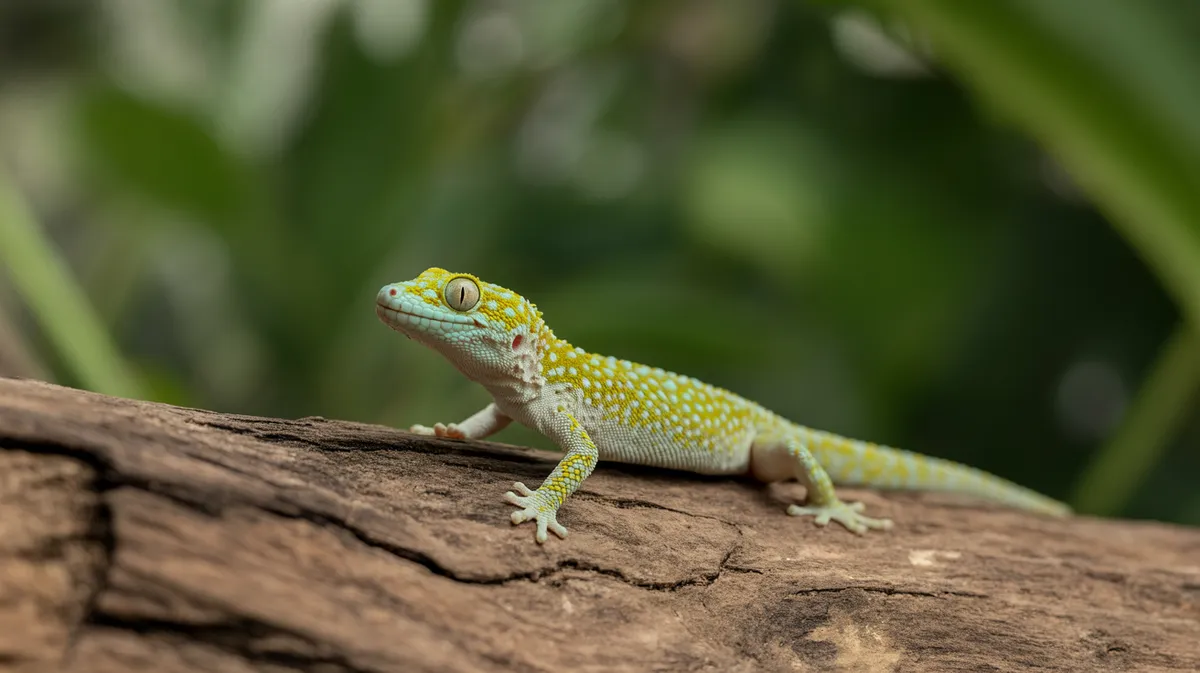
About the Tokay House Gecko
The Tokay House Gecko is a large, vibrantly colored gecko native to Southeast Asia and parts of the Indo-Australian Archipelago. Recognized for its striking blue-gray skin adorned with bright orange or red spots, the Tokay is one of the largest gecko species, often reaching lengths of up to 35 centimeters. It is primarily nocturnal, displaying territorial and aggressive behavior, especially among males. Known for its loud, distinctive 'to-kay' call, this gecko thrives in both wild and human-inhabited environments, taking refuge in trees, cliffs, and inside homes.
Fascinating facts
Vivid Coloration
Tokay geckos display a beautiful combination of blue-gray skin with bright orange or red spots, which helps camouflage them among tree bark and rocks.
Loud Calls
Males produce a distinctive, repetitive 'to-kay' call during mating season or to defend territory, making them one of the most vocal gecko species.
Climbing Ability
Specialized toe pads covered in microscopic setae allow Tokay geckos to effortlessly adhere to and climb smooth surfaces, including glass windows and walls.
Detailed description
The Tokay House Gecko (Gekko gecko) is among the largest gecko species, with adults typically measuring 30–35 cm in total length and weighing between 150–400 grams. Its robust body is covered in granular scales, with a striking blue-gray background color punctuated by vivid orange to red spots, providing effective camouflage among tree bark and rocky crevices. The head is large and triangular, featuring prominent eyes with vertical pupils adapted for nocturnal vision. Its digits are equipped with specialized adhesive pads composed of microscopic setae, enabling remarkable climbing abilities on smooth vertical surfaces and ceilings. Tokay geckos are primarily nocturnal and exhibit strong territoriality, particularly among males, who defend their domains with aggressive displays and loud vocalizations. Their powerful jaws can deliver a strong bite, used both in defense and subduing prey. The species is largely solitary outside of breeding, with individuals occupying overlapping but distinct home ranges. In the wild, they inhabit humid lowland forests, limestone cliffs, and caves, but have adapted well to anthropogenic environments, often residing in buildings and other structures. Their resilience and adaptability have contributed to their wide distribution across Southeast Asia and introduced populations in other regions.
Did you know?
The Tokay Gecko's vocalizations are so loud and unique that its name is an imitation of its call, which is often heard echoing through Southeast Asian villages at night.
Research & sources
Behaviour & social structure
Tokay geckos are highly territorial and solitary, with males aggressively defending their chosen territory through vocalizations, posturing, and, if necessary, physical combat. Their signature 'to-kay' call, repeated in a series of loud, resonant notes, serves both as a mating call and a territorial warning. They are crepuscular to nocturnal, emerging at dusk to hunt and patrol their territory. Their diet consists mainly of insects such as beetles, moths, and cockroaches, but they are opportunistic predators and will consume small vertebrates, including rodents, smaller reptiles, and occasionally other geckos. Tokays employ a sit-and-wait hunting strategy, remaining motionless before ambushing prey with a rapid lunge and powerful bite. During the day, they seek refuge in tree hollows, under bark, or within cracks in buildings. Social interactions are limited outside the breeding season, with encounters between adults often resulting in aggressive displays.
Reproduction & life cycle
Tokay geckos are oviparous, with breeding occurring year-round in tropical climates but peaking during the rainy season. Courtship involves the male approaching the female with a series of vocalizations and tactile signals, followed by copulation. Females lay clutches of 1–2 hard-shelled eggs, typically adhering them to hidden surfaces such as tree cavities, rock crevices, or building walls. The eggs are left unattended, but females may remain nearby for several days post-laying. Incubation lasts 60–200 days, depending on ambient temperature and humidity, with higher temperatures accelerating development. Hatchlings are fully independent at birth, measuring about 7–10 cm in length, and exhibit adult coloration and behavior. Sexual maturity is reached at 1–2 years of age. In captivity, some females have been observed to lay multiple clutches per year.
Adaptations & survival
Tokay geckos possess several notable adaptations, including expanded toe pads with microscopic setae that exploit van der Waals forces, allowing them to adhere to and move across smooth surfaces. Their cryptic coloration provides camouflage from predators and prey. The large, muscular jaws deliver a formidable bite, useful for subduing prey and deterring threats. Their eyes are adapted for low-light vision, with a high density of rod cells and a reflective tapetum lucidum. The gecko's skin can regenerate rapidly after injury, and they are capable of caudal autotomy—voluntarily shedding their tail to escape predators, with subsequent regeneration. Their vocalizations are among the loudest in geckos, serving as both a deterrent to rivals and an attractant to mates. Behavioral plasticity allows them to exploit a range of habitats, including urban environments.
Cultural significance
Tokay geckos hold significant cultural value in many Asian societies. In traditional Chinese and Southeast Asian medicine, dried geckos are believed to have medicinal properties, purportedly treating respiratory ailments and enhancing vitality, though these claims lack scientific support. Their distinctive call is often considered auspicious, and in some cultures, the number of 'to-kay' calls is thought to predict good fortune or the outcome of events. In folklore, they are sometimes seen as protectors of the home, while in others, their presence is associated with omens or supernatural beliefs. The trade in live and preserved geckos for medicinal and pet purposes is a major economic activity in some regions.
Recent research
Recent research has focused on the biomechanics of Tokay gecko adhesion, providing insights into the development of synthetic adhesives. Studies have also examined their vocal communication, revealing complex call structures used in social interactions. Genetic analyses are clarifying population structure and phylogeography, with evidence of cryptic diversity across their range. Conservation research highlights the impact of overexploitation and the need for sustainable management. Ongoing studies investigate their role as bioindicators in urban ecosystems and their interactions with invasive species. Advances in captive breeding have improved understanding of their reproductive biology and potential for ex situ conservation.
Sources
Gekko gecko (Tokay Gecko): Natural History, Ecology, and Conservation
Grismer, L.L. et al. (2021)
scientificGekko gecko: The IUCN Red List of Threatened Species 2019
IUCN SSC Amphibian Specialist Group
conservationGekko gecko (Tokay Gecko): Natural History, Ecology, and Conservation
Grismer, L.L. et al. (2021)
scientificGekko gecko: The IUCN Red List of Threatened Species 2019
IUCN SSC Amphibian Specialist Group
conservationVideos
Habitat
Tropical forests and human dwellings
 Global
Forest
Wooded areas with significant tree cover and diverse plant and animal communities.
 Tropical Regions
Rainforest
Dense, wet forests with the highest biodiversity on Earth, containing more than half of the world's plant and animal species.
 Elevated Terrain
Mountain
High-altitude environments with varying climates and specialized wildlife adapted to rugged terrain and thin air.
Conservation
The Tokay House Gecko is currently classified as Least Concern on the IUCN Red List.
Threats & challenges
Despite being classified as Least Concern by the IUCN, Tokay geckos face several localized threats. Overharvesting for the traditional medicine and pet trades has caused population declines in some regions, particularly in Indonesia and the Philippines. Habitat loss due to deforestation and urbanization also poses risks, though their adaptability to human environments mitigates some impacts. Invasive populations have been reported in Florida and several Pacific islands, where they may compete with native species. Disease transmission and predation by domestic animals (cats, dogs) are additional challenges in urban areas. Conservation efforts focus on regulating trade and protecting natural habitats, but illegal collection remains a concern.
Taxonomy
Scientific name
Gekko gecko
- Kingdom
- Animalia
- Phylum
- Chordata
- Class
- Reptilia
- Order
- Squamata
- Family
- Gekkonidae
- Genus
- Gekko
- Species
- gecko
Community notes
Share your observations about the Tokay House Gecko.
No community notes yet. Be the first!
Discover more wildlife
More fascinating animals from the encyclopedia.