
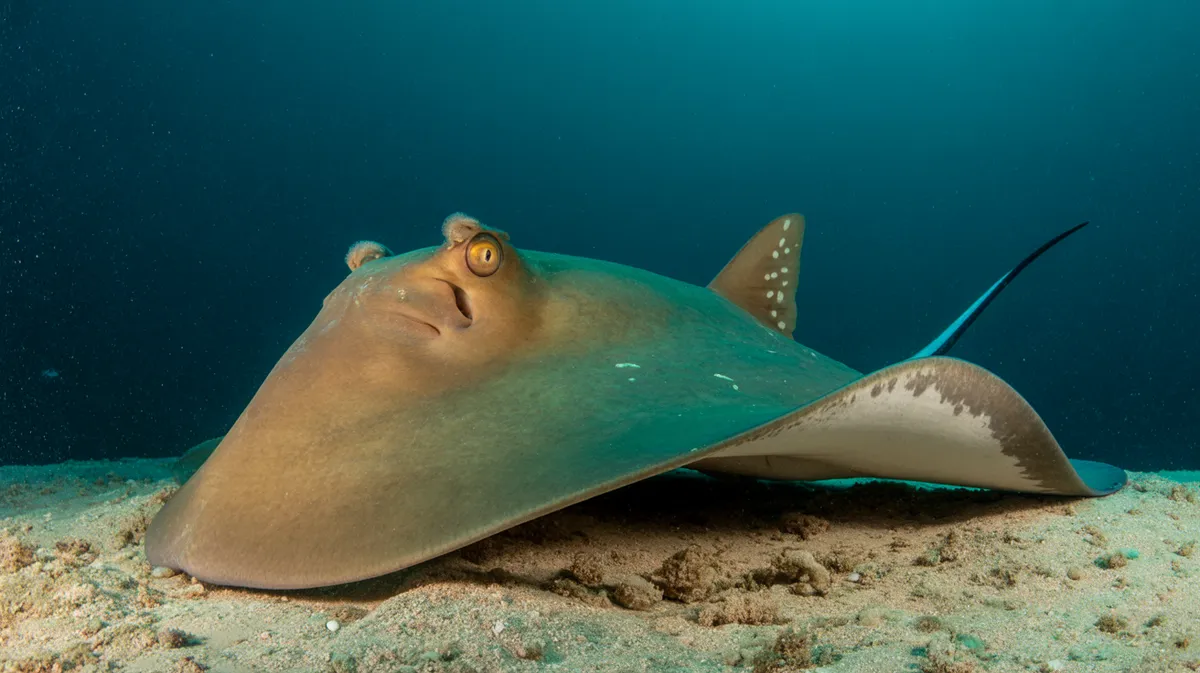
About the Torpedo Ray
Torpedo rays (genus Torpedo) generate electricity from a pair of kidney-shaped organs sitting either side of the head, built from stacked columns of modified muscle cells called electrocytes wired in series like the cells of a battery. The Atlantic torpedo, Torpedo nobiliana, can discharge around 220 volts, enough to knock a person over. The ray uses this to hunt: it drops onto a fish, wraps its disc around it, and fires a rapid train of pulses that overwhelms the prey's nervous system, and it also discharges defensively when disturbed. Torpedoes are slow, flabby, ambush-buried animals that could catch nothing without this weapon. Their historical importance is out of all proportion to their size. Roman physicians, notably Scribonius Largus in the first century AD, prescribed standing on a live torpedo to treat headache and gout, which makes this the earliest documented electrotherapy in medicine. Much later, the electric organ of Torpedo became one of the most consequential tissues in neuroscience: because it is essentially a solid block of nerve-muscle junctions, it provided the raw material from which the nicotinic acetylcholine receptor was first isolated and characterised in the 1970s, work that underpins the modern understanding of synapses and of diseases such as myasthenia gravis.
Fascinating facts
Electric Defense
Torpedo rays possess specialized electric organs that allow them to deliver powerful shocks to both predators and prey.
Hidden in Sand
These rays often bury themselves in the seabed, lying in wait to ambush prey or avoid threats.
Unique Hunting Method
Instead of chasing prey, torpedo rays use their electric discharge to immobilize fish and crustaceans before eating them.
Detailed description
The Torpedo Ray (Torpedo marmorata), commonly known as the marbled electric ray, is a robust cartilaginous fish reaching lengths of up to 100 cm, though most individuals are between 40 and 80 cm. Its body is distinctly rounded and dorsoventrally flattened, with large, disc-like pectoral fins that merge seamlessly with the head, giving it a circular outline. The dorsal surface is marbled brown with irregular dark blotches and spots, providing effective camouflage against sandy or muddy sea floors. The eyes are small and positioned dorsally, just ahead of the prominent spiracles. The mouth is relatively small, and the tail is short, ending in a well-developed caudal fin. Notably, Torpedo marmorata possesses a pair of kidney-shaped electric organs located on either side of the head, capable of generating electric discharges up to 200 volts. These organs are composed of specialized electrocytes arranged in columns, functioning as biological batteries. The species is primarily nocturnal, spending daylight hours partially buried in substrate. It is a solitary animal, rarely observed in groups, and exhibits slow, undulating swimming movements. Its diet consists mainly of benthic teleost fish, crustaceans, and occasionally cephalopods, which it incapacitates with electric shocks. Reproduction is ovoviviparous, with embryos developing inside the female and nourished by yolk sacs until birth. Torpedo rays are well-adapted to their demersal lifestyle, with sensory adaptations for detecting prey under low visibility conditions.
Did you know?
The name 'torpedo' comes from the Latin word for 'numbness' or 'paralysis,' referencing the numbing effect of its electric shock.
Research & sources
Wikipedia summary
The electric rays are a group of rays, flattened cartilaginous fish with enlarged pectoral fins, composing the order Torpediniformes. They are known for being capable of producing an electric discharge, ranging from 8 to 220 volts, depending on species, used to stun prey and for defense. There are 69 species in four families.
Behaviour & social structure
Torpedo marmorata is a predominantly solitary and nocturnal predator. During the day, it buries itself in sand or mud with only its eyes and spiracles exposed, minimizing detection by both predators and prey. At night, it becomes more active, patrolling the benthic zone in search of food. The ray uses electroreception to locate hidden prey, often ambushing small fish or invertebrates by lunging and enveloping them with its disc before delivering a high-voltage electric shock. This shock both stuns the prey and deters potential predators. Feeding is infrequent but opportunistic, with the ray capable of consuming relatively large prey items. Social interactions are minimal outside of the breeding season, and there is little evidence of territoriality or complex social structures. Torpedo rays are slow-moving and rely on stealth rather than speed, using their electric organs as their primary means of predation and defense.
Reproduction & life cycle
The marbled electric ray is ovoviviparous, meaning embryos develop inside eggs that remain within the mother's body until they are ready to hatch. Mating typically occurs in late spring to early summer, with males using their claspers to internally fertilize the female. Gestation lasts approximately 4 to 9 months, depending on water temperature and environmental conditions. Females give birth to litters of 5 to 32 pups, each measuring 10–14 cm at birth. There is no parental care post-birth; the young are fully independent and capable of producing electric shocks almost immediately. Breeding frequency is generally annual, but may vary with food availability and environmental stressors. Sexual maturity is reached at around 2–4 years of age, with females maturing slightly later and at a larger size than males.
Adaptations & survival
Torpedo marmorata exhibits several unique adaptations for its benthic, predatory lifestyle. The most notable are its paired electric organs, which can generate powerful electric discharges for both predation and defense. Its marbled coloration provides effective camouflage on heterogeneous substrates. The flattened body and large pectoral fins facilitate efficient movement along the sea floor and enable the ray to bury itself for concealment. Electroreceptors (ampullae of Lorenzini) on the snout allow detection of bioelectric fields produced by prey, even when buried. The spiracles, located behind the eyes, enable respiration while the animal is buried. The ray's slow metabolism and infrequent feeding are adaptations to an energy-conserving lifestyle in environments where prey may be patchily distributed.
Cultural significance
Historically, electric rays, including Torpedo marmorata, have held a place in Mediterranean folklore and early medicine. Ancient Greeks and Romans documented the use of electric shocks from these rays to treat ailments such as headaches and gout, a practice referenced in classical texts. The genus name 'Torpedo' is derived from the Latin word for numbness or paralysis, reflecting the ray's ability to induce temporary loss of sensation. While not a major figure in modern culture, the torpedo ray's unique electric abilities continue to inspire scientific research and public fascination.
Recent research
Recent research on Torpedo marmorata has focused on the physiology and molecular biology of its electric organs, which serve as a model for bioelectrogenesis and neurobiology. Studies have investigated the structure and function of electrocytes, as well as the genetic regulation of electric organ development. Ecological research has examined habitat preferences, movement patterns using acoustic telemetry, and the impact of environmental stressors on population dynamics. There is ongoing interest in the ray's role in benthic ecosystems as both predator and prey. Conservation studies are increasingly utilizing non-invasive survey techniques, such as environmental DNA (eDNA), to monitor populations and assess biodiversity in coastal habitats.
Videos
Habitat
Coastal marine environments, sandy and muddy bottoms

Conservation
The Torpedo Ray is currently classified as Least Concern on the IUCN Red List.
Threats & challenges
Currently classified as Least Concern by the IUCN, Torpedo marmorata faces localized threats from habitat degradation, coastal development, and bycatch in trawl and gillnet fisheries. Although not targeted commercially, its benthic habits make it susceptible to incidental capture. Pollution, especially in the Mediterranean, may impact reproductive success and larval survival. Population trends are generally stable, but data are limited in some regions. Climate change and associated shifts in sea temperature and substrate composition could pose future challenges to habitat suitability.
Taxonomy
Scientific name
Torpedo marmorata
- Kingdom
- Animalia
- Phylum
- Chordata
- Class
- Chondrichthyes
- Order
- Torpediniformes
- Family
- Torpedinidae
- Genus
- Torpedo
- Species
- marmorata
Community notes
Share your observations about the Torpedo Ray.
No community notes yet. Be the first!
Discover more wildlife
More fascinating animals from the encyclopedia.