
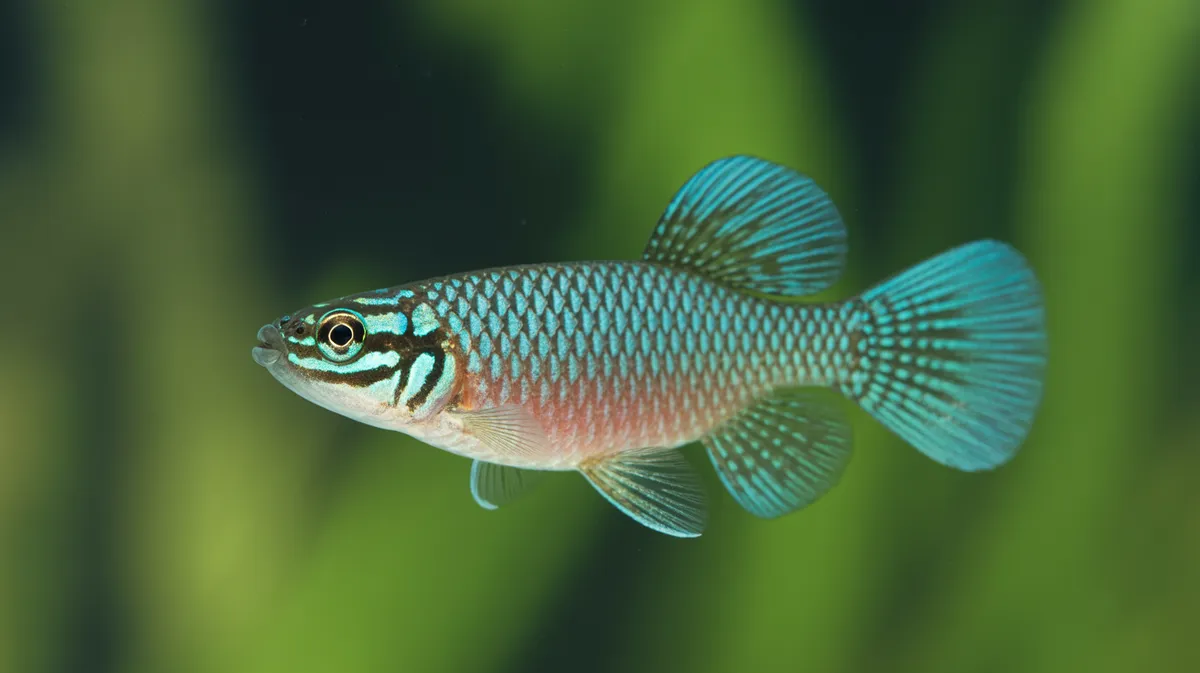
About the Turquoise Killifish
The turquoise killifish (Nothobranchius furzeri) is the shortest-lived vertebrate that can be bred in captivity, and it holds that record because of where it lives: ephemeral rain pools on the savannas of Mozambique and Zimbabwe that fill in the wet season and bake dry a few months later. Every fish in the pool dies when it dries. The species has therefore compressed a whole life into weeks. Fish hatch as the pool fills, reach sexual maturity in as little as 14 to 17 days, the fastest maturation of any known vertebrate, and spawn continuously thereafter, with a median lifespan in the wild populations of around four to six months and, in the driest populations, considerably less. The eggs are the durable stage. Laid in the mud, they enter one of several diapause states in which development halts, and they survive desiccation for months or years, hatching only when rain and the right chemical cues return; a pool can be reseeded from eggs laid years earlier. All this has made the fish an important laboratory model for ageing, because it goes through the entire suite of vertebrate senescence, including neurodegeneration, loss of fertility, cellular senescence and tumours, in a few months rather than the years a mouse takes.
Fascinating facts
Shortest Lifespan
The Turquoise Killifish has one of the shortest recorded lifespans among vertebrates, sometimes living less than three months in the wild.
Survival Strategy
Its eggs can survive in dry mud for months, only hatching when the seasonal rains refill the pools.
Model for Science
Scientists use the Turquoise Killifish as a model organism to study the genetics of aging and age-related diseases.
Detailed description
The Turquoise Killifish (Nothobranchius furzeri) is a diminutive annual fish, typically reaching 4–5 cm in length, with males exhibiting vivid turquoise, blue, and red coloration, while females are generally more subdued in hue. The body is laterally compressed with a rounded snout and a terminal mouth adapted for surface feeding. Fins are relatively short, with males displaying elongated dorsal and anal fins that are often edged in contrasting colors. This species is endemic to the ephemeral savannah pools of southeastern Mozambique and Zimbabwe, where it experiences extreme seasonal fluctuations in water availability. Turquoise Killifish are highly adapted to their unpredictable environment, with a life cycle synchronized to the wet and dry seasons. They display rapid growth, maturing sexually within just 3–4 weeks post-hatching, and can complete their entire life cycle in as little as 12 weeks. Their eggs are resistant to desiccation, entering diapause during the dry season and hatching only when rains return. Socially, males are territorial and display courtship behaviors to attract females, often engaging in brief but intense interactions. The species is a model organism in aging research due to its exceptionally short natural lifespan and well-characterized genome.
Did you know?
Despite their brief lifespan, Turquoise Killifish reach sexual maturity in just two to three weeks after hatching.
Research & sources
Behaviour & social structure
Turquoise Killifish are crepuscular, being most active during dawn and dusk when they forage for small invertebrates, insect larvae, and detritus. They exhibit opportunistic feeding behavior, consuming a variety of prey items depending on availability. Males are notably territorial, defending small patches of substrate where they attempt to court passing females. Aggressive displays, including fin flaring and chasing, are common among males, especially in confined habitats. Females tend to be more solitary, moving between territories to select mates. The species is generally not schooling but may aggregate loosely in favorable feeding areas. Daily routines are dictated by the availability of light and food, with periods of rest during the hottest parts of the day. In captivity, they display a high degree of curiosity and can recognize routine feeding times.
Reproduction & life cycle
Reproduction in Nothobranchius furzeri is tightly linked to the onset of the rainy season. Spawning occurs in shallow water, where females deposit eggs into the substrate, often burying them several centimeters deep. Mating involves a brief embrace, during which the male wraps around the female to fertilize the eggs as she deposits them. There is no parental care post-spawning; adults do not guard the eggs. Embryos enter diapause, a state of suspended development, which can last several months until environmental cues such as increased moisture and temperature trigger hatching. The species is capable of multiple spawning events over its short lifespan, with females laying dozens of eggs per session. Rapid sexual maturation allows for several generations within a single wet season if conditions permit.
Adaptations & survival
The Turquoise Killifish exhibits several remarkable adaptations for survival in ephemeral habitats. Its eggs are highly resistant to desiccation, capable of surviving months of drought in a dormant state. The species demonstrates rapid growth and early sexual maturity, allowing it to exploit the brief window of aquatic habitat availability. Physiologically, it has evolved efficient metabolic pathways to support accelerated aging and reproduction. Genomic studies have revealed unique genetic adaptations related to DNA repair, oxidative stress resistance, and hormonal regulation, all contributing to its short but intense life cycle. Behaviorally, territoriality and aggressive courtship increase reproductive success in crowded, resource-limited pools.
Cultural significance
While the Turquoise Killifish does not hold significant traditional or mythological importance in local cultures, it has gained international recognition as a model organism in scientific research, particularly in the fields of aging, genetics, and developmental biology. Its use in laboratories worldwide has contributed to advances in understanding vertebrate aging and lifespan regulation. In the aquarium hobby, it is prized for its vibrant coloration and unique life cycle, though its short lifespan makes it a species for dedicated enthusiasts.
Recent research
Nothobranchius furzeri is the subject of extensive research due to its status as the shortest-lived vertebrate in captivity, with a median lifespan of 4–6 months. It was the first annual fish to have its genome fully sequenced, providing insights into the genetic basis of aging and age-related diseases. Recent studies have explored its diapause mechanisms, telomere dynamics, and resistance to oxidative stress. The species is also used in drug screening for anti-aging compounds and in studies of vertebrate development. Ongoing research investigates how environmental factors influence lifespan plasticity and reproductive strategies. There is growing interest in its potential as a model for studying rapid evolution and adaptation to extreme environments.
Sources
The short-lived African turquoise killifish: an emerging experimental model for ageing
Valenzano, D.R., Terzibasi, E., Cellerino, A. (2006)
scientificNothobranchius furzeri: The IUCN Red List of Threatened Species 2019
IUCN SSC Freshwater Fish Specialist Group
conservationThe short-lived African turquoise killifish: an emerging vertebrate model for aging research
Valenzano, D.R., Terzibasi, E., Cellerino, A. (2011)
scientificNothobranchius furzeri: The IUCN Red List of Threatened Species 2019
Nagy, B. & Watters, B.
conservationVideos
Habitat
Temporary freshwater pools and seasonal ponds


Conservation
The Turquoise Killifish is currently classified as Vulnerable on the IUCN Red List.
Threats & challenges
Major threats to Nothobranchius furzeri include habitat loss due to agricultural expansion, water diversion, and climate change, which alter the frequency and duration of seasonal pools. Over-collection for the aquarium trade poses an additional risk, although captive breeding programs have mitigated some pressure. The species is listed as Vulnerable by the IUCN, with population declines observed in several localities. Habitat fragmentation and pollution further exacerbate conservation challenges. The highly specialized life history makes the species particularly sensitive to environmental changes, and local extinctions can occur if breeding sites are lost or altered.
Taxonomy
Scientific name
Nothobranchius furzeri
- Kingdom
- Animalia
- Phylum
- Chordata
- Class
- Actinopterygii
- Order
- Cyprinodontiformes
- Family
- Nothobranchiidae
- Genus
- Nothobranchius
- Species
- furzeri
Community notes
Share your observations about the Turquoise Killifish.
No community notes yet. Be the first!
Discover more wildlife
More fascinating animals from the encyclopedia.