
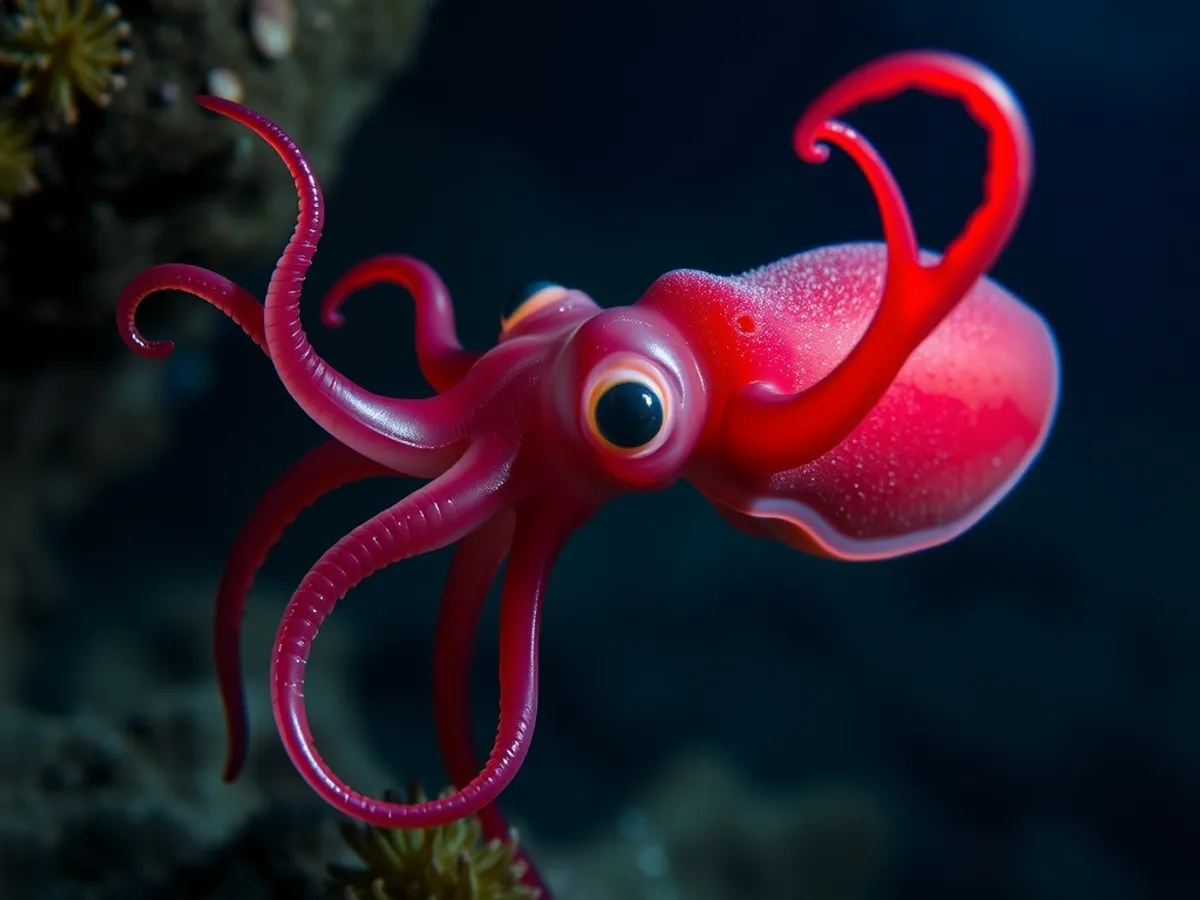
About the Vampire Squid
The vampire squid is neither a squid nor an octopus but the sole survivor of an order of its own, and it does not drink blood. It lives in the oxygen minimum zone, a deep layer where there is so little dissolved oxygen that almost nothing else can survive, and it persists there by doing almost nothing: it has the lowest metabolic rate of any cephalopod, drifts rather than swims, and has blood extraordinarily good at binding what little oxygen there is. It also eats what nothing else will. It extends two long, sticky retractile filaments into the water and collects marine snow — the drifting sediment of dead plankton, faecal pellets and mucus falling from the ocean above — then scrapes them clean and rolls the debris into a mucus ball. It has no ink, because ink is useless in the dark. Threatened, it inverts its webbed arms over its own body like a spiked cloak, and can eject a cloud of glowing bioluminescent mucus to blind and confuse a predator while it slips away.
Fascinating facts
Deep-Sea Dweller
Vampire squids inhabit depths from 600 to 1,200 meters, where oxygen levels are too low for most other animals.
Enormous Eyes
It has the largest eyes relative to body size of any known animal, helping it see in the darkness of its deep-sea habitat.
Bioluminescent Defense
Instead of ink, vampire squids release clouds of glowing mucus to startle and evade predators.
Detailed description
The vampire squid (Vampyroteuthis infernalis) is a small, gelatinous cephalopod reaching a maximum mantle length of about 28 cm, with a total body length up to 30 cm. Its body is soft and delicate, colored deep red to black, and is covered in light-producing photophores. The animal’s eight arms are connected by a cloak-like webbing, lined with fleshy, finger-like projections called cirri and rows of spiny projections, giving it a dramatic appearance when threatened. Unlike true squids or octopuses, the vampire squid possesses two long, retractile sensory filaments instead of feeding tentacles, a unique feature among cephalopods. Its eyes are proportionally the largest of any animal, up to 2.5 cm in diameter, optimized for detecting faint bioluminescence in the perpetual darkness of the deep sea. The vampire squid inhabits the oxygen minimum zone (OMZ) at depths of 600–1200 meters, where oxygen levels are as low as 3% saturation. Its metabolism is exceptionally low, enabling survival in these hypoxic conditions. The animal’s body is neutrally buoyant, allowing it to hover with minimal energy expenditure. It is a solitary species, rarely observed in groups, and displays little evidence of complex social behavior. Its reproductive strategy is unique among cephalopods, with females capable of multiple spawning events over their lifespan, a process known as iteroparity.
Did you know?
Despite its fearsome name, the vampire squid primarily feeds on 'marine snow'—a mixture of dead plankton, fecal matter, and organic debris.
Research & sources
Wikipedia summary
The vampire squid is a small cephalopod found throughout temperate and tropical oceans in extreme deep sea conditions. The vampire squid uses its bioluminescent organs and its unique oxygen metabolism to thrive in the parts of the ocean with the lowest concentrations of oxygen. It has two long retractile filaments, located between the first two pairs of arms on its dorsal side, which distinguish it from both octopuses and squids, and places it in its own order, Vampyromorphida, although its closest relatives are octopods. As a phylogenetic relict, it is the only known surviving member of its order.
Behaviour & social structure
Vampire squids are primarily detritivores, feeding on 'marine snow'—a mixture of organic debris, fecal pellets, and dead plankton that drifts down from upper ocean layers. They use their long, sticky filaments to capture these particles, retracting them and transferring the food to their mouth with the help of cirri and mucus secretions. Unlike most cephalopods, they do not actively hunt live prey. When threatened, vampire squids do not expel ink; instead, they eject a cloud of bioluminescent mucus containing thousands of glowing particles, which can startle or confuse predators. They also perform a defensive posture called 'pumpkin posture,' inverting their webbed arms over their body to display spiny cirri and photophores. Vampire squids are largely inactive, spending much of their time drifting or hovering motionless, conserving energy in the low-oxygen environment. Social interactions are minimal, as individuals are typically encountered alone.
Reproduction & life cycle
Vampire squids exhibit a unique reproductive strategy among cephalopods. Females produce relatively small batches of eggs (about 100–3,000 per batch) and are capable of multiple spawning events throughout their lifespan, which may last up to 8 years. Fertilization is internal; males transfer spermatophores to females using a modified arm (hectocotylus). After fertilization, the female broods the eggs by carrying them in her arms for several months until hatching. There is no parental care post-hatching; the planktonic hatchlings are miniature versions of adults, lacking the full development of filaments and photophores. Breeding does not appear to be seasonal, likely due to the stable conditions of the deep sea.
Adaptations & survival
The vampire squid is highly specialized for life in the deep sea OMZ. Its low metabolic rate and high-affinity hemocyanin allow it to extract oxygen efficiently from water with extremely low oxygen content. The gelatinous, neutrally buoyant body reduces energy expenditure for movement. The animal’s large eyes are adapted for maximizing light sensitivity, crucial for detecting bioluminescent signals. Bioluminescent photophores on the body and arm tips serve both as camouflage (counter-illumination) and as a defense mechanism. The retractile filaments, unique among cephalopods, are highly sensitive and adapted for passive feeding on detritus rather than active predation. The absence of ink sacs reflects the low predation pressure and the inefficacy of ink in the deep sea.
Cultural significance
The vampire squid’s dramatic appearance and evocative name have inspired fascination in popular culture, often depicted as a mysterious or monstrous deep-sea creature. Its scientific name, meaning 'vampire squid from hell,' reflects early misconceptions about its feeding habits. While it holds no direct significance in traditional folklore or as a resource, it is a subject of interest in documentaries, literature, and art, symbolizing the enigmatic nature of the deep ocean.
Recent research
Recent research has focused on the vampire squid’s unique adaptations to low-oxygen environments, including studies on its hemocyanin oxygen-binding properties and metabolic rates. Genomic analyses have clarified its phylogenetic position as a relict lineage, providing insights into cephalopod evolution. Ongoing studies investigate its reproductive biology, larval development, and the ecological role of detritivory in deep-sea food webs. Advances in remotely operated vehicle (ROV) technology have enabled more frequent in situ observations, revealing new aspects of its behavior and distribution.
Videos
Habitat
Deep ocean (Oxygen Minimum Zone)

Conservation
The Vampire Squid is currently classified as Least Concern on the IUCN Red List.
Threats & challenges
Currently, the vampire squid faces few direct threats due to its deep-sea habitat, which is largely inaccessible to humans and most predators. Its main natural predators include deep-diving fish, sea lions, and whales. Human impacts are minimal but may increase with expanding deep-sea fishing, mining, and climate change, which could alter OMZ boundaries and food availability. The species is classified as Least Concern by the IUCN, with stable population trends, but ongoing monitoring is recommended due to potential future threats from ocean deoxygenation and habitat disturbance.
Taxonomy
Scientific name
Vampyroteuthis infernalis
- Kingdom
- Animalia
- Phylum
- Mollusca
- Class
- Cephalopoda
- Order
- Vampyromorphida
- Family
- Vampyroteuthidae
- Genus
- Vampyroteuthis
- Species
- infernalis
Community notes
Share your observations about the Vampire Squid.
No community notes yet. Be the first!
Discover more wildlife
More fascinating animals from the encyclopedia.