
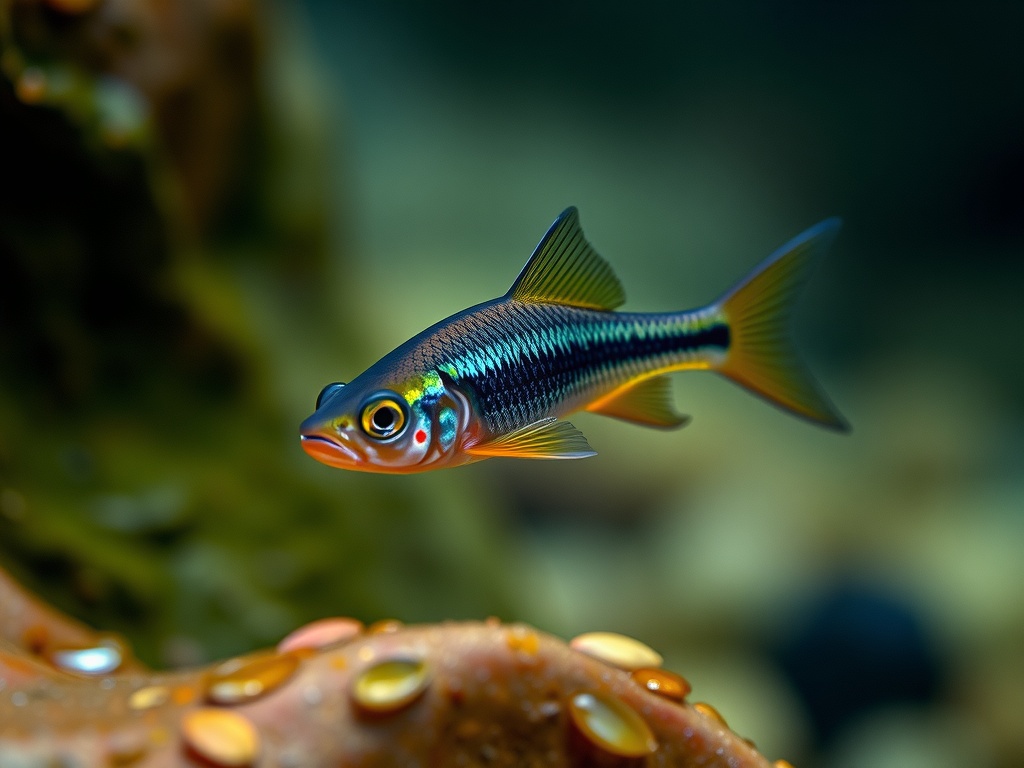
About the Vampire tetra
The vampire tetra or payara (Hydrolycus scomberoides and its relatives) is a silver, deep-bodied characin of the fast water and rapids of the Amazon and Orinoco, and it is armed with a pair of fangs on the lower jaw that can reach 10 to 15 centimetres in a large fish. Those teeth are far too long to fit inside a closed mouth, so the fish has evolved two holes, sheaths that run up through the upper jaw and into the roof of the skull, into which the fangs slot when the mouth shuts; a payara with its mouth closed looks almost normal. It hunts by charging into a shoal from below or behind at high speed and impaling a fish outright, then working it around to swallow head-first, and it is fond of piranhas, which makes it one of the few animals that eats them routinely. Adults may reach a metre and 15 kilograms or more. They favour turbulent, oxygen-rich rapids and the plunge pools below falls, where they sit in the current and ambush disoriented fish sweeping past. They are a prized game fish, and their power in the water and lethal-looking dentition give them a reputation out of proportion to any actual danger to people, of which there is essentially none.
Fascinating facts
Enormous Fangs
The vampire tetra's two lower fangs can reach up to 6 inches (15 cm) in length, making them proportionally among the largest teeth of any freshwater fish.
Fast-Flowing Hunter
Adapted to life in turbulent waters, the vampire tetra prefers rapids and strong currents, where it uses its speed to ambush prey.
Sport Fishing Favorite
Its strength and leaping ability make the vampire tetra a popular but challenging target for sport fishermen in South America.
Detailed description
The vampire tetra (Hydrolycus scomberoides) is a large, predatory characin fish distinguished by its highly elongated lower jaw fangs, which can reach up to 15 cm (6 inches) in length and are among the longest relative to body size in any freshwater fish. Adults typically measure 30–50 cm (12–20 inches) in length, though some individuals can exceed 75 cm (30 inches) and weigh up to 5 kg (11 lbs). The body is laterally compressed and covered in small, silvery cycloid scales, with a pronounced forked caudal fin and a streamlined profile optimized for speed and maneuverability in turbulent river currents. The head is robust, with large, forward-facing eyes adapted for detecting movement in low-light, murky waters. The fangs fit into specialized sockets in the upper jaw, allowing the mouth to close completely despite their length. Internally, the vampire tetra possesses a powerful musculature and a large, expandable stomach to accommodate sizable prey. This species is primarily piscivorous, using its fangs to impale and grasp slippery fish, which it swallows headfirst. While generally solitary, individuals may aggregate loosely in areas of abundant prey. The vampire tetra is a fast-growing species with a relatively short lifespan of 2–4 years in the wild. Its predatory dominance and unique anatomical features make it a keystone species in its native riverine ecosystems.
Did you know?
The vampire tetra’s lower fangs can grow so long they extend past its jaw, earning it a reputation as one of the most intimidating freshwater fish in the world.
Research & sources
Behaviour & social structure
Vampire tetras are diurnal hunters, most active during dawn and dusk (crepuscular periods) when prey fish are abundant and visibility is reduced. They rely on rapid bursts of speed and acute vision to ambush prey, often lying in wait among submerged structures or swift currents. Their hunting strategy involves impaling prey with their fangs, then quickly repositioning to swallow the fish whole. Socially, Hydrolycus scomberoides are largely solitary, though juveniles may form small, loose shoals for increased protection. Adults are territorial and may display aggressive behaviors towards conspecifics, especially during feeding. They are known for their powerful leaps and acrobatic movements, both in the wild and when hooked by anglers. Rest periods are brief, as the fish must constantly swim to maintain position in fast-flowing waters and ensure adequate oxygenation.
Reproduction & life cycle
Reproductive activity in vampire tetras is closely tied to seasonal flooding (the 'flood pulse') in the Amazon and Orinoco basins, typically occurring at the onset of the rainy season (November to March). Spawning is believed to be pelagic, with eggs and sperm released directly into the water column. Females are highly fecund, producing thousands of small, buoyant eggs that drift downstream and settle in floodplain habitats. There is no parental care; larvae are planktonic and rely on rapid growth to avoid predation. Sexual maturity is reached within 1–2 years, depending on environmental conditions and food availability. Detailed studies on courtship or spawning behaviors are limited due to the species' elusive nature and the challenges of observing them in the wild.
Adaptations & survival
Hydrolycus scomberoides exhibits several remarkable adaptations for predation in fast-flowing rivers. Its elongated fangs are specialized for impaling and securing slippery prey, while the sockets in the upper jaw prevent self-injury and allow for a full range of mouth movement. The streamlined body and deeply forked tail enhance swimming speed and agility, crucial for both chasing prey and evading larger predators. Large eyes provide enhanced visual acuity in turbid waters, and the lateral line system is highly developed for detecting vibrations and movement. Physiologically, the species has adapted to high-oxygen, turbulent environments, with efficient gill structures and a high metabolic rate. Behaviorally, its crepuscular activity reduces competition and predation risk.
Cultural significance
The vampire tetra holds a prominent place in local folklore, often regarded with awe due to its fearsome appearance and predatory prowess. It is sometimes referred to as the 'water wolf' or 'sabre-toothed fish' in regional languages. While not traditionally targeted for food due to its bony structure, it is highly prized by sport anglers for its fighting ability and is occasionally featured in public aquaria, though its large size and aggressive nature make it challenging to keep. The species has gained international notoriety through documentaries and media, contributing to its mystique as one of the Amazon's most formidable freshwater predators.
Recent research
Recent research has focused on the biomechanics of the vampire tetra's jaw and fang structure, revealing unique evolutionary adaptations for rapid prey capture and handling. Studies using high-speed videography have documented the precise mechanics of fang deployment and prey impalement. Genetic analyses are underway to clarify the relationships within the Hydrolycus genus and to assess population structure across different river systems. Ecological studies highlight the species' role as an apex predator and its influence on fish community dynamics. Ongoing research also examines the impacts of habitat alteration and climate change on reproductive cycles and distribution.
Videos
Habitat
Fast-flowing freshwater rivers

Conservation
The Vampire tetra is currently classified as Least Concern on the IUCN Red List.
Threats & challenges
Currently listed as Least Concern by the IUCN, the vampire tetra faces localized threats from habitat degradation, dam construction, and overfishing, particularly for the ornamental fish trade and recreational angling. River fragmentation and altered flow regimes can disrupt spawning migrations and reduce prey availability. Pollution from mining and agriculture also poses risks to water quality and fish health. While populations remain stable in much of their range, ongoing monitoring is needed due to increasing anthropogenic pressures in the Amazon and Orinoco basins.
Taxonomy
Scientific name
Hydrolycus scomberoides
- Kingdom
- Animalia
- Phylum
- Chordata
- Class
- Actinopterygii
- Order
- Characiformes
- Family
- Cynodontidae
- Genus
- Hydrolycus
- Species
- scomberoides
Community notes
Share your observations about the Vampire tetra.
No community notes yet. Be the first!
Discover more wildlife
More fascinating animals from the encyclopedia.