
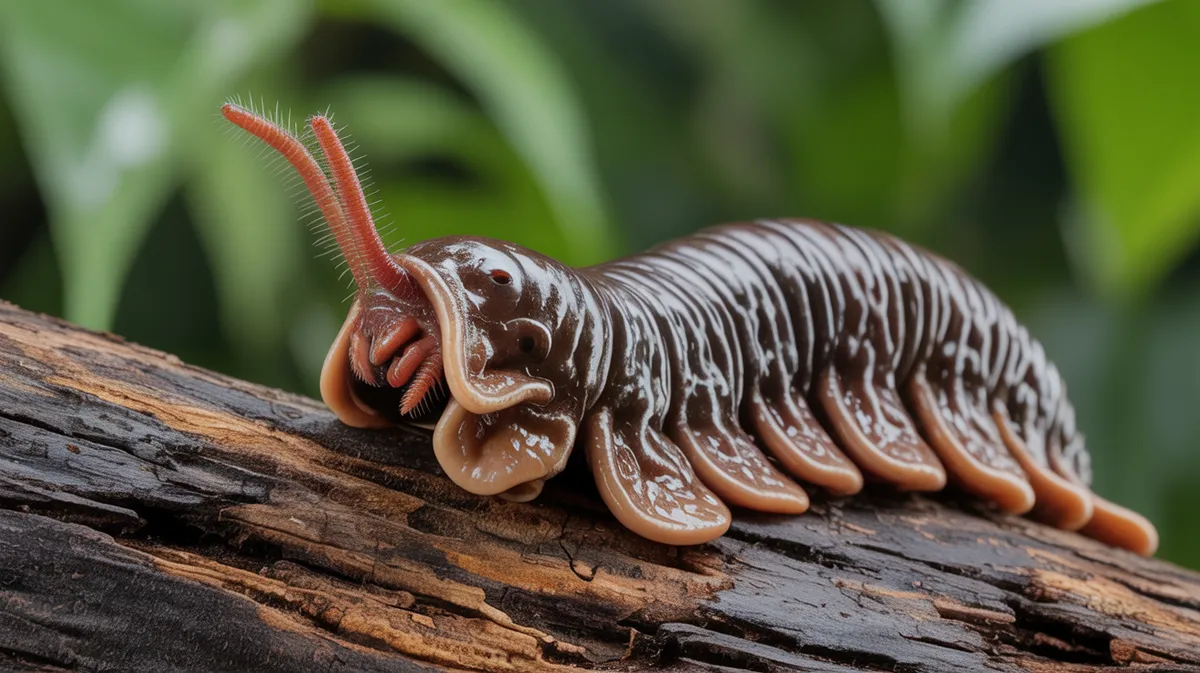
About the Velvet Worm
Velvet worms (phylum Onychophora) are soft, caterpillar-like predators of damp tropical and temperate forest litter, and they are their own phylum, sister to the arthropods, with a body plan that has changed little since the Cambrian. They hunt with glue. A pair of oral papillae either side of the head fire jets of adhesive slime up to 40 centimetres, and the jets oscillate rapidly from side to side, laying down a net over the prey. The oscillation is not muscular: a 2015 study showed the nozzles are flexible tubes driven past a critical flow rate, at which the elastic tube itself becomes unstable and whips back and forth, so the animal simply squeezes and physics does the aiming. The slime hardens on contact, and the velvet worm then bites through the immobilised prey, injects saliva to digest it, and drinks it out; it also eats its own dried slime, recycling the protein. Locomotion is hydrostatic, on stubby unjointed legs tipped with claws, and the animal moves in a smooth, unhurried glide. Some species bear live young nourished by a true placenta. Australian Euperipatoides live in social groups of a dozen or more with a dominant female, hunt together, and feed in a strict hierarchy in which the matriarch eats first.
Fascinating facts
Living Fossil
Velvet worms are considered living fossils, with ancestors dating back over 500 million years.
Slime Attack
They immobilize prey by squirting a rapid-hardening slime from glands near their head.
Hidden Dwellers
These elusive creatures spend their lives hidden in moist, decaying wood and leaf litter to avoid drying out.
Detailed description
Peripatus juliformis, a representative of the velvet worms (phylum Onychophora), is a soft-bodied, elongate invertebrate measuring typically 4–7 cm in length, though some individuals may reach up to 15 cm. Its body is cylindrical and covered in a fine, velvety cuticle composed of tiny papillae, which help retain moisture and provide a distinctive tactile sensation. The animal possesses 22–43 pairs of unjointed, lobopodous legs, each ending in a pair of claws, facilitating movement through complex substrates like leaf litter and decaying wood. The head bears a pair of simple eyes, antennae for tactile and chemical sensing, and specialized oral papillae used for ejecting adhesive slime. Internally, velvet worms have a hydrostatic skeleton, a simple circulatory system with a tubular heart, and tracheal tubes for respiration. They are nocturnal ambush predators, relying on stealth and their slime glands to subdue prey. Social interactions are generally limited, though some species exhibit hierarchical feeding behavior. P. juliformis is viviparous, with females giving birth to live young after internal gestation. This species is considered a living fossil, retaining many primitive features that illuminate the evolutionary transition from annelid-like ancestors to arthropods.
Did you know?
Peripatus and other velvet worms are among the few animals that have changed very little since the Cambrian period, making them important for studying evolutionary biology.
Research & sources
Wikipedia summary
Onychophora, commonly known as velvet worms or more ambiguously as peripatus, is a phylum of elongate, soft-bodied, many-legged animals. In appearance they have variously been compared to worms with legs, caterpillars, and slugs. They prey upon other invertebrates, which they catch by ejecting an adhesive slime. Approximately 200 species of velvet worms have been described, although the true number is likely to be much greater.
Behaviour & social structure
Velvet worms are primarily nocturnal, remaining hidden during the day to avoid desiccation and predation. At night, they emerge to hunt, using their sensitive antennae to detect vibrations and chemical cues from potential prey. When prey such as termites, small insects, or other arthropods are located, P. juliformis ejects twin streams of proteinaceous adhesive from oral papillae, entangling and immobilizing the victim. The worm then uses its jaws to pierce the exoskeleton and inject digestive enzymes, liquefying the prey's tissues for ingestion. Feeding is typically solitary, but in some species, larger individuals may dominate access to food. Velvet worms are slow-moving and rely on stealth rather than speed. They exhibit thigmotactic behavior, preferring to remain in close contact with moist surfaces and crevices. Social interactions are minimal, though some evidence suggests limited intraspecific competition and, rarely, communal sheltering.
Reproduction & life cycle
Peripatus juliformis is viviparous, with internal fertilization. Mating involves the transfer of spermatophores (sperm packets) from the male to the female, often placed on the female's body surface, where sperm penetrate the cuticle and migrate to the ovaries. Females have a gestation period ranging from several months up to a year, depending on environmental conditions. Embryos develop within the uterus, nourished by a placental-like structure unique among invertebrates. Females give birth to fully formed, miniature velvet worms, typically producing 5–15 offspring per reproductive event. There is no parental care post-birth; juveniles are independent and must fend for themselves immediately. Breeding may occur year-round in stable tropical environments, but reproductive rates are generally low, contributing to population vulnerability.
Adaptations & survival
Velvet worms possess several remarkable adaptations for survival in humid, terrestrial habitats. Their cuticle is hydrophobic and covered with papillae, minimizing water loss. The tracheal respiratory system allows efficient gas exchange while reducing desiccation risk. The unique slime glands, capable of rapidly ejecting adhesive up to 30 cm, are highly effective for prey capture and defense. Their unjointed, hydrostatic legs provide flexibility and traction in cluttered microhabitats. Chemosensory and tactile antennae enable navigation and prey detection in low-light environments. The viviparous reproductive strategy ensures offspring are born into favorable conditions, increasing juvenile survival. Evolutionarily, velvet worms bridge key morphological and developmental traits between annelids and arthropods, such as segmentation and the presence of a hemocoel.
Cultural significance
Velvet worms have intrigued scientists and naturalists since their discovery, often cited as 'living fossils' and evolutionary missing links. In some cultures, they have been used in traditional medicine, though such uses are rare and poorly documented. Their unique appearance and predatory behavior have inspired popular media, including documentaries and science fiction. In scientific circles, velvet worms symbolize evolutionary innovation and are frequently featured in educational materials about animal diversity and the history of life. They are not known to have significant roles in folklore or mythology.
Recent research
Recent research on Peripatus juliformis and related species has focused on the molecular composition and biomechanics of their adhesive slime, revealing a complex mixture of proteins and polysaccharides with potential biomimetic applications. Genomic studies have provided insights into the evolutionary relationships between Onychophora, arthropods, and tardigrades, supporting the Panarthropoda clade. Developmental biology research has explored segmentation and limb formation, shedding light on the origins of arthropod body plans. Conservation genetics is an emerging field, aiming to assess genetic diversity and inform management strategies. Ongoing studies are investigating the impacts of climate change and habitat fragmentation on population viability. Velvet worms continue to serve as model organisms for understanding evolutionary stasis and innovation.
Videos
Habitat
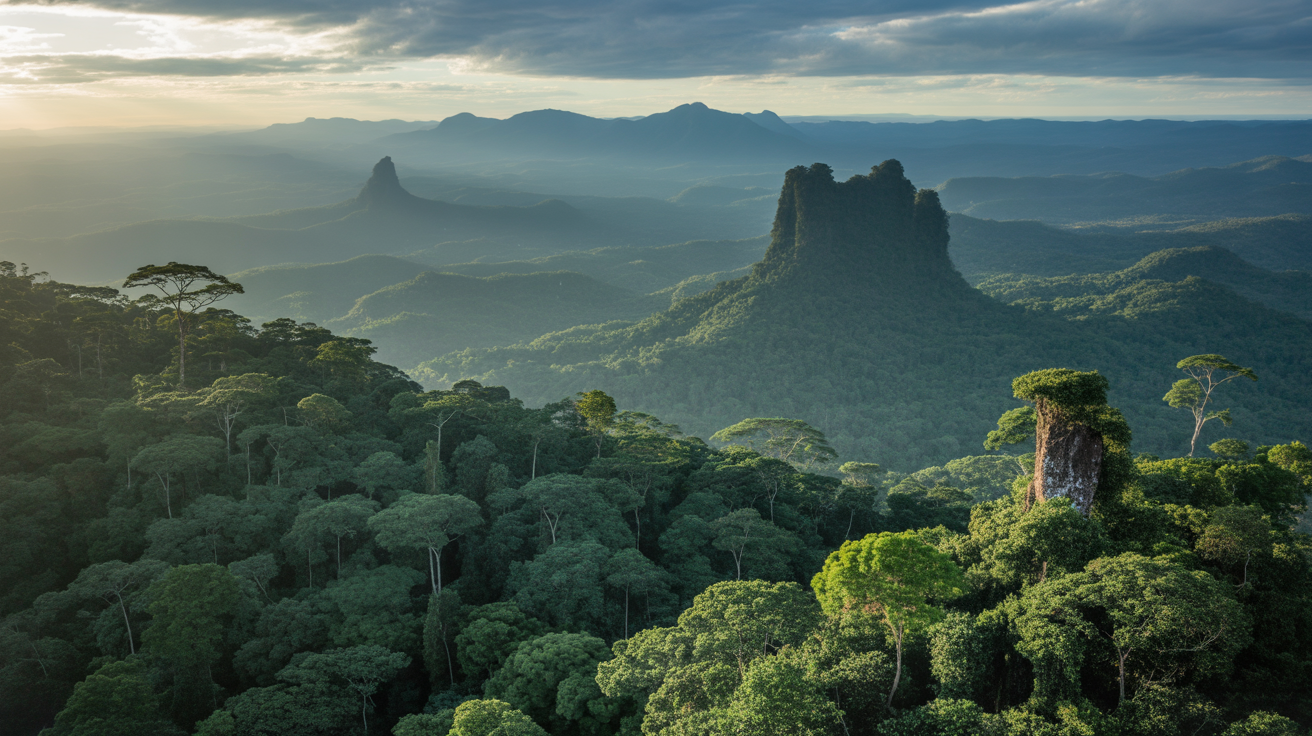
Tropical rainforest leaf litter and rotting logs

Conservation
The Velvet Worm is currently classified as Near Threatened on the IUCN Red List.
Threats & challenges
Peripatus juliformis faces significant threats from habitat destruction, particularly deforestation and land conversion in tropical regions. Their dependence on moist, undisturbed microhabitats makes them highly sensitive to changes in humidity and temperature. Pollution, pesticide use, and the introduction of invasive species further threaten populations. Due to their cryptic lifestyle and low reproductive rates, population declines can go unnoticed until local extinctions occur. Climate change poses an additional risk by altering rainfall patterns and increasing drought frequency. Conservation challenges include limited public awareness, difficulty in surveying populations, and a lack of comprehensive legal protection. The IUCN currently lists many velvet worm species as Near Threatened or Data Deficient due to insufficient data.
Taxonomy
Scientific name
Peripatus juliformis
- Kingdom
- Animalia
- Phylum
- Onychophora
- Class
- Udeonychophora
- Order
- Euonychophora
- Family
- Peripatidae
- Genus
- Peripatus
- Species
- juliformis
Community notes
Share your observations about the Velvet Worm.
No community notes yet. Be the first!
Discover more wildlife
More fascinating animals from the encyclopedia.