
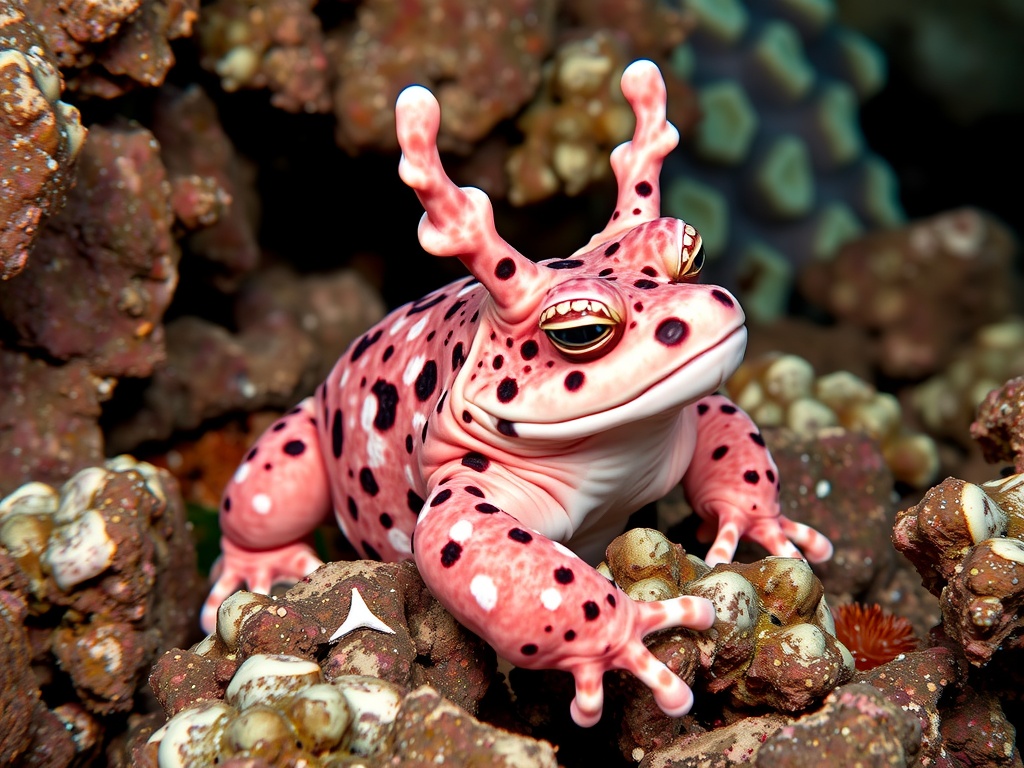
About the Warty Frogfish
The warty frogfish, also known as the clown frogfish, is a small, benthic marine fish renowned for its globular, warty appearance and remarkable camouflage abilities. It can change its color and pattern to blend seamlessly with its surroundings, mimicking sponges or coral. This ambush predator uses a specialized lure, called an esca, on its head to attract prey close enough to be snatched up in an instant. Warty frogfish are found in shallow tropical waters of the Indo-Pacific region, often among coral reefs and rocky substrates.
Fascinating facts
Lures Prey
The warty frogfish has a fleshy lure (esca) on its head that it wiggles to attract unsuspecting prey.
Walks on Fins
Instead of swimming, this fish uses its pectoral fins to 'walk' along the ocean floor.
Color Changing
It can alter its body color and pattern over time for better camouflage among corals and sponges.
Detailed description
The warty frogfish (Antennarius maculatus) is a small, laterally compressed anglerfish, typically reaching 7–15 cm in length, with a maximum recorded size of about 15 cm. Its globular body is covered in wart-like protuberances and variable skin appendages, aiding in camouflage among sponges and corals. The skin coloration is highly variable, ranging from white, yellow, orange, red, to brown, often with contrasting spots or blotches, and individuals can change color over days or weeks to match their environment. The first dorsal spine is modified into an illicium (fishing rod) tipped with a fleshy esca (lure) that mimics the appearance of small prey, such as worms or shrimp. The mouth is capacious and upturned, capable of rapidly expanding to engulf prey nearly as large as the frogfish itself. The pectoral and pelvic fins are limb-like, allowing the fish to 'walk' or clamber across the substrate rather than swim. Warty frogfish are solitary and highly sedentary, relying on ambush predation. Their eyes are small and well-camouflaged, and they possess a unique gill opening behind the pectoral fin, reducing movement that might betray their presence. They inhabit shallow tropical marine waters, typically at depths of 1–20 meters, favoring coral reefs, rubble zones, and occasionally artificial structures.
Did you know?
The warty frogfish can change its color and pattern in a matter of weeks to match its environment, making it a master of disguise in the animal kingdom.
Research & sources
Behaviour & social structure
Warty frogfish are predominantly solitary and territorial, rarely interacting with conspecifics outside of breeding. They are ambush predators, remaining motionless for extended periods while using their illicium to attract prey, which includes small fish, crustaceans, and occasionally other frogfish. Prey is captured with an extremely rapid strike, with mouth expansion and suction occurring in as little as 6 milliseconds. They are primarily diurnal but may hunt opportunistically at any time. Locomotion is mostly by 'walking' on pectoral and pelvic fins, though they can swim short distances using jet propulsion by expelling water through their gill openings. Warty frogfish exhibit site fidelity, often remaining in a small home range unless disturbed. They are known for occasional cannibalism, particularly when food is scarce or during encounters with smaller conspecifics.
Reproduction & life cycle
Reproduction in Antennarius maculatus is oviparous, with external fertilization. Spawning typically occurs during warmer months, though precise seasonality varies by region. Courtship involves a male following a gravid female, often for several hours. At spawning, the female releases a gelatinous egg raft containing up to 180,000 eggs, which floats in the water column. The male fertilizes the eggs externally. After spawning, adults separate, and there is no parental care. The eggs hatch in 2–5 days, releasing planktonic larvae that drift with currents for several weeks before settling to the benthos and metamorphosing into juvenile frogfish. High larval mortality is common, with survival dependent on suitable habitat availability.
Adaptations & survival
Key adaptations of the warty frogfish include extreme camouflage, both in coloration and body texture, allowing it to blend seamlessly with sponges, corals, and algae. The illicium and esca serve as a specialized predatory adaptation, enabling aggressive mimicry to attract prey. Their capacious mouth and rapid strike mechanism allow them to capture large, agile prey. Modified pectoral and pelvic fins facilitate benthic locomotion and stability on uneven substrates. The reduced gill opening minimizes visible movement, further aiding stealth. Their ability to change color and pattern is mediated by chromatophores in the skin, providing dynamic camouflage. Some individuals have been observed to mimic toxic or unpalatable species, offering additional protection from predators.
Cultural significance
The warty frogfish is not a major figure in folklore or traditional culture, but it is popular among underwater photographers and divers due to its bizarre appearance and remarkable camouflage. In some regions, it is collected for the marine aquarium trade, prized for its unique morphology and coloration. The species is occasionally featured in educational and documentary media as an example of extreme adaptation and mimicry in marine fishes. There are no known traditional uses or significant symbolic associations.
Recent research
Recent research has focused on the biomechanics of the frogfish's feeding strike, revealing it as one of the fastest vertebrate feeding mechanisms. Studies on chromatophore function have provided insights into rapid color change and camouflage. Ongoing genetic analyses are clarifying relationships within the Antennariidae family and population connectivity across the Indo-Pacific. Ecological studies are examining the species' role in reef food webs and its response to habitat changes. There is growing interest in the impact of the aquarium trade on wild populations, though current evidence suggests minimal impact. The species is also used as a model for studying aggressive mimicry and evolutionary adaptation in benthic fishes.
Videos
Habitat
Coral reefs and coastal rocky areas in tropical marine waters

Conservation
The Warty Frogfish is currently classified as Least Concern on the IUCN Red List.
Threats & challenges
Currently classified as Least Concern by the IUCN, the warty frogfish faces localized threats from habitat degradation, particularly coral reef destruction due to climate change, ocean acidification, and coastal development. Collection for the aquarium trade poses a minor threat in some regions, though populations appear stable overall. Pollution, sedimentation, and destructive fishing practices (such as blast fishing) can reduce suitable habitat. The species' dependence on healthy reef systems makes it vulnerable to ongoing coral decline. No significant population declines have been documented, but continued monitoring is recommended.
Taxonomy
Scientific name
Antennarius maculatus
- Kingdom
- Animalia
- Phylum
- Chordata
- Class
- Actinopterygii
- Order
- Lophiiformes
- Family
- Antennariidae
- Genus
- Antennarius
- Species
- maculatus
Community notes
Share your observations about the Warty Frogfish.
No community notes yet. Be the first!
Discover more wildlife
More fascinating animals from the encyclopedia.