
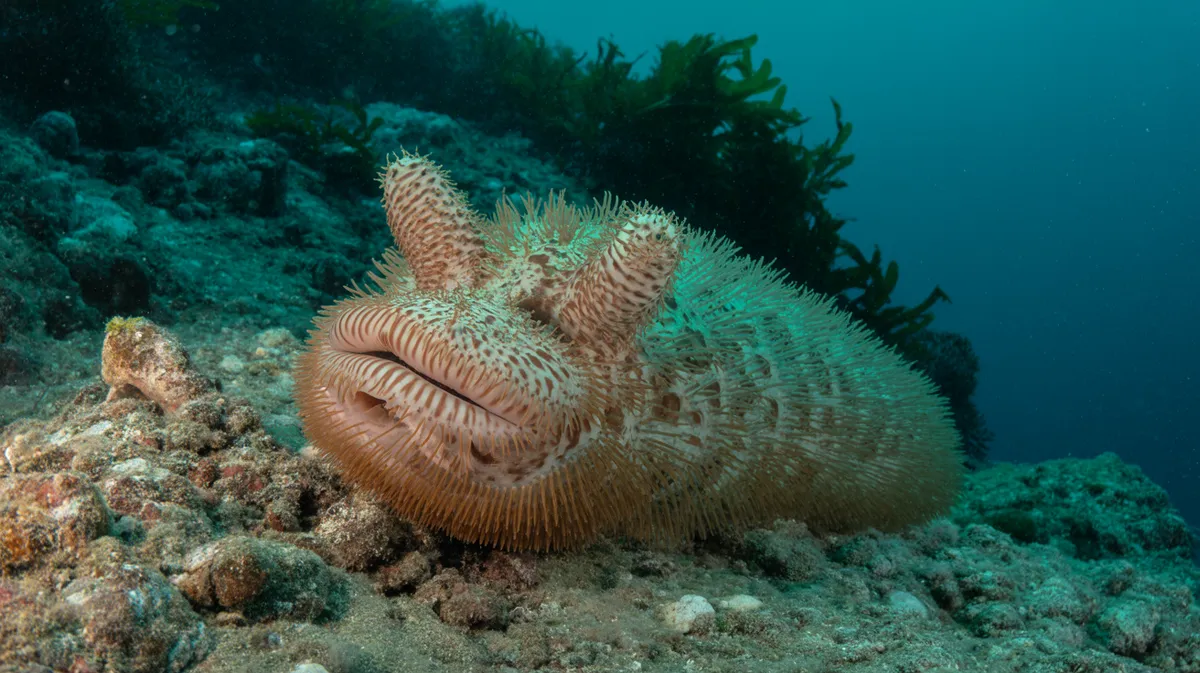
About the Warty Sea Cucumber
The sea cucumber's principal defence is to throw its own internal organs at whatever is attacking it. Under serious threat it will violently expel part of its gut — and in some species a mass of sticky, thread-like tubules — through the anus or a rupture in the body wall, leaving the predator entangled in a repellent, adhesive mess while the animal crawls away and regenerates the lost organs over the following weeks. Its body is stranger still. It is held together by catch collagen, a mutable connective tissue whose stiffness is under nervous control, so the animal can go from firm to nearly liquid at will — pouring itself through a crack barely wider than a coin and then setting solid again on the other side. It has no brain. It feeds by processing sediment, swallowing sand, stripping the organic matter and excreting the rest cleaned, which makes it one of the great recyclers of the seabed and a genuine force in keeping reef sediments healthy.
Fascinating facts
Ecosystem Cleaners
They help maintain healthy ocean environments by consuming decaying organic matter and recycling nutrients.
Unusual Defense
When threatened, they can eject sticky filaments that entangle and deter predators.
Regenerative Powers
Warty Sea Cucumbers can regenerate lost body parts, including internal organs, over several weeks.
Detailed description
The Warty Sea Cucumber (Apostichopus parvimensis) is a medium-sized holothuroid echinoderm, typically reaching lengths of 10–20 cm, though some individuals may grow larger. Its body is cylindrical and flexible, with a leathery skin densely covered in prominent, wart-like papillae that serve as both camouflage and a deterrent to predators. The coloration ranges from mottled brown to olive or gray, often matching the substrate of rocky reefs and kelp forests where it resides. The mouth, located at one end of the body, is surrounded by 20 short, branched feeding tentacles adapted for sifting through sediment. Internally, the Warty Sea Cucumber possesses a unique water vascular system and a mutable collagenous tissue, allowing it to alter body rigidity in response to environmental conditions or threats. It is primarily nocturnal, emerging at night to feed and retreating into crevices during the day. Unlike some sea cucumbers, A. parvimensis is solitary and does not form dense aggregations. It plays a crucial ecological role as a bioturbator, processing organic detritus and contributing to nutrient cycling on the seafloor. The species is capable of evisceration, expelling its internal organs as a defense mechanism, which are later regenerated—a remarkable adaptation among echinoderms.
Did you know?
Warty Sea Cucumbers breathe through their anus, using a unique respiratory tree structure to extract oxygen from the water.
Research & sources
Behaviour & social structure
Apostichopus parvimensis exhibits slow, deliberate locomotion using tube feet located on its ventral surface, aided by subtle contractions of its body wall. It is a deposit feeder, extending its branched oral tentacles to collect detritus, microalgae, and organic particles from the substrate. Feeding typically occurs at night, reducing predation risk from diurnal fish and invertebrates. The species is generally solitary, with limited social interaction outside of breeding periods. When threatened, it may contract its body, secrete toxic saponins, or eviscerate internal organs to deter predators. During daylight hours, individuals seek shelter under rocks or within crevices, minimizing exposure. Seasonal changes in temperature and food availability can influence activity levels and distribution within their habitat.
Reproduction & life cycle
Reproduction in the Warty Sea Cucumber is primarily sexual and involves external fertilization. Spawning typically occurs in late spring to early summer, often synchronized with lunar cycles and water temperature increases. Males and females release gametes into the water column, where fertilization takes place. The resulting planktonic larvae, known as auricularia, drift with currents for several weeks before settling to the substrate and metamorphosing into juvenile cucumbers. There is no parental care post-fertilization. Some evidence suggests that environmental cues such as photoperiod and phytoplankton blooms may trigger mass spawning events. A. parvimensis is capable of asexual reproduction via transverse fission, though this is less common than sexual reproduction.
Adaptations & survival
Apostichopus parvimensis possesses several adaptations for survival in dynamic coastal environments. Its thick, warty skin provides camouflage and physical protection, while the secretion of saponins (holothurin toxins) deters most predators. The mutable collagenous tissue allows rapid changes in body firmness, enabling the animal to wedge into tight spaces or escape predation. Evisceration, followed by regeneration of lost organs, is a dramatic defensive adaptation. The branched feeding tentacles are highly sensitive and efficient at capturing fine organic particles. The species’ nocturnal habits reduce predation risk, and its ability to tolerate a range of salinities and temperatures allows it to inhabit diverse microhabitats within the intertidal and subtidal zones.
Cultural significance
The Warty Sea Cucumber has limited direct cultural significance in North America, as it is not a major target for fisheries or traditional medicine. However, sea cucumbers in general are valued in many Asian cultures for their culinary and purported medicinal properties. While A. parvimensis is not widely harvested, its ecological role in maintaining healthy benthic environments indirectly supports fisheries and coastal communities. In marine education and ecotourism, it serves as an example of unique echinoderm adaptations and the importance of detritivores in ecosystem functioning.
Recent research
Recent research on Apostichopus parvimensis has focused on its ecological role in sediment bioturbation and nutrient cycling, highlighting its importance in maintaining healthy benthic communities. Studies have examined the species’ capacity for regeneration and the molecular mechanisms underlying evisceration, contributing to broader understanding of echinoderm biology. Genetic analyses are ongoing to clarify population structure and connectivity along the Pacific coast, which may inform future conservation management. There is growing interest in the potential impacts of ocean acidification and warming on its physiology and reproductive success. Additionally, monitoring programs are tracking population trends in response to environmental change and human activities.
Videos
Habitat
Rocky reefs and kelp forests along the eastern Pacific Ocean

Conservation
The Warty Sea Cucumber is currently classified as Least Concern on the IUCN Red List.
Threats & challenges
Currently, Apostichopus parvimensis is listed as Least Concern, with stable populations throughout its range. However, localized threats include habitat degradation from coastal development, pollution, and sedimentation. Overharvesting for the Asian seafood market, which has impacted other sea cucumber species, is a potential future concern, though A. parvimensis is not a primary target at present. Climate change poses additional risks, including ocean warming, acidification, and changes in kelp forest dynamics, which could affect food availability and habitat structure. Bycatch in commercial fisheries and disturbance from recreational activities may also impact local populations.
Taxonomy
Scientific name
Apostichopus parvimensis
- Kingdom
- Animalia
- Phylum
- Echinodermata
- Class
- Holothuroidea
- Order
- Aspidochirotida
- Family
- Stichopodidae
- Genus
- Apostichopus
- Species
- parvimensis
Community notes
Share your observations about the Warty Sea Cucumber.
No community notes yet. Be the first!
Discover more wildlife
More fascinating animals from the encyclopedia.