
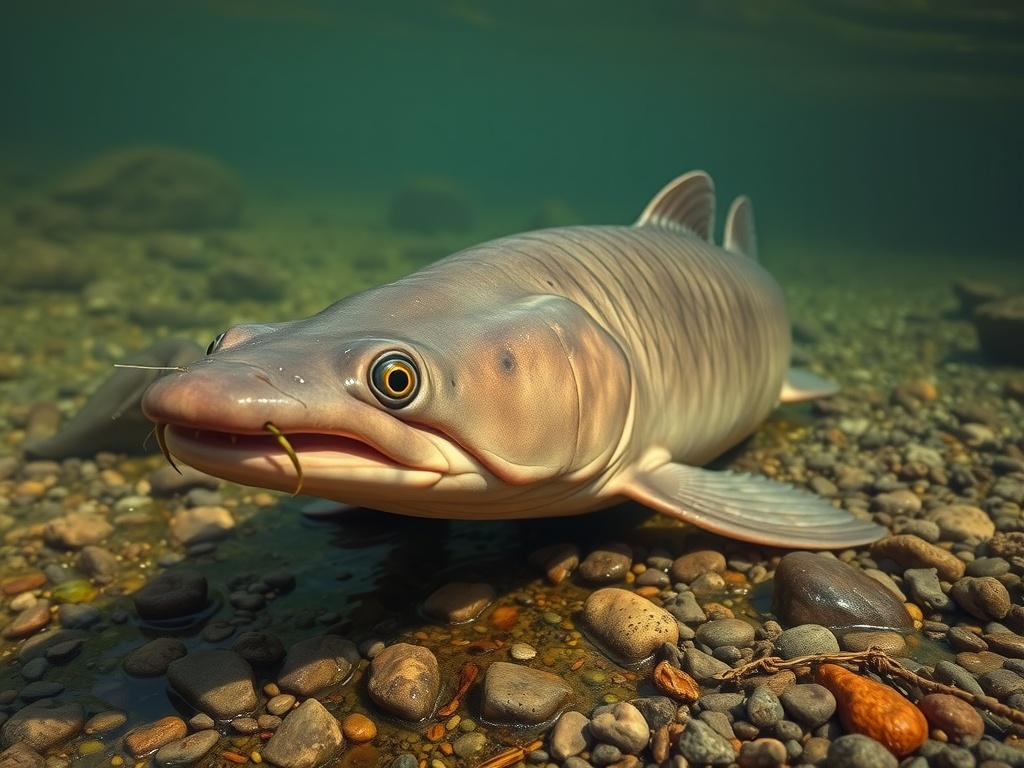
About the Wels catfish
The wels catfish (Silurus glanis) is Europe's largest freshwater fish, reliably reaching 2 metres and well over 100 kilograms, with credible historical records considerably larger. It has no scales, a broad flat head, tiny eyes, two long maxillary barbels and four shorter ones on the chin, and it hunts by taste, touch and electroreception in water where seeing is pointless. Its thousands of tiny, backward-facing teeth are not for cutting but for gripping, and it feeds by suction, opening a cavernous mouth so fast that the pressure drop pulls prey in whole. Introduced far outside its native range, it has produced one of the most striking cases of behavioural innovation recorded in a fish. In the Tarn River at Albi in southern France, wels catfish have learned to beach themselves. They lunge out of the water onto a gravel bar, grab a pigeon that has come to bathe or drink, and thrash back into the river, and a study published in 2012 documented the behaviour in detail, finding that roughly a quarter of attempts succeeded and that only some individuals in the population did it. The parallel with killer whales beaching for seals is exact, and it appeared within a few decades of the fish being introduced to a river full of naive pigeons. Males build and guard nests and defend the eggs.
Fascinating facts
Record Size
The largest verified Wels catfish caught weighed over 144 kg (317 lbs) and measured more than 2.7 meters (9 feet) in length.
Nocturnal Hunter
Wels catfish are most active at night, using their sensitive barbels to locate and ambush prey in the dark.
Unique Skeleton
Unlike many other fish, Wels catfish lack scales and have a smooth, slippery skin that protects them from parasites and injury.
Detailed description
The Wels catfish (Silurus glanis) is the largest freshwater fish native to Europe, with exceptional specimens reaching lengths over 2.7 meters (8.9 feet) and weights exceeding 130 kg (287 lbs), though most individuals are smaller. Its elongated, laterally compressed body is covered in smooth, scaleless skin, aiding in stealthy movement through turbid waters. The head is broad and flattened, equipped with a cavernous mouth lined with numerous small, brush-like teeth, and surrounded by two long maxillary barbels and four shorter mandibular barbels that serve as tactile and chemical sensors. The eyes are relatively small, reflecting its reliance on non-visual senses for hunting, especially in low-light conditions. The dorsal fin is short and set far forward, while the anal fin is extremely long, running most of the length of the body, contributing to its undulating swimming motion. Wels catfish are primarily nocturnal and solitary, emerging at dusk to hunt. They are apex predators, preying on a wide range of aquatic organisms, including fish, amphibians, waterfowl, and occasionally small mammals. Sexual maturity is typically reached at 3–5 years, with lifespans often exceeding 30 years in the wild. Their adaptability to various freshwater habitats, including deep lakes, slow-flowing rivers, and artificial reservoirs, has facilitated their spread across much of Eurasia.
Did you know?
A Wels catfish can produce deep, rumbling sounds using its swim bladder to communicate or startle prey.
Research & sources
Wikipedia summary
The wels catfish, also called sheatfish or just wels, is a large species of catfish native to wide areas of central, southern, and eastern Europe, in the basins of the Baltic, Black and Caspian Seas. It has been introduced to Western Europe as a prized sport fish and is now found from the United Kingdom east to Kazakhstan and China and south to Greece and Turkey.
Behaviour & social structure
Wels catfish exhibit primarily solitary behavior, with individuals occupying and defending large home ranges, especially during the breeding season. They are crepuscular to nocturnal, spending daylight hours concealed in submerged structures or deep holes. Their hunting strategy is opportunistic and highly adaptable: they use their sensitive barbels to detect prey in murky water, often ambushing fish, crustaceans, and even birds or rodents near the water's surface. In some introduced populations, Wels catfish have demonstrated unique behaviors such as beaching themselves briefly to catch pigeons or waterfowl. Feeding frenzies may occur when food is abundant, but otherwise, they maintain a low metabolic rate and can endure long periods without feeding. Social interactions are minimal outside of the breeding season, though aggregations may form in winter when individuals seek deeper, warmer waters.
Reproduction & life cycle
Breeding typically occurs from late spring to early summer when water temperatures reach 18–22°C (64–72°F). Males select and prepare shallow, vegetated nesting sites, often in sheltered bays or riverbanks, by clearing debris with their tails. After courtship, females lay between 30,000 and 300,000 adhesive eggs, depending on size and age, which the male fertilizes externally. The male guards the nest aggressively, fanning the eggs to provide oxygenation and protect them from predators. Incubation lasts 3–10 days, after which larvae remain in the nest for several days before dispersing. Juvenile catfish grow rapidly, feeding on zooplankton and small invertebrates before shifting to piscivory as they mature. Parental care is limited to nest guarding by the male; after hatching, the young are independent.
Adaptations & survival
Wels catfish possess several adaptations for survival in diverse freshwater environments. Their barbels are highly sensitive to chemical and tactile cues, allowing them to locate prey in darkness or turbid water. The elongated anal fin and flexible body enable powerful, undulating swimming, ideal for ambush predation. Their large size and rapid growth reduce predation risk after the juvenile stage. Physiologically, they can tolerate low oxygen levels and wide temperature fluctuations, aiding survival in degraded or variable habitats. Their opportunistic diet and ability to exploit new food sources, including terrestrial prey, have facilitated their success as both native and invasive species.
Cultural significance
The Wels catfish has held a prominent place in European folklore and mythology, often depicted as a monstrous river dweller capable of swallowing animals or even humans. In some regions, it is revered as a symbol of strength and longevity. Historically, it has been an important food fish, with records of large specimens celebrated in local traditions. In modern times, it is highly prized by anglers for its size and fighting ability, supporting a thriving recreational fishery. The species also features in art, literature, and local legends throughout its range.
Recent research
Recent research has focused on the ecological impacts of Wels catfish introductions, particularly their predation on non-fish prey such as birds and mammals, and their role in altering food web dynamics. Genetic studies have explored population structure and phylogeography, revealing distinct lineages across Europe and Asia. Tagging and telemetry work has provided insights into movement patterns, habitat use, and seasonal aggregations. Ongoing studies are investigating their physiological tolerance to environmental stressors, potential for bioaccumulation of pollutants, and their use as bioindicators in freshwater ecosystems. Notably, behavioral observations of terrestrial hunting in France have attracted significant scientific attention.
Videos
Habitat
Large slow-moving rivers, lakes, and reservoirs

Conservation
The Wels catfish is currently classified as Least Concern on the IUCN Red List.
Threats & challenges
While currently listed as Least Concern by the IUCN, Wels catfish face localized threats such as habitat degradation, pollution, and overfishing, particularly in parts of their native range. Invasive populations in Western Europe have raised ecological concerns, as their predatory behavior can disrupt native fish communities and impact biodiversity. Waterway modifications, such as damming and channelization, can affect spawning habitats and migration routes. However, their adaptability and generalist habits have allowed populations to remain stable or even expand in many areas. Management challenges include balancing their value as a sport fish with potential ecological impacts in non-native regions.
Taxonomy
Scientific name
Silurus glanis
- Kingdom
- Animalia
- Phylum
- Chordata
- Class
- Actinopterygii
- Order
- Siluriformes
- Family
- Siluridae
- Genus
- Silurus
- Species
- glanis
Community notes
Share your observations about the Wels catfish.
No community notes yet. Be the first!
Discover more wildlife
More fascinating animals from the encyclopedia.