
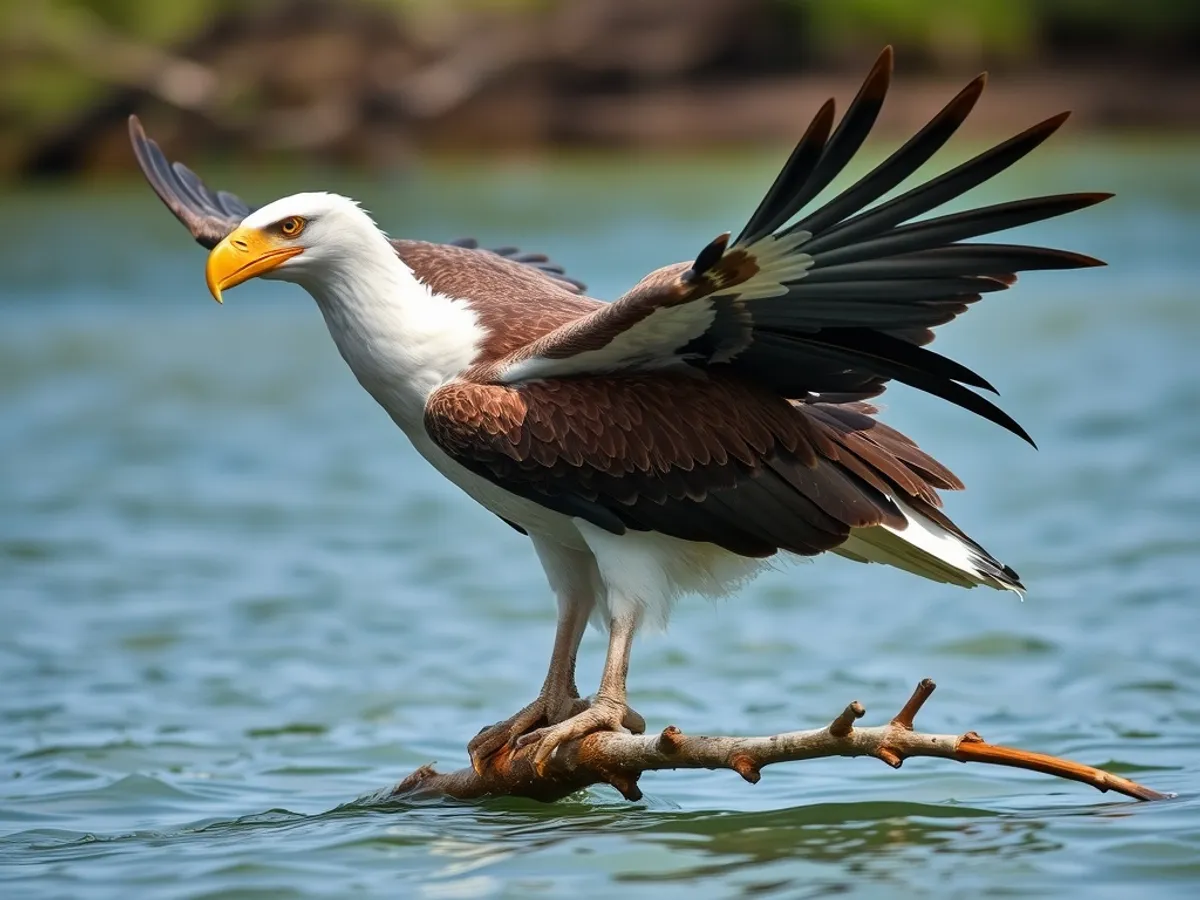
About the White-bellied Sea Eagle
The White-bellied Sea Eagle is a large raptor found throughout coastal Australia, Southeast Asia, and the Indian subcontinent. It is characterized by its striking white head, underparts, and tail, contrasted with dark grey wings and back. This eagle is most often seen soaring over coastlines, rivers, and large lakes, searching for fish and other prey. Socially monogamous, pairs are known to maintain large stick nests for many years. Its impressive wingspan and piercing call make it one of the most recognizable birds of prey in its range.
Fascinating facts
Impressive Wingspan
The White-bellied Sea Eagle boasts a wingspan of up to 2.2 meters, making it one of the largest raptors in Australasia.
Versatile Hunter
While fish comprise much of its diet, this eagle also preys on water birds, turtles, mammals, and carrion.
Loyal Nests
Breeding pairs often return to the same nest each year, building massive stick structures that can grow over 2 meters wide.
Detailed description
The White-bellied Sea Eagle (Haliaeetus leucogaster) is a large, powerful raptor with a distinctive appearance and wide distribution across Australasia and Southeast Asia. Adults display striking white plumage on the head, breast, belly, and tail, contrasting with slate-grey wings, back, and upper mantle. The underwing flight feathers are black, providing a bold pattern in flight, while the tail is short and wedge-shaped, aiding maneuverability. Females are larger than males, reaching up to 90 cm in length, with a wingspan of 1.8–2.2 meters and weights of 3.0–4.5 kg, while males average 2.5–3.0 kg. Immature birds are mostly brown with pale streaking, gradually acquiring adult plumage over five to six years. The beak is large, hooked, and pale bluish-grey, adapted for tearing flesh, and the legs are unfeathered with strong talons for grasping slippery prey. Eyes are dark brown, providing keen vision for spotting prey from great heights. The species is highly territorial, with pairs occupying and defending large home ranges along coasts, rivers, and large lakes. Their loud, resonant, goose-like calls are often heard during territorial displays and courtship. Nests are massive stick platforms, often reused and enlarged annually, sometimes reaching over 2 meters in diameter. The White-bellied Sea Eagle is an apex predator in its ecosystem, playing a key role in regulating fish and waterbird populations.
Did you know?
Despite their name, White-bellied Sea Eagles are frequently found hunting far inland, sometimes hundreds of kilometers from the coast.
Research & sources
Wikipedia summary
The white-bellied sea eagle, also known as the white-breasted sea eagle, is a large diurnal bird of prey in the family Accipitridae. Originally described by Johann Friedrich Gmelin in 1788, it is closely related to Sanford's sea eagle of the Solomon Islands, and the two are considered a superspecies. A distinctive bird, the adult white-bellied sea eagle has a white head, breast, under-wing coverts and tail. The upper parts are grey and the black under-wing flight feathers contrast with the white coverts. The tail is short and wedge-shaped as in all Haliaeetinae species. Like many raptors, the female is larger than the male, and can measure up to 90 cm (35 in) long with a wingspan of up to 2.2 m (7.2 ft), and weigh 4.5 kg (9.9 lb). Immature birds have brown plumage, which is gradually replaced by white until the age of five or six years. The call is a loud goose-like honking.
Behaviour & social structure
White-bellied Sea Eagles are primarily diurnal, with peak activity in the early morning and late afternoon. They are often seen soaring high above water bodies, using thermal currents to conserve energy while scanning for prey. Hunting is typically solitary or in pairs, involving low, slow flights over water or perches from which they swoop down to snatch fish, waterbirds, reptiles, or carrion. Their diet is opportunistic, with fish comprising the bulk, but they readily take birds (such as ducks and coots), mammals, turtles, and occasionally scavenge on dead animals. They exhibit kleptoparasitic behavior, harassing other birds (notably ospreys) to steal their catches. Socially, they are monogamous and maintain long-term pair bonds, with both partners participating in nest defense and territory maintenance. Territorial disputes are marked by aerial displays, calling, and sometimes physical confrontations. Juveniles disperse widely after fledging, often traveling hundreds of kilometers before establishing their own territories.
Reproduction & life cycle
Breeding season varies geographically but generally occurs during the dry season (March–August in Australia, November–March in Southeast Asia). Courtship involves aerial displays, mutual calling, and talon-grappling flights. Pairs construct large nests in tall trees or occasionally on cliffs, often near water. The nest, made of sticks and lined with green leaves, is reused and expanded each year. Females lay 1–3 eggs (usually 2), which are white and oval-shaped. Incubation lasts 35–42 days, primarily by the female, while the male provides food. Both parents feed the chicks, which hatch asynchronously, leading to size hierarchies and sometimes siblicide. Fledging occurs at 70–80 days, but juveniles remain dependent for several months. Sexual maturity is reached at 4–6 years.
Adaptations & survival
The species exhibits several adaptations for a piscivorous and coastal lifestyle. Its large, hooked bill and powerful talons are specialized for catching and holding slippery fish. The unfeathered tarsi reduce drag in water and facilitate prey handling. Keen eyesight allows detection of prey from great distances. The wedge-shaped tail and broad wings enable agile flight and efficient soaring over open water. Behavioral adaptations include kleptoparasitism and opportunistic scavenging, maximizing food intake in variable environments. Their vocalizations serve both territorial and pair-bonding functions, important in open habitats where visual contact may be limited.
Cultural significance
The White-bellied Sea Eagle holds significant cultural value across its range. In Indigenous Australian cultures, it is revered as a totemic animal and features in creation stories and traditional art. Its image is used in emblems and as a symbol of power, freedom, and connection to water. In Malaysia and Singapore, the eagle is a prominent symbol, with the town of Langkawi named after the bird ("Lang" meaning eagle in Malay). The eagle is also featured in local folklore and is sometimes regarded as a guardian spirit of waterways.
Recent research
Recent research has focused on the eagle’s role as a bioindicator of ecosystem health, particularly in monitoring heavy metal contamination and environmental changes in coastal habitats. Satellite tracking studies have revealed extensive juvenile dispersal and highlighted the importance of large, undisturbed territories for breeding success. Genetic analyses confirm the close relationship between Haliaeetus leucogaster and Sanford’s Sea Eagle, supporting their classification as a superspecies. Ongoing studies are examining the effects of urbanization and climate change on nesting success, prey availability, and long-term population viability. Community-based conservation projects in Australia and Southeast Asia are engaging local stakeholders in nest protection and habitat restoration.
Videos
Habitat
Coastal regions, estuaries, and large inland waterways
 Various Continental Regions
Grassland
Open areas dominated by grasses rather than trees, supporting numerous herbivores and their predators.
 Global
Forest
Wooded areas with significant tree cover and diverse plant and animal communities.
 Global
Freshwater
Lakes, rivers, and wetlands with diverse aquatic ecosystems.
Conservation
The White-bellied Sea Eagle is currently classified as Least Concern on the IUCN Red List.
Threats & challenges
While the White-bellied Sea Eagle is currently listed as Least Concern, it faces several localized threats. Habitat loss from coastal development, deforestation, and wetland drainage reduces nesting and hunting grounds. Human disturbance near nests can lead to breeding failure. Pollution, particularly bioaccumulation of heavy metals and pesticides, poses risks to eggs and chicks. Entanglement in fishing gear and persecution (historically for perceived threats to fisheries) have also impacted populations. Climate change may alter prey availability and nesting sites, especially in low-lying coastal areas. Despite these pressures, the species remains widespread, but some regional populations are declining, necessitating ongoing monitoring.
Taxonomy
Scientific name
Haliaeetus leucogaster
- Kingdom
- Animalia
- Phylum
- Chordata
- Class
- Aves
- Order
- Accipitriformes
- Family
- Accipitridae
- Genus
- Haliaeetus
- Species
- leucogaster
Community notes
Share your observations about the White-bellied Sea Eagle.
No community notes yet. Be the first!
Discover more wildlife
More fascinating animals from the encyclopedia.