
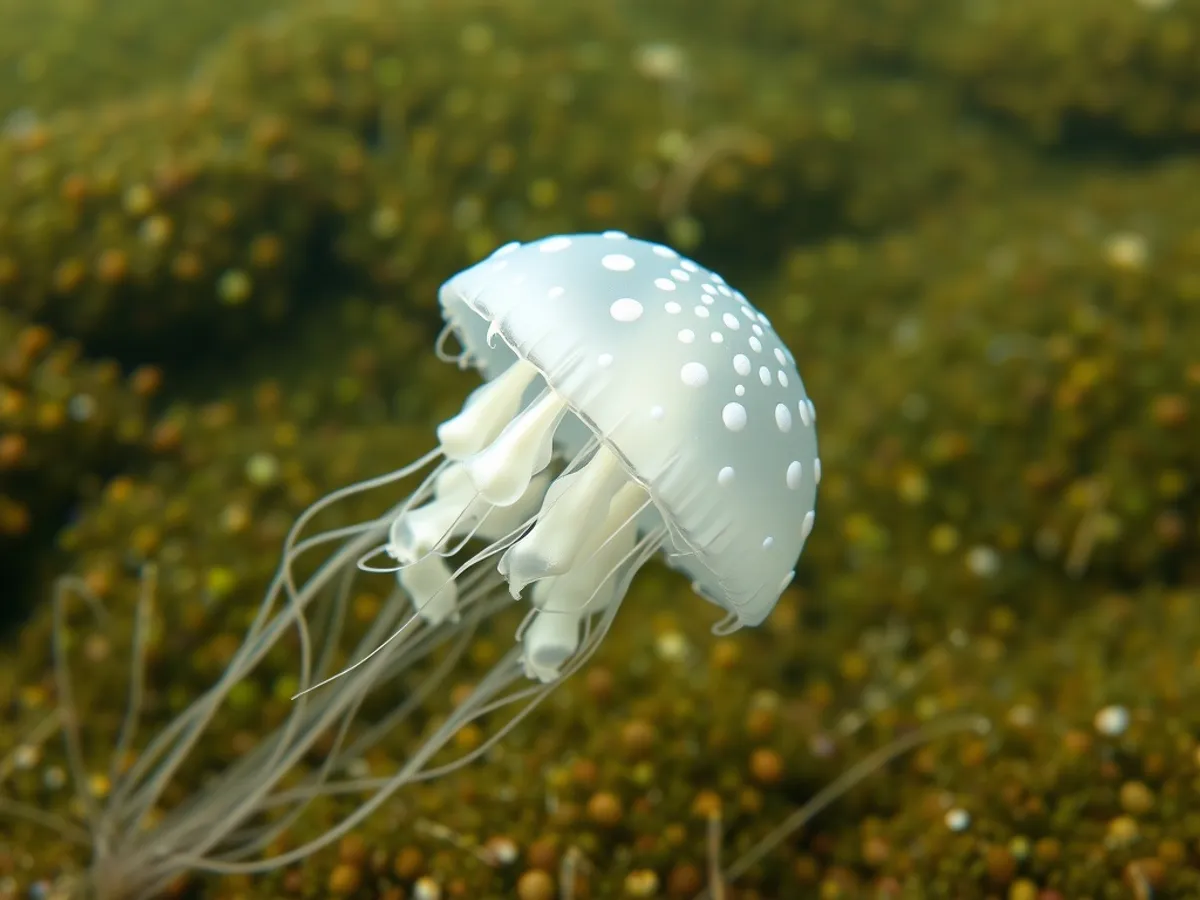
About the White-spotted jellyfish
The White-spotted jellyfish is a large, visually striking jellyfish known for its translucent bell adorned with distinctive white spots. Native to the southwestern Pacific region, particularly around Australia, this species has since spread to other parts of the world, including the Gulf of Mexico. Unlike many other jellyfish, its stings are mild and generally harmless to humans. The White-spotted jellyfish is a filter feeder, consuming plankton and small particles suspended in the water, which can impact local ecosystems in areas where it becomes invasive.
Fascinating facts
Efficient Filter Feeders
White-spotted jellyfish filter vast amounts of plankton, which can reduce food availability for native species.
Invasive Species
They have established populations outside their native range, particularly in the Gulf of Mexico and Caribbean Sea.
Gentle Sting
Their stings are very mild and rarely cause any harm to humans, making them less dangerous than many other jellyfish species.
Detailed description
The White-spotted jellyfish (Phyllorhiza punctata) is a large scyphozoan medusa, easily recognized by its hemispherical, translucent bell adorned with numerous opaque white spots. Adult bells typically reach 35–50 cm in diameter, though exceptional individuals up to 74 cm have been recorded. The bell is gelatinous and firm, with eight thick, frilled oral arms extending beneath, each lined with dense, finger-like appendages used for filter feeding. The jellyfish lacks true eyes but possesses simple photoreceptors and statocysts for orientation. Its coloration ranges from pale blue to brownish, with the white spots providing camouflage among sun-dappled waters. Internally, the gastrovascular system is highly branched, facilitating efficient nutrient distribution. Unlike many jellyfish, P. punctata's sting is mild and rarely harmful to humans due to relatively weak nematocysts. This species is primarily planktonic, drifting with currents but capable of limited bell pulsation for vertical movement. Its life cycle alternates between a benthic polyp stage and a free-swimming medusa, with asexual budding and sexual reproduction both occurring. The species is notable for forming large swarms or blooms, particularly in nutrient-rich or disturbed waters, which can have significant ecological impacts.
Did you know?
Despite their size and appearance, White-spotted jellyfish have a very mild sting and are almost harmless to humans.
Research & sources
Wikipedia summary
Phyllorhiza punctata is a species of jellyfish, also known as the floating bell, Australian spotted jellyfish, brown jellyfish or the white-spotted jellyfish. It is native to the western Pacific from Australia to Japan, but has been introduced widely elsewhere. It feeds primarily on zooplankton. P. punctata generally can reach up to 50 centimetres (20 in) in bell diameter, but in October 2007, one 74 cm (29 in) wide, perhaps the largest ever recorded, was found on Sunset Beach, North Carolina.
Behaviour & social structure
Phyllorhiza punctata is a passive filter feeder, spending most of its time drifting in the water column. It pulses its bell rhythmically to maintain position and facilitate feeding, drawing water through its oral arms where plankton and small particles are trapped by mucus and cilia. The jellyfish is non-aggressive and solitary, but can aggregate in massive groups, especially during bloom conditions, sometimes numbering in the thousands. These aggregations are not social but result from synchronized responses to environmental cues such as temperature, salinity, and food availability. The species exhibits diel vertical migration, often rising toward the surface at night to feed and descending during the day to avoid predators and UV exposure. Predation on P. punctata is limited due to its size and mild toxicity, but some sea turtles and large fish are known predators. The species does not exhibit parental care or complex social interactions.
Reproduction & life cycle
Reproduction in P. punctata involves both sexual and asexual phases. Medusae are dioecious, releasing eggs and sperm into the water column where external fertilization occurs. The resulting planula larvae settle onto substrates and develop into sessile polyps (scyphistomae). Polyps can reproduce asexually by budding or strobilation, producing stacks of ephyrae (juvenile medusae) that detach and mature into adult jellyfish. Breeding is generally seasonal, peaking in warmer months (spring and summer) when water temperatures rise, though in tropical regions, reproduction can occur year-round. There is no parental care; all life stages are independent. The duration from fertilization to medusa varies with temperature and food availability but typically spans several weeks.
Adaptations & survival
Phyllorhiza punctata exhibits several adaptations for survival in coastal and estuarine environments. Its large, spotted bell provides camouflage against the dappled light of shallow waters, reducing predation risk. The extensive oral arms and mucous-coated appendages are specialized for efficient filter feeding, allowing the jellyfish to exploit plankton-rich waters. The species tolerates a wide range of salinities, enabling it to thrive in both marine and brackish habitats. Its rapid asexual reproduction via polyps facilitates quick population expansion, especially in disturbed or nutrient-enriched environments. The mild sting is sufficient to deter small predators but not harmful to larger animals or humans, reducing energy investment in venom production.
Cultural significance
Phyllorhiza punctata has limited direct cultural significance but is sometimes featured in public aquaria for its striking appearance. In regions where it becomes invasive, it is often viewed as a nuisance due to its impact on fisheries and infrastructure. There are no known traditional uses or significant roles in folklore or mythology. However, its presence in new ecosystems has prompted increased public and scientific interest in jellyfish ecology and marine bioinvasions.
Recent research
Recent research has focused on the ecological impacts of P. punctata as an invasive species, particularly its effects on plankton communities and competition with native filter feeders. Studies have also examined its rapid population growth in response to eutrophication and warming waters. Molecular analyses have clarified its phylogenetic placement within Mastigiidae and revealed genetic diversity among native and introduced populations. Ongoing research includes the use of environmental DNA (eDNA) for monitoring jellyfish blooms and investigations into the species' tolerance to changing salinity and temperature regimes. There is also interest in its potential as a bioindicator for coastal ecosystem health.
Videos
Habitat
Coastal and estuarine waters

Conservation
The White-spotted jellyfish is currently classified as Least Concern on the IUCN Red List.
Threats & challenges
Currently, P. punctata faces few natural threats due to its broad environmental tolerance and rapid reproductive capacity. However, predation by sea turtles, large fish, and some birds does occur. Invasive populations, particularly in the Gulf of Mexico, Caribbean, and Mediterranean, have raised ecological concerns, as dense blooms can outcompete native filter feeders, reduce zooplankton populations, and clog fishing nets or power plant intakes. Human impacts include habitat alteration, pollution, and ballast water transport, which facilitate its spread. Despite these challenges, global populations are stable or increasing, and the species is classified as Least Concern by conservation authorities. Localized die-offs can occur due to sudden environmental changes or predation.
Taxonomy
Scientific name
Phyllorhiza punctata
- Kingdom
- Animalia
- Phylum
- Cnidaria
- Class
- Scyphozoa
- Order
- Rhizostomeae
- Family
- Mastigiidae
- Genus
- Phyllorhiza
- Species
- punctata
Community notes
Share your observations about the White-spotted jellyfish.
No community notes yet. Be the first!
Discover more wildlife
More fascinating animals from the encyclopedia.