
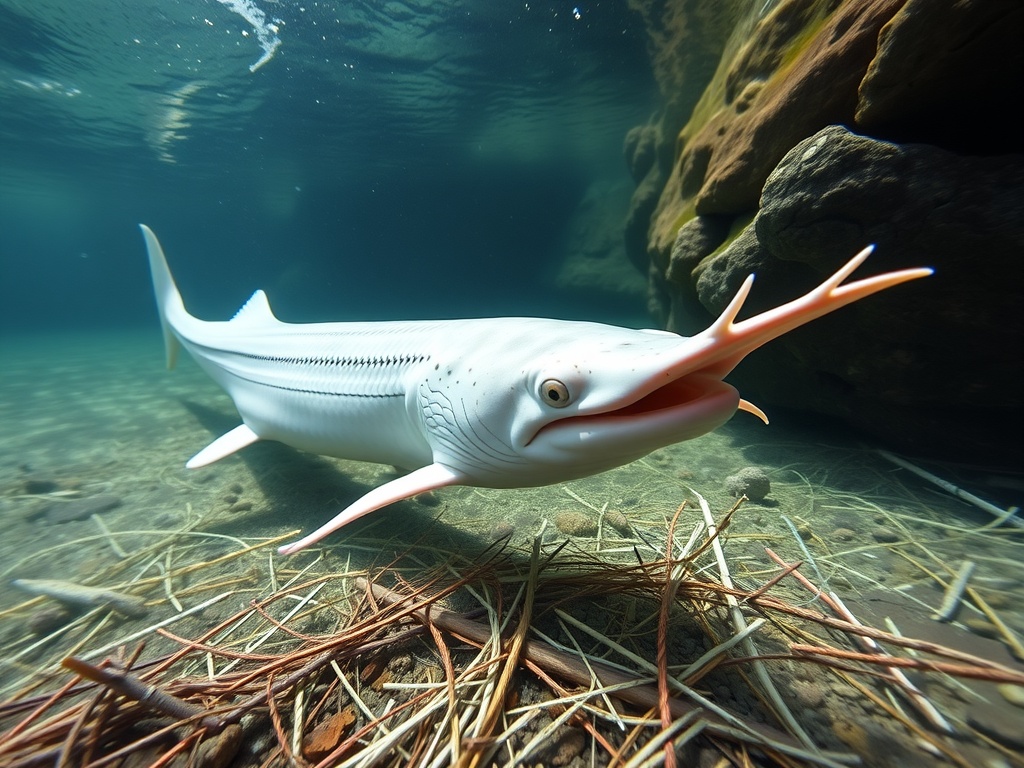
About the White sturgeon
The white sturgeon (Acipenser transmontanus) is the largest freshwater fish in North America, with historical Fraser River and Columbia River fish recorded at close to 6 metres and 600 kilograms, and individuals live well over 100 years. Sturgeon are not modern bony fish in the ordinary sense: the skeleton is largely cartilage, there are no scales, and the body is protected instead by five rows of bony plates called scutes, which are sharp in young fish and wear smooth with age. The head is a sensory instrument. Four barbels hang beneath a long snout, and the underside of that snout is peppered with ampullary electroreceptors that detect the faint electrical fields of buried prey; when a sturgeon locates something, its toothless mouth telescopes downward and outward into a tube and vacuums it out of the mud. Life history is the whole conservation problem. Females may not mature until 15 to 25 years old and then spawn only every four to eleven years, so a population can be fished out faster than it can possibly replace itself, and a dam that blocks one spawning reach removes a generation. The landlocked Kootenai River population has produced almost no surviving young since Libby Dam altered the river's flow in the 1970s and now survives largely on hatchery releases.
Fascinating facts
Ancient Giants
White sturgeon are among the oldest living fish species, tracing their lineage back over 200 million years.
No Teeth Needed
Despite their size, white sturgeon have no teeth—they use suction to pull in prey such as fish, clams, and crustaceans.
River Travelers
Many white sturgeon migrate long distances within river systems to find suitable spawning grounds.
Detailed description
The white sturgeon (Acipenser transmontanus) is a massive, long-lived, anadromous fish and the largest freshwater species in North America, with individuals commonly reaching 2–3 meters in length and exceptional specimens exceeding 6 meters and 800 kg. Its body is elongated, torpedo-shaped, and covered with five distinct rows of bony scutes rather than scales, providing both protection and flexibility. The head is broad and flattened, featuring a protrusible, toothless mouth located ventrally, and four sensitive barbels in front of the mouth that detect prey in murky waters. White sturgeon are primarily benthic, spending much of their life near the river or estuary bottom. Their coloration is typically gray to olive dorsally, fading to white ventrally, which aids in camouflage. They possess a heterocercal tail (upper lobe longer than lower), aiding in slow, powerful swimming. White sturgeon are known for their remarkable longevity, often living 70–100 years, with some individuals documented at over 150 years. Their sensory systems are highly developed, allowing them to locate prey in low-visibility environments. The species exhibits slow growth and late sexual maturity, with females often not spawning until 15–25 years old. This ancient lineage, dating back over 200 million years, displays a suite of primitive features, including a cartilaginous skeleton and spiral valve intestine.
Did you know?
The largest recorded white sturgeon weighed over 680 kg (1,500 lbs) and measured more than 6 meters (20 feet) long.
Research & sources
Wikipedia summary
White sturgeon is a species of sturgeon in the family Acipenseridae of the order Acipenseriformes. They are an anadromous (migratory) fish species ranging in the Eastern Pacific; from the Gulf of Alaska to Monterey, California. However, some are landlocked in the Columbia River Drainage, Montana, and Lake Shasta in California, with reported sightings in northern Baja California, Mexico.
Behaviour & social structure
White sturgeon are generally solitary or loosely aggregated, especially outside of spawning periods, but may form temporary groups in areas of abundant food or during migration. They are primarily nocturnal or crepuscular feeders, using their barbels to detect invertebrates, small fish, and carrion along the substrate. Their diet shifts with age: juveniles feed on insect larvae and small crustaceans, while adults consume a wider range of prey, including lamprey, salmon eggs, and mollusks. White sturgeon are known for long-distance migrations, particularly during spawning runs, sometimes traveling hundreds of kilometers upstream. They exhibit site fidelity to specific spawning grounds. Outside of the breeding season, they are relatively sedentary, occupying deep pools or estuarine habitats. Communication is poorly understood but may involve tactile and chemical cues. Aggression is minimal, with competition for food or space rarely resulting in physical conflict.
Reproduction & life cycle
White sturgeon are iteroparous, with females spawning every 2–11 years and males every 1–5 years. Spawning occurs in late spring to early summer (April–July), triggered by rising water temperatures (typically 13–18°C) and increased river flow. Adults migrate to fast-flowing, gravel-bottomed river sections to spawn. Females release between 100,000 and 4 million adhesive eggs, which are fertilized externally by multiple males. There is no parental care; eggs adhere to substrate and hatch after 7–15 days, depending on temperature. Larvae are initially photophobic and drift downstream to nursery habitats. Juvenile sturgeon experience high mortality, with survival increasing significantly after the first year. Sexual maturity is reached at 12–17 years for males and 15–25 years for females, with significant variation depending on environmental conditions.
Adaptations & survival
White sturgeon possess several adaptations for benthic life and anadromous migration. Their flattened snout and ventral mouth facilitate bottom-feeding, while sensitive barbels detect prey in turbid water. The bony scutes provide armor against predators and abrasive substrates. Their cartilaginous skeleton reduces body weight, aiding buoyancy and energy efficiency during long migrations. A spiral valve intestine increases nutrient absorption from a varied diet. They can tolerate a wide range of salinities, allowing them to move between freshwater and estuarine environments. Their slow metabolism and ability to withstand low-oxygen conditions enable survival in diverse and sometimes degraded habitats.
Cultural significance
White sturgeon hold significant cultural and economic value, especially among Indigenous peoples of the Pacific Northwest, who have relied on them for food, tools, and ceremonial purposes for millennia. The species features in regional mythology and oral traditions, often symbolizing longevity, strength, and resilience. In the 19th and early 20th centuries, sturgeon fisheries contributed to local economies, though overexploitation led to dramatic declines. Today, white sturgeon are prized in recreational fisheries, with strict catch-and-release regulations in many areas. Sturgeon caviar remains a luxury product, though most legal trade is now from aquaculture. Conservation programs often involve collaboration with Indigenous communities, recognizing traditional ecological knowledge.
Recent research
Recent research has focused on sturgeon genetics, population structure, and the effects of environmental stressors such as contaminants and altered flow regimes. Advances in telemetry and tagging have improved understanding of migration patterns and habitat use. Studies on reproductive physiology have informed hatchery practices and conservation strategies. Genomic analyses are clarifying evolutionary relationships within Acipenseridae. Ongoing research addresses the impacts of climate change on sturgeon spawning and recruitment. Restoration projects in the Columbia and Kootenai rivers are closely monitored, providing valuable data on population recovery and adaptive management. White sturgeon are also studied as bioindicators of river ecosystem health due to their sensitivity to habitat changes.
Sources
Acipenser transmontanus (White Sturgeon): Species Account
J. Crossman & L. Hildebrand, IUCN SSC Sturgeon Specialist Group (2022)
scientificWhite Sturgeon Biology and Management
North American Sturgeon and Paddlefish Society (2020)
scientificVideos
Habitat
Large river systems, estuaries, and freshwater lakes

Conservation
The White sturgeon is currently classified as Least Concern on the IUCN Red List.
Threats & challenges
Major threats to white sturgeon include overfishing (historically for caviar and meat), habitat fragmentation from dams, water pollution, altered river flows, and loss of spawning grounds. Dams block migratory routes and change sediment dynamics, reducing reproductive success. Pollution from agriculture and industry can impair development and reduce prey availability. Illegal poaching for caviar remains a concern. Climate change poses emerging threats through altered hydrology and increased water temperatures. Some populations, especially in the upper Columbia and Kootenai rivers, are critically endangered, while others remain stable. Conservation efforts include fishing regulations, hatchery supplementation, habitat restoration, and dam passage improvements. Population trends are variable, with some landlocked populations declining and others recovering due to management.
Taxonomy
Scientific name
Acipenser transmontanus
- Kingdom
- Animalia
- Phylum
- Chordata
- Class
- Actinopterygii
- Order
- Acipenseriformes
- Family
- Acipenseridae
- Genus
- Acipenser
- Species
- transmontanus
Where to see a white sturgeon
1 zoo and aquarium in 1 country are recorded as keeping this species.

Community notes
Share your observations about the White sturgeon.
No community notes yet. Be the first!
Discover more wildlife
More fascinating animals from the encyclopedia.