
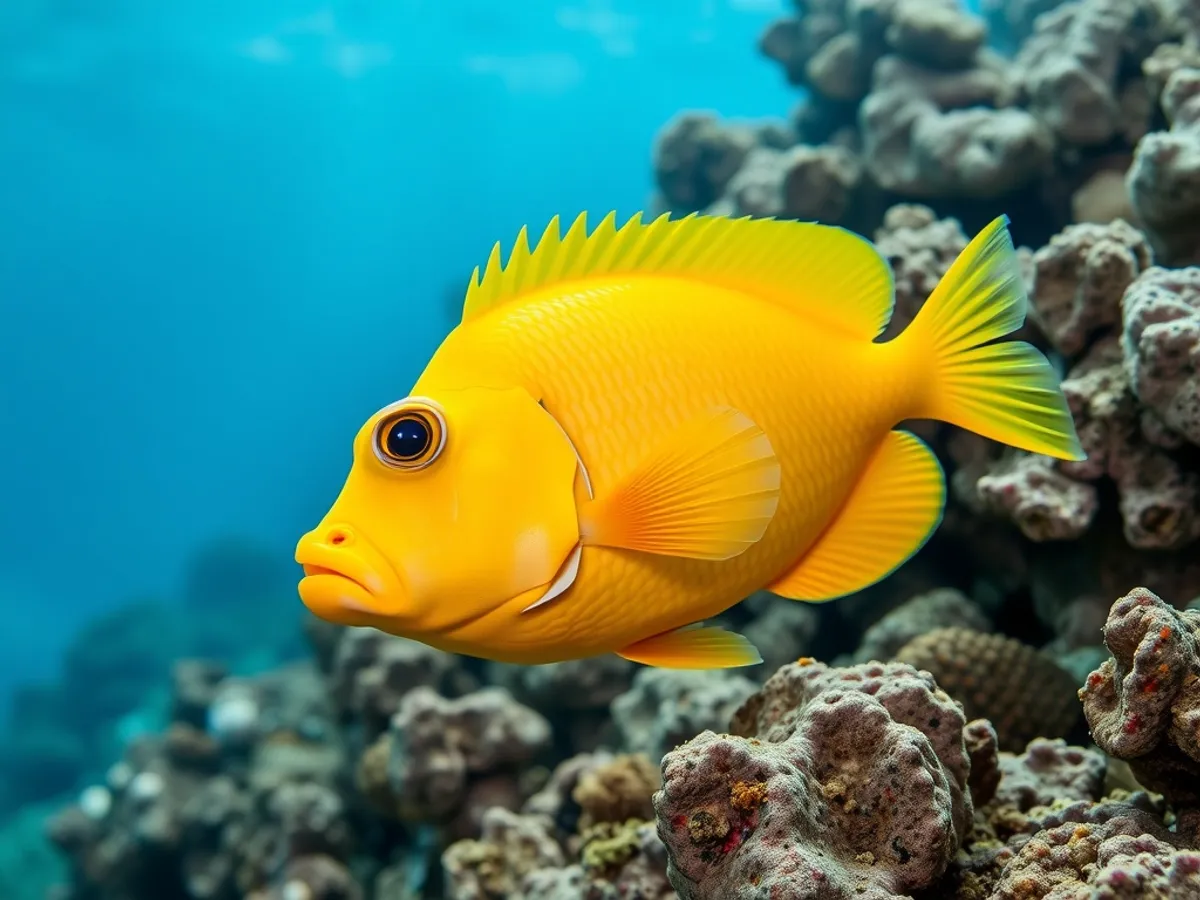
About the Yellow boxfish
The yellow boxfish is a striking marine fish recognized for its bright yellow, box-shaped body adorned with small black spots. Native to coral and rocky reefs in the Indo-Pacific, juveniles are particularly vibrant while adults may dull slightly in color as they age. This species is renowned for its rigid, box-like carapace formed by fused bony plates, which offers protection from predators. The yellow boxfish moves with a characteristic undulating motion, using its dorsal, anal, and pectoral fins for precise maneuverability. Despite its small, seemingly harmless appearance, it can secrete toxic substances when stressed, deterring predators.
Fascinating facts
Rigid Armor
The yellow boxfish's body is encased in a hard, bony carapace formed by fused plates, protecting it from most predators.
Toxic Defense
When stressed or threatened, this fish can release ostracitoxin, a toxin harmful to both predators and other fish nearby.
Colorful Juveniles
Juvenile yellow boxfish are bright yellow with bold black spots, but their color fades and spots become less distinct as they mature.
Detailed description
The yellow boxfish (Ostracion cubicus) is a small to medium-sized marine fish, typically reaching up to 45 cm in length, though most individuals are smaller. Its most distinctive feature is the rigid, box-like carapace formed by fused hexagonal bony plates, which encases the body and leaves only the mouth, eyes, fins, and tail exposed. Juveniles are a vivid, bright yellow with numerous black spots, while adults often become more muted in color, sometimes developing blue or brownish hues with faded spots. The species possesses small, terminal mouths adapted for picking at benthic invertebrates and algae. The eyes are set high on the head, providing a wide field of vision. Locomotion is primarily achieved through undulating movements of the dorsal, anal, and pectoral fins, allowing for precise maneuvering but limiting speed. The caudal fin is used for sudden bursts of movement. When threatened, O. cubicus can secrete a potent toxin (ostracitoxin or pahutoxin) from its skin mucus, which is harmful to other fish and can disrupt aquarium environments. This species is diurnal, spending daylight hours foraging among coral and rocky reefs at depths ranging from 1 to 50 meters. Its rigid body structure offers substantial protection against predators but also makes it vulnerable to entrapment and limits its ability to hide in narrow crevices.
Did you know?
Despite their clumsy appearance, yellow boxfish are surprisingly agile swimmers thanks to their specialized fin movement.
Research & sources
Wikipedia summary
The yellow boxfish is a species of marine ray-finned fish belonging to the family Ostraciidae, the boxfishes. This species is found in reefs throughout the Pacific Ocean and Indian Ocean as well as the southeastern Atlantic Ocean, although since 2011 it has also been occasionally recorded in the Levantine waters of the Mediterranean Sea which it likely entered via the Suez Canal. The species is present in the aquarium trade. They are known for their cuboid body shape, bright yellow and black spotted coloration, and the secretion of a toxic mucus when threatened.
Behaviour & social structure
Yellow boxfish are generally solitary, especially as adults, although juveniles may be observed in loose aggregations in sheltered reef areas. They are slow-moving and deliberate, spending much of the day grazing on algae, sponges, tunicates, crustaceans, and mollusks. Their small mouths and specialized jaw muscles enable them to extract food from crevices and scrape encrusting organisms from hard surfaces. Feeding is usually conducted during daylight hours, with individuals maintaining small home ranges. When threatened, they may freeze, relying on their rigid armor, or secrete toxic mucus as a chemical defense. Social interactions are limited, with occasional displays of aggression between males during the breeding season. They exhibit site fidelity, often returning to the same shelter sites at night.
Reproduction & life cycle
Ostracion cubicus is oviparous, with external fertilization. Spawning typically occurs during the warmer months, often at dusk. Males may establish temporary territories and court females through visual displays and circling behaviors. After a brief courtship, the pair ascends into the water column to release eggs and sperm simultaneously. The eggs are pelagic, drifting with currents until hatching after approximately 24–48 hours, depending on water temperature. Larvae are planktonic and undergo several developmental stages before settling onto the reef as juveniles. There is no parental care; survival rates are low due to predation and environmental factors. Sexual maturity is reached at around 15–20 cm in length, usually within 1–2 years.
Adaptations & survival
The yellow boxfish exhibits several notable adaptations. Its rigid, box-shaped carapace provides exceptional protection against most predators, a rare trait among reef fishes. The secretion of ostracitoxin is a unique chemical defense, capable of killing or deterring potential threats and even affecting other fish in the vicinity. Its body shape, while limiting speed, allows for precise maneuvering in complex reef environments, facilitated by the independent movement of its fins. The bright coloration of juveniles may serve as aposematic (warning) signaling, advertising their toxicity. Additionally, their diet flexibility enables them to exploit a wide range of food resources, contributing to their ecological success.
Cultural significance
The yellow boxfish is popular in the marine aquarium trade due to its striking appearance, but its care is challenging because of its toxin secretion, which can be fatal to tankmates. In some cultures, boxfish have been featured in art and folklore as symbols of protection and resilience, inspired by their armored bodies. The species has also influenced biomimetic engineering; its unique body shape has inspired designs for aerodynamic vehicles and underwater robotics, as studied by automotive and robotics engineers.
Recent research
Recent research has focused on the biomechanics of the boxfish's rigid carapace, revealing that its shape provides both protection and hydrodynamic efficiency, contrary to earlier assumptions about its drag. Studies on ostracitoxin have advanced understanding of fish chemical defenses and their ecological roles. Genetic analyses have clarified phylogenetic relationships within Ostraciidae, and ongoing monitoring in the Mediterranean is documenting the species' range expansion and potential impacts on local ecosystems. There is also interest in the species' microbiome and its role in toxin production.
Videos
Habitat
Coral and rocky reefs in tropical marine waters

Conservation
The Yellow boxfish is currently classified as Least Concern on the IUCN Red List.
Threats & challenges
Currently, the yellow boxfish is classified as Least Concern by the IUCN, with stable populations across its broad Indo-Pacific range. However, localized threats include habitat degradation from coral reef destruction, pollution, and overcollection for the aquarium trade. The species' reliance on healthy reef systems makes it susceptible to the impacts of climate change, such as coral bleaching and ocean acidification. Invasive spread into the Mediterranean via the Suez Canal (Lessepsian migration) has been documented, raising concerns about ecological impacts in non-native regions. While not targeted by fisheries, accidental capture and mortality in the aquarium trade remain conservation challenges.
Taxonomy
Scientific name
Ostracion cubicus
- Kingdom
- Animalia
- Phylum
- Chordata
- Class
- Actinopterygii
- Order
- Tetraodontiformes
- Family
- Ostraciidae
- Genus
- Ostracion
- Species
- cubicus
Community notes
Share your observations about the Yellow boxfish.
No community notes yet. Be the first!
Discover more wildlife
More fascinating animals from the encyclopedia.