
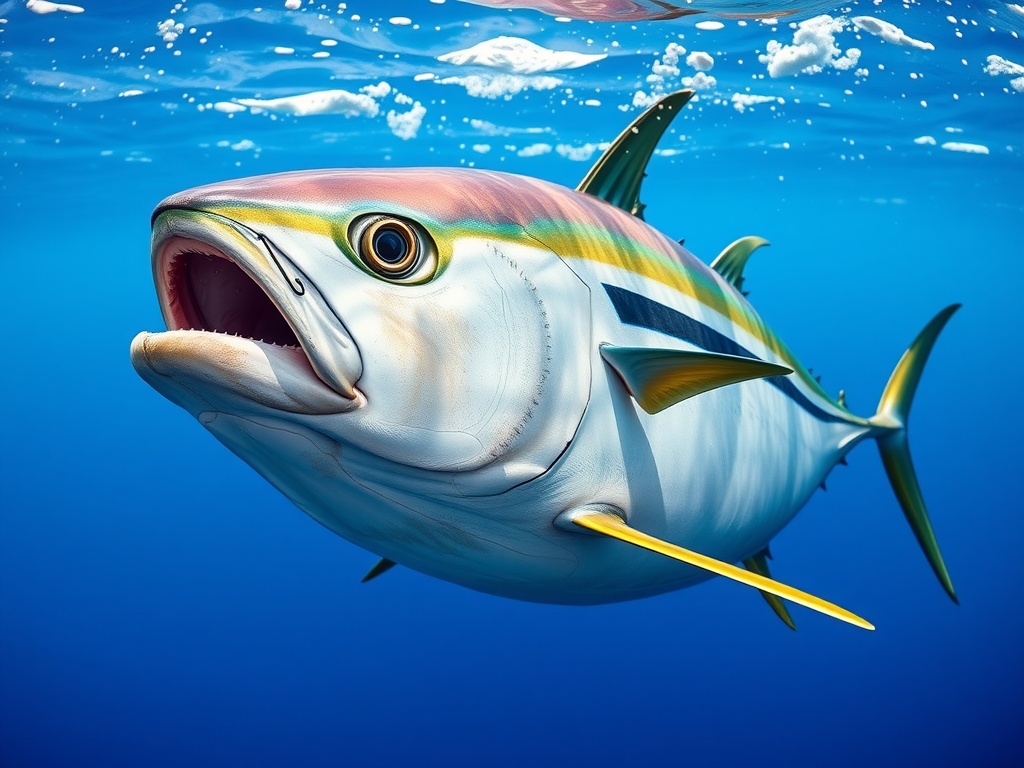
About the Yellowfin Tuna
The yellowfin tuna (Thunnus albacares) is a warm-water tuna reaching 2 metres and over 180 kilograms, named for the long, bright yellow second dorsal and anal fins, which in old fish grow into extravagant sickles trailing back toward the tail. Like other tunas it is regionally endothermic, keeping its swimming muscles several degrees above the surrounding water using countercurrent heat exchangers called retia mirabilia that trap the heat of muscle work before the blood reaches the gills. But its retia are considerably less developed than a bluefin's, so it retains far less heat and, as a result, is confined to warm surface waters rather than being able to hunt in cold northern seas the way a bluefin can. It is an obligate ram ventilator: it cannot pump water over its gills and must swim continuously, mouth open, or suffocate. Yellowfin grow fast, maturing at around two years, which is exactly why the species has weathered industrial fishing better than the slow-growing bluefins. Its most consequential trait is behavioural: in the eastern tropical Pacific, large yellowfin swim beneath schools of spotted and spinner dolphins for reasons still debated, and fishermen learned to find tuna by finding dolphins and to set purse seines around both, killing millions of dolphins before the dolphin-safe regulations of the 1990s.
Fascinating facts
Schooling Behavior
Yellowfin tuna often form large schools with other tuna species and have been observed associating with dolphins for protection and hunting efficiency.
Incredible Speed
They are among the fastest fish in the ocean, capable of reaching burst speeds up to 75 km/h (47 mph) thanks to their streamlined bodies and retractable fins.
Warm-blooded Adaptation
Yellowfin tuna can regulate their body temperature above that of the surrounding water, which helps them remain active in a wide range of ocean temperatures.
Detailed description
The yellowfin tuna (Thunnus albacares) is a robust, streamlined pelagic fish distinguished by its metallic dark blue dorsal surface, silvery belly, and vivid yellow lateral sides and fins. Adults can reach lengths of up to 239 cm (about 7.8 ft) and weigh as much as 200 kg (440 lbs), though most individuals encountered are smaller. The species is noted for its exceptionally long second dorsal and anal fins, which are bright yellow and can extend almost as far as the tail in mature individuals. Yellowfin tuna possess a fusiform body shape optimized for high-speed swimming, with a series of finlets running between the dorsal and anal fins and the crescent-shaped caudal fin. Their large eyes and powerful jaws are adaptations for hunting in open water. Socially, yellowfin tuna are highly gregarious, forming large schools that can include thousands of individuals, often associating with other tuna species, billfish, and even marine mammals such as dolphins. They are obligate ram ventilators, meaning they must swim continuously to force water over their gills for respiration. Yellowfin tuna are endothermic to a degree, maintaining body temperatures above ambient water, which enhances their muscle efficiency and predatory capabilities. Their life span is typically 5–9 years, with rapid growth rates in the first few years. As apex and mesopredators, they play a critical role in pelagic food webs, preying on a wide range of fish, cephalopods, and crustaceans, while serving as prey for large sharks and marine mammals.
Did you know?
Unlike most fish, yellowfin tuna are warm-blooded, allowing them to maintain a higher body temperature and be more active predators.
Research & sources
Wikipedia summary
The yellowfin tuna is a species of tuna found in pelagic waters of tropical and subtropical oceans worldwide.
Behaviour & social structure
Yellowfin tuna exhibit complex schooling behavior, often forming mixed-species aggregations with skipjack (Katsuwonus pelamis) and bigeye tuna (Thunnus obesus), as well as with dolphins, which may provide protection from predators or enhance foraging efficiency. They are diurnal, with peak feeding activity occurring during daylight hours, especially at dawn and dusk. Yellowfin hunt by sight, using their acute vision to locate prey near the surface or at depths up to 250 meters. Their diet consists primarily of small pelagic fish (e.g., sardines, anchovies, mackerel), cephalopods (squid and octopus), and crustaceans. They are opportunistic feeders, often exploiting seasonal or localized prey abundances. Yellowfin tuna are known for their remarkable speed and endurance, capable of sustained swimming at 5–10 km/h and burst speeds exceeding 70 km/h when chasing prey or evading predators. Their social interactions include coordinated hunting and synchronized swimming, which may confuse prey or reduce individual predation risk.
Reproduction & life cycle
Yellowfin tuna are serial broadcast spawners, releasing eggs and sperm into the open water column where external fertilization occurs. Spawning occurs year-round in equatorial regions and seasonally in subtropical areas, typically when water temperatures exceed 24°C. Females are highly fecund, capable of producing 2–8 million eggs per spawning event, and may spawn every few days during peak season. There is no parental care; eggs and larvae are planktonic and subject to high mortality rates. Larvae grow rapidly, reaching juvenile stages within weeks. Sexual maturity is generally reached at 2–3 years of age, when individuals are about 100–120 cm in length. Spawning grounds are often located in offshore, oligotrophic waters, with notable regions in the western Pacific, Indian Ocean, and eastern Atlantic.
Adaptations & survival
Yellowfin tuna possess several adaptations for pelagic life and high-performance predation. Their streamlined, hydrodynamic bodies and retractable fins minimize drag, while a high proportion of red muscle enables sustained, aerobic swimming. The counter-current heat exchange system (rete mirabile) allows partial endothermy, maintaining muscle temperatures up to 10°C above ambient water, which improves power output and neural function. Their large eyes are adapted for wide-angle vision and low-light conditions, aiding in prey detection at depth. The presence of finlets and a lunate caudal fin enhances maneuverability and speed. Physiologically, yellowfin have high metabolic rates and efficient oxygen extraction, supporting their active lifestyle. Behaviorally, schooling provides protection and foraging advantages, while their migratory nature allows exploitation of seasonally productive habitats.
Cultural significance
Yellowfin tuna hold substantial economic and cultural importance in many coastal nations, especially in the Pacific, Indian, and Atlantic Oceans. They are a staple in global seafood markets, valued for their high-quality flesh used in sushi, sashimi, and canned products. In some Pacific cultures, tuna fishing is deeply embedded in traditional practices, ceremonies, and folklore, symbolizing abundance and maritime skill. Sport fishing for yellowfin is popular in many regions, contributing to local economies through tourism. The species also features in conservation campaigns highlighting the need for sustainable fisheries and marine biodiversity protection.
Recent research
Recent research has focused on yellowfin tuna population genetics, revealing distinct regional stocks with limited gene flow, which has implications for management and conservation. Satellite tagging studies have elucidated their extensive migratory patterns, with individuals traveling thousands of kilometers across ocean basins. Advances in otolith microchemistry and stable isotope analysis have improved understanding of their life history, natal origins, and trophic ecology. Ongoing studies are investigating the impacts of climate change on spawning phenology and larval survival, as well as the effectiveness of marine protected areas (MPAs) and fisheries management measures. There is also active research into reducing bycatch and improving traceability in tuna supply chains.
Videos
Habitat
Open ocean (pelagic zones) of tropical and subtropical waters

Conservation
The Yellowfin Tuna is currently classified as Near Threatened on the IUCN Red List.
Threats & challenges
Yellowfin tuna face significant threats from overfishing, primarily due to high demand in commercial and artisanal fisheries for sashimi, canned products, and sport fishing. Purse seine, longline, and pole-and-line fisheries target both adults and juveniles, with bycatch of non-target species (including sharks, turtles, and dolphins) posing additional ecological concerns. Illegal, unreported, and unregulated (IUU) fishing exacerbates population declines. Climate change and ocean warming may alter spawning grounds, migratory routes, and prey availability, further challenging population stability. Although currently listed as Near Threatened by the IUCN, some regional stocks show signs of overexploitation, with declining catch-per-unit-effort (CPUE) and reduced average size of individuals. Management efforts include catch quotas, time-area closures, and gear restrictions, but enforcement and international cooperation remain challenging.
Taxonomy
Scientific name
Thunnus albacares
- Kingdom
- Animalia
- Phylum
- Chordata
- Class
- Actinopterygii
- Order
- Scombriformes
- Family
- Scombridae
- Genus
- Thunnus
- Species
- albacares
Community notes
Share your observations about the Yellowfin Tuna.
No community notes yet. Be the first!
Discover more wildlife
More fascinating animals from the encyclopedia.