
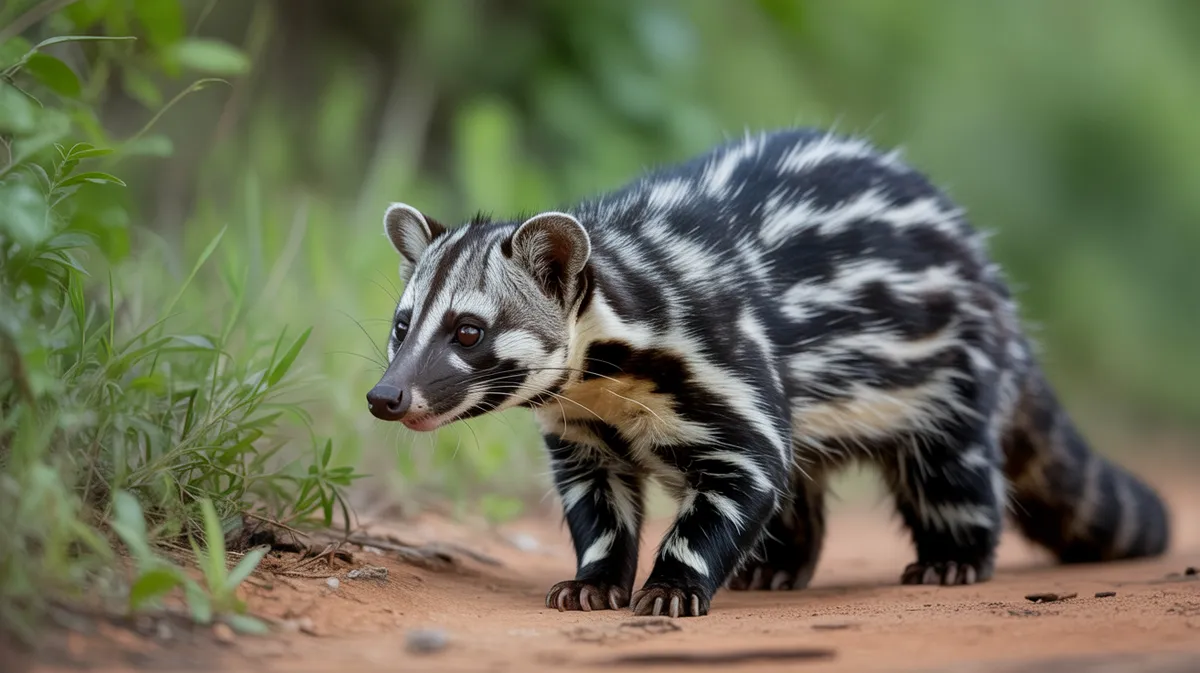
About the African Civet
The African civet is a nocturnal, medium-sized mammal known for its distinctive black and white markings and a mane of long hair along its back. It is famous for the musky secretion called civetone, which is used in the perfume industry. The species is solitary and highly territorial, using scent marking to communicate with others. African civets are agile climbers and swimmers, inhabiting a wide range of environments across sub-Saharan Africa.
Fascinating facts
Nocturnal Lifestyle
African civets are primarily active at night, using their keen senses of smell and hearing to hunt and forage.
Unique Scent Glands
They have perineal glands that secrete a musky substance called civetone, historically prized in perfumery.
Diet Diversity
Civets eat fruits, insects, small mammals, birds, reptiles, and carrion, making them true omnivores.
Detailed description
The African civet (Civettictis civetta) is the largest representative of the African Viverridae, with adults typically weighing between 7 and 20 kg (15–44 lbs) and measuring 67–84 cm (26–33 in) in head-body length, with a bushy tail adding an additional 34–47 cm (13–19 in). Its pelage is coarse and marked by striking black and white bands and blotches, providing effective camouflage in dappled woodland environments. A prominent erectile mane runs along the spine and can be raised in threat displays to make the animal appear larger. The head is broad with a pointed muzzle, small rounded ears, and large, forward-facing eyes adapted for nocturnal vision. The feet are plantigrade with partially retractile claws, aiding in climbing and digging. Scent glands near the perineum produce civetone, a musky substance used for territorial marking and historically harvested for perfumery. African civets are primarily solitary and nocturnal, spending the day in dense vegetation or burrows and emerging at dusk to forage. Their omnivorous diet includes invertebrates, small vertebrates, eggs, fruit, and carrion. Home ranges are maintained through frequent scent marking, and individuals are highly territorial. Communication is primarily olfactory, but vocalizations such as growls, screams, and coughs are used in aggressive encounters. The species is highly adaptable, occupying a range of habitats from lowland forests and savannas to agricultural mosaics, provided water is accessible.
Did you know?
One of the world's most expensive coffees, kopi luwak, is made from coffee beans that have been eaten and excreted by civets.
Research & sources
Wikipedia summary
The African civet is a large viverrid native to sub-Saharan Africa, where it is considered common and widely distributed in woodlands and secondary forests. It is listed as Least Concern on the IUCN Red List since 2008. In some countries, it is threatened by hunting, and wild-caught individuals are kept for producing civetone for the perfume industry.
Behaviour & social structure
African civets are predominantly solitary, with individuals maintaining overlapping but exclusive territories marked by frequent scent deposits from their perineal glands. They are strictly nocturnal, with peak activity occurring shortly after sunset and before dawn. Foraging is opportunistic and wide-ranging; civets use their acute sense of smell to locate food, often following established paths. Their diet is highly varied, including insects (especially beetles and orthopterans), rodents, birds, reptiles, eggs, fruits, and occasionally carrion. They have been observed to scavenge from human refuse in peri-urban areas. African civets exhibit a characteristic 'hop' or bounding gait when startled and can climb trees to escape predators or access food. Social interactions are limited to mating and, occasionally, overlapping feeding grounds. Agonistic encounters are rare but involve threat postures, piloerection, and vocalizations. Resting sites are often reused and may be burrows, dense thickets, or abandoned aardvark holes.
Reproduction & life cycle
Breeding in African civets can occur year-round in equatorial regions, but in southern Africa, peaks are observed during the rainy season (September to January). The species is polygynous, with males and females coming together only briefly to mate. After a gestation period of approximately 60–72 days, females give birth to litters of 1–4 young, typically in secluded, well-concealed nests. Neonates are born fully furred and with eyes open, a rare trait among carnivores, and weigh about 250–300 grams at birth. The mother provides all parental care, nursing the young for 4–6 weeks before they begin to take solid food. Juveniles remain with the mother for up to 3 months before dispersing to establish their own territories. Sexual maturity is reached at around 1 year of age.
Adaptations & survival
African civets possess several adaptations for survival in variable environments. Their cryptic coloration and ability to raise the dorsal mane provide both camouflage and a means of intimidation. The robust dentition and strong jaws enable them to process a wide range of foods, from hard-shelled insects to small vertebrates. Acute olfactory and auditory senses facilitate nocturnal foraging and predator avoidance. The perineal scent gland is highly developed, producing civetone used for territorial marking and communication. Plantigrade feet and semi-retractile claws allow for efficient movement on the ground, climbing, and digging. Their omnivorous diet and behavioral flexibility allow them to exploit diverse habitats, including areas modified by humans.
Cultural significance
African civets have played a notable role in human culture, particularly due to their association with the perfume industry. Civetone, extracted from the perineal glands, was historically a prized fixative in high-end perfumes, leading to the capture and keeping of civets in captivity for 'civet farming.' In some African cultures, civets are featured in folklore and are sometimes regarded as omens or symbols of stealth and cunning. Their skins and body parts have been used in traditional medicine and rituals in certain regions. The use of synthetic civetone has reduced commercial demand, but traditional uses persist in some areas.
Recent research
Recent research on African civets has focused on their ecological adaptability to human-modified landscapes, with studies documenting their presence in peri-urban and agricultural zones. Genetic studies have clarified the taxonomy of the species, confirming several subspecies and highlighting significant genetic diversity across its range. Camera trap surveys have improved understanding of population densities and habitat preferences. There is ongoing research into the chemical composition and ecological function of civetone and other scent gland secretions. Conservation studies are increasingly examining the impact of civet farming and bushmeat hunting on wild populations, as well as the species' role in seed dispersal and ecosystem functioning.
Sources
Civettictis civetta (African Civet): Taxonomy, Ecology, and Conservation
Do Linh San, E., Gaubert, P., Wondmagegne, D., Ray, J. (2019)
scientificThe IUCN Red List of Threatened Species: Civettictis civetta
IUCN SSC Small Carnivore Specialist Group
conservationThe Mammals of Africa, Volume V: Carnivores, Pangolins, Equids and Rhinoceroses
Kingdon, J., Hoffmann, M. (eds.) (2013)
scientificVideos
Habitat
Forests, savannas, and grasslands near water sources
 Africa
Savanna
Grasslands with scattered trees, characterized by seasonal rainfall and home to diverse grazing animals and predators.
 Various Continental Regions
Grassland
Open areas dominated by grasses rather than trees, supporting numerous herbivores and their predators.
 Global
Forest
Wooded areas with significant tree cover and diverse plant and animal communities.
Conservation
The African Civet is currently classified as Least Concern on the IUCN Red List.
Threats & challenges
While the African civet is currently listed as Least Concern by the IUCN due to its wide distribution and presumed large population, localized threats persist. These include hunting for bushmeat, the pet trade, and particularly for the extraction of civetone, which often involves keeping wild civets in captivity under poor conditions. Habitat loss due to agricultural expansion and deforestation poses a long-term threat, especially in West and Central Africa. In some regions, civets are persecuted as poultry predators or for their perceived nuisance value. Despite these pressures, the species shows resilience and adaptability, with stable populations in many areas. However, ongoing habitat fragmentation and unsustainable hunting could impact local populations if not managed.
Taxonomy
Scientific name
Civettictis civetta
- Kingdom
- Animalia
- Phylum
- Chordata
- Class
- Mammalia
- Order
- Carnivora
- Family
- Viverridae
- Genus
- Civettictis
- Species
- civetta
Community notes
Share your observations about the African Civet.
No community notes yet. Be the first!
Discover more wildlife
More fascinating animals from the encyclopedia.