
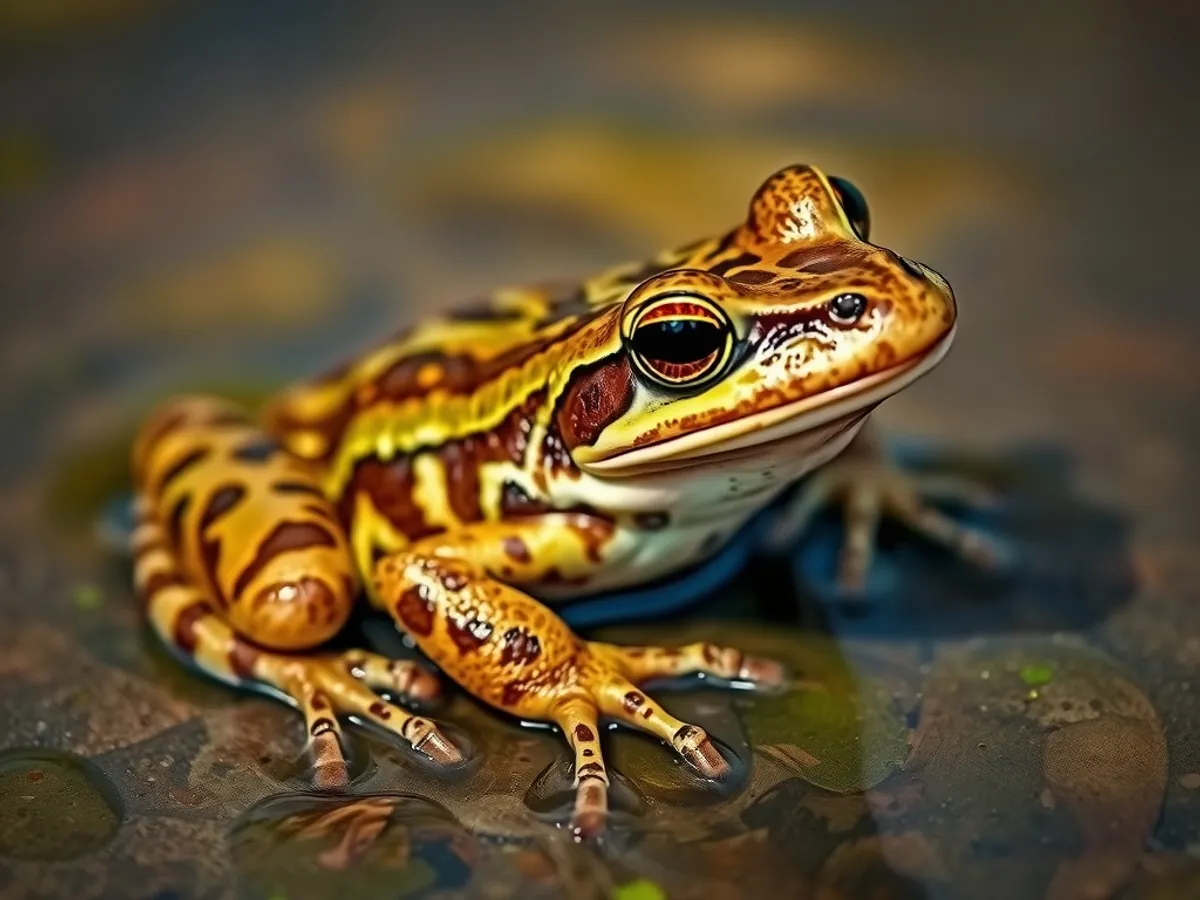
About the African Reed Frog
The African Reed Frog is a small, agile amphibian known for its vibrant coloration and remarkable adaptability. These frogs are typically found in wetlands, marshes, and reed beds throughout sub-Saharan Africa, often displaying a variety of colors and patterns, ranging from greens and yellows to browns and even blues. Their skin secretes a waxy substance that helps prevent dehydration, enabling them to thrive in both permanent and temporary water bodies. African Reed Frogs are especially famous for their loud, distinctive calls during the breeding season, which can be heard echoing across wetlands at dusk and night.
Fascinating facts
Masters of Color
African Reed Frogs can change their skin color, often to match their environment or mood, helping them avoid predators.
Loud Callers
During the rainy season, males gather and produce loud, high-pitched calls to attract females, creating a symphony in the wetlands.
Waxy Protection
These frogs produce a waxy secretion and spread it over their bodies to reduce water loss, a rare adaptation among amphibians.
Detailed description
The African Reed Frog (Hyperolius viridiflavus) is a small, slender amphibian, typically measuring 25–40 mm in length, with females generally larger than males. Its skin is smooth and often exhibits striking polymorphism, with individuals displaying a range of colors and patterns, including green, yellow, brown, and blue, often with spots or stripes. This coloration can change with age, sex, and environmental conditions, serving both camouflage and social signaling functions. The species possesses expanded toe pads that aid in climbing vegetation, a crucial adaptation for its semi-arboreal lifestyle. The ventral surface is usually pale, while the dorsal side is more vividly colored. African Reed Frogs are primarily nocturnal, seeking shelter among reeds and grasses during the day to avoid desiccation and predation. Their skin secretes a lipid-rich, waxy substance, which they spread over their bodies with their hind legs to reduce water loss—a vital adaptation for surviving in fluctuating wetland environments. The tympanum (external eardrum) is visible, reflecting their reliance on acoustic communication, especially during the breeding season. Their agile, lightweight bodies and long limbs allow for impressive jumping and climbing abilities, facilitating movement through dense vegetation.
Did you know?
Unlike most frogs, African Reed Frogs secrete a waxy coating they spread over their skin to prevent water loss in hot, dry conditions.
Research & sources
Behaviour & social structure
African Reed Frogs are most active at night, emerging at dusk to forage and call. They are primarily insectivorous, preying on a variety of small arthropods such as flies, mosquitoes, beetles, and spiders, which they capture with their sticky tongues. Hunting is typically a sit-and-wait strategy, with frogs remaining motionless until prey comes within range. Social interactions intensify during the breeding season, when males congregate in large choruses, each establishing small territories among reeds or floating vegetation. Their calls are loud, high-pitched trills, used to attract females and deter rival males. Outside the breeding season, they are more solitary, dispersing widely across suitable habitats. During the day, they rest on the undersides of leaves or among dense vegetation, minimizing water loss and exposure to predators. They exhibit rapid escape responses when threatened, leaping into water or dense cover.
Reproduction & life cycle
Breeding is closely tied to rainfall and typically occurs during the wet season, though in some regions with permanent water, reproduction can happen year-round. Males call from perches above water to attract females, engaging in vocal competition and occasional physical displays. Amplexus (mating embrace) is axillary, with the male grasping the female behind her forelimbs. Females lay clutches of 100–400 eggs, usually attaching them to submerged or emergent vegetation. The eggs hatch within 3–6 days, depending on temperature and humidity. Tadpoles are aquatic, feeding on algae and detritus, and undergo metamorphosis in 6–10 weeks. There is no parental care after egg-laying. High fecundity and rapid development are key strategies for surviving in temporary water bodies prone to drying.
Adaptations & survival
Hyperolius viridiflavus exhibits several notable adaptations. The waxy skin secretion is a unique evolutionary trait among reed frogs, enabling them to inhabit open, sun-exposed wetlands without desiccating. Their variable coloration provides camouflage against diverse backgrounds and may also play a role in thermoregulation and predator avoidance. Enlarged toe pads facilitate climbing and adherence to smooth plant surfaces. Their reproductive strategy—laying numerous eggs in ephemeral water bodies—reduces predation risk and allows rapid colonization of new habitats. The species' ability to tolerate a wide range of environmental conditions, including disturbed or artificial wetlands, underpins its remarkable ecological success.
Cultural significance
African Reed Frogs are often appreciated for their vibrant appearance and melodious calls, which are a familiar sound in many African wetlands. In some regions, they are featured in local folklore as symbols of rain and fertility, reflecting their close association with seasonal rains. Their presence is sometimes used as an indicator of healthy wetland ecosystems. There are no widespread traditional uses or significant roles in mythology compared to other African amphibians, but their ecological importance is recognized in environmental education and conservation outreach.
Recent research
Recent research has focused on the remarkable color polymorphism in Hyperolius viridiflavus, exploring its genetic basis and ecological significance. Studies have shown that color morphs can vary not only geographically but also within single populations, possibly driven by a combination of sexual selection and predation pressure. Bioacoustic analyses have detailed the structure and variability of male calls, which are important for species recognition and mate choice. Ongoing research is investigating the impact of environmental change on breeding phenology and population dynamics. The species is also used as a model for studying amphibian skin secretions and their potential antimicrobial properties.
Sources
Hyperolius viridiflavus (Anura: Hyperoliidae): polymorphism, systematics, and distribution
Schiøtz, A. (1999)
scientificHyperolius viridiflavus: The IUCN Red List of Threatened Species 2016
IUCN SSC Amphibian Specialist Group
conservationColor polymorphism and speciation in reed frogs (Hyperolius viridiflavus complex)
J. T. Evans, M. T. J. Johnson (2007)
scientificHyperolius viridiflavus: The IUCN Red List of Threatened Species 2016
IUCN SSC Amphibian Specialist Group
conservationVideos
Habitat
Wetlands, marshes, reed beds, and freshwater ponds
 Various Continental Regions
Grassland
Open areas dominated by grasses rather than trees, supporting numerous herbivores and their predators.
 Global
Forest
Wooded areas with significant tree cover and diverse plant and animal communities.
 Global
Freshwater
Lakes, rivers, and wetlands with diverse aquatic ecosystems.
Conservation
The African Reed Frog is currently classified as Least Concern on the IUCN Red List.
Threats & challenges
Currently assessed as Least Concern by the IUCN, African Reed Frogs remain widespread and abundant across sub-Saharan Africa. However, localized threats include habitat loss due to wetland drainage, agricultural expansion, pollution (especially pesticide runoff), and the introduction of predatory fish. Climate change poses a potential long-term threat by altering rainfall patterns and reducing suitable breeding sites. While the species shows resilience and adaptability, populations in heavily modified landscapes may experience declines. Disease, such as chytridiomycosis, has not been reported as a major threat for this species, but ongoing monitoring is warranted.
Taxonomy
Scientific name
Hyperolius viridiflavus
- Kingdom
- Animalia
- Phylum
- Chordata
- Class
- Amphibia
- Order
- Anura
- Family
- Hyperoliidae
- Genus
- Hyperolius
- Species
- viridiflavus
Community notes
Share your observations about the African Reed Frog.
No community notes yet. Be the first!
Discover more wildlife
More fascinating animals from the encyclopedia.