
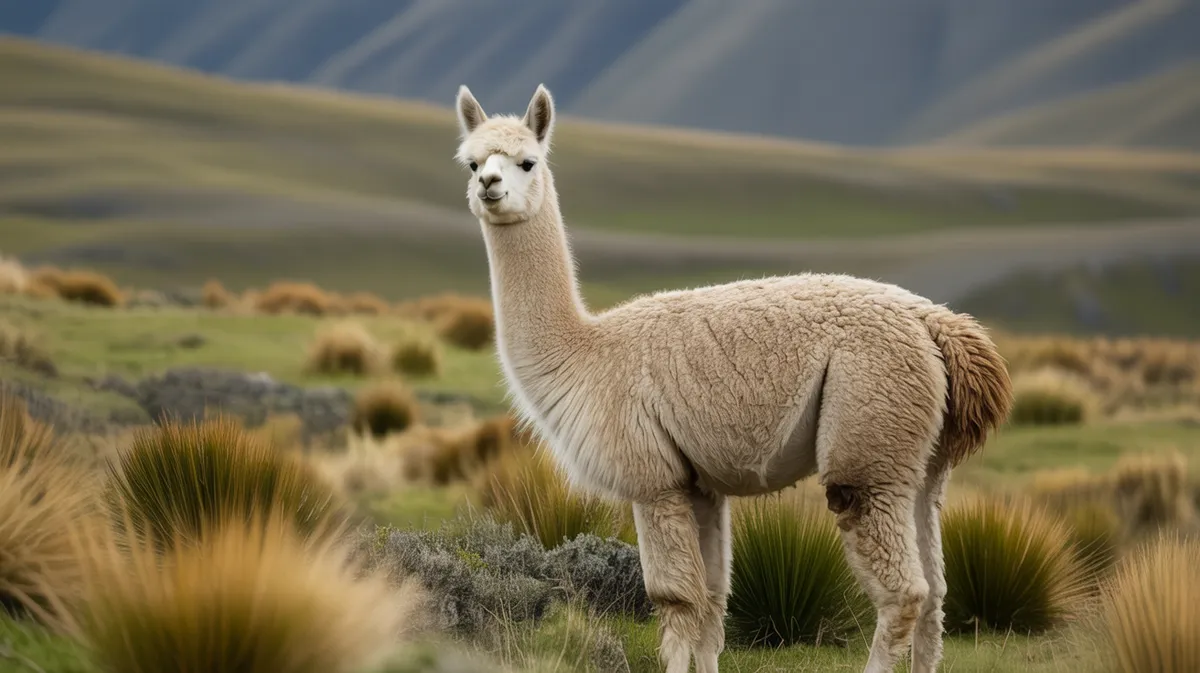
About the Alpaca
The alpaca is a domesticated species of South American camelid renowned for its soft and luxurious fleece, which is prized in the textile industry. Smaller than its close relative, the llama, alpacas are gentle, social animals that thrive in herds and are primarily kept for their wool. Originating from the high Andes mountains, they are well-adapted to cold, harsh environments at high altitudes. Alpacas have a calm temperament and communicate through body language and a variety of vocalizations. Their unique appearance, marked by long necks and large, expressive eyes, makes them a favorite among animal enthusiasts.
Fascinating facts
Softest Fleece
Alpaca fleece is softer and more insulating than sheep's wool and contains no lanolin, making it hypoallergenic.
High Altitude Dwellers
Alpacas are native to the Andes mountains, living at elevations between 3,500 and 5,000 meters above sea level.
Highly Social Animals
Alpacas are herd animals and rely on close social bonds, often communicating with each other through humming and body postures.
Detailed description
The alpaca (Vicugna pacos) is a small, domesticated camelid characterized by its slender body, long neck, and fine, dense fleece. Adults typically stand 81–99 cm (32–39 in) at the withers and weigh between 48–84 kg (106–185 lbs), with females generally smaller than males. Alpacas have a compact head, large, expressive eyes, and short, pointed ears, distinguishing them from their close relatives, the llama and vicuña. Their fleece, which lacks lanolin, comes in over 22 recognized natural colors and is highly valued for its softness, warmth, and hypoallergenic properties. Alpacas are gregarious animals, forming cohesive herds with defined social hierarchies, often led by a dominant female. They communicate through a range of vocalizations, including humming, grumbling, and alarm calls, as well as through body postures and ear movements. Adapted to high-altitude Andean environments (3,500–5,000 m), alpacas possess a high red blood cell count and efficient oxygen transport mechanisms. Their padded, two-toed feet minimize impact on fragile mountain grasslands. Alpacas are strictly herbivorous, grazing on native grasses and forbs, and their efficient three-chambered stomachs allow them to extract maximum nutrition from low-quality forage. Reproduction is seasonal, with a single offspring (cria) born after an 11–12 month gestation. Alpacas exhibit strong maternal care, with females nursing and protecting their young within the herd structure.
Did you know?
Alpacas have only been domesticated for about 6,000 years, making them one of the oldest domesticated livestock species in the world.
Research & sources
Wikipedia summary
The alpaca is a species of South American camelid mammal. Traditionally, alpacas were kept in herds that grazed on the level heights of the Andes of Southern Peru, Western Bolivia, Ecuador, and Northern Chile. More recently, alpacas may be found on farms and ranches worldwide, with thousands of animals born and raised annually. Alpacas are especially popular in North America, Europe, and Australia.
Behaviour & social structure
Alpacas are diurnal and spend much of their day grazing, interspersed with periods of rest and social interaction. They exhibit strong herd instincts, relying on group cohesion for protection against predators. Social hierarchies are established through subtle displays such as neck wrestling, spitting, and posturing, particularly among males. Spitting, a mixture of saliva and regurgitated stomach contents, is used primarily as a social deterrent rather than a defense against predators. Alpacas communicate using a variety of vocalizations: humming (contentment or curiosity), clucking (maternal communication), and sharp alarm calls when sensing danger. They are highly vigilant and will collectively alert the herd to threats. Feeding behavior involves selective grazing, with alpacas preferring tender shoots and avoiding toxic plants. They often use communal dung piles, which help reduce parasite loads and mark territory. Grooming and dust-bathing are common behaviors that help maintain fleece quality and skin health.
Reproduction & life cycle
Alpacas are induced ovulators, meaning ovulation is triggered by mating rather than occurring cyclically. Breeding can occur year-round in managed herds, but in the wild or traditional settings, it often peaks during the rainy season to ensure optimal forage availability for lactating females. Mating is a prolonged process, typically lasting 20–45 minutes, and occurs in a cush (recumbent) position. The gestation period averages 345 days (11–12 months), after which a single cria is born; twins are extremely rare. Births usually occur in the morning, which may reduce predation risk. Newborn crias weigh 6–9 kg (13–20 lbs) and are able to stand and nurse within an hour. Maternal care is pronounced, with females nursing crias for 4–6 months. Males do not participate in parental care and are often separated from breeding females to prevent aggressive behavior. Sexual maturity is reached at 12–24 months, with females often bred at 18 months and males at 2–3 years.
Adaptations & survival
Alpacas are highly adapted to the hypoxic, cold environments of the Andean highlands. Their blood has a high concentration of hemoglobin and red blood cells, facilitating efficient oxygen uptake at altitudes above 3,500 meters. Their thick, insulating fleece provides protection against temperature extremes and UV radiation. The fleece’s lack of lanolin makes it lightweight and water-resistant. Alpacas have split upper lips and a prehensile mouth, allowing them to selectively graze on sparse, low-nutrient vegetation. Their padded, two-toed feet minimize soil compaction and erosion, preserving fragile highland ecosystems. Behavioral adaptations include communal dung piles, which reduce parasite transmission and mark territory, and a strong herd instinct that enhances predator detection and deterrence. Their digestive system, with a three-compartment stomach, allows efficient fermentation and extraction of nutrients from fibrous plants.
Cultural significance
Alpacas have been integral to Andean cultures for over 6,000 years, valued for their fiber, meat, and as pack animals. Their fleece was historically reserved for Incan royalty and remains a symbol of wealth and status in Andean societies. Alpacas feature prominently in indigenous mythology and folklore, often associated with fertility and prosperity. Rituals and festivals, such as the annual 'Chaccu' shearing event, celebrate their importance. In contemporary times, alpacas are central to rural economies, ecotourism, and sustainable agriculture initiatives in South America. Globally, they are popular in hobby farming, therapeutic animal programs, and as ambassadors for Andean culture.
Recent research
Recent genetic studies have clarified the alpaca’s ancestry, confirming its domestication from the wild vicuña (Vicugna vicugna) rather than the guanaco, as previously thought. Ongoing research focuses on improving fiber quality through selective breeding, understanding disease resistance (notably to parasites and respiratory pathogens), and optimizing nutrition in non-native environments. Studies on alpaca behavior have highlighted their complex social structures and communication systems. Conservation genetics research aims to preserve rare color morphs and maintain genetic diversity within global populations. Advances in reproductive technologies, such as artificial insemination and embryo transfer, are being explored to enhance breeding programs.
Videos
Habitat
Mountain grasslands and high-altitude plains


Conservation
The Alpaca is currently classified as Least Concern on the IUCN Red List.
Threats & challenges
While alpacas are classified as Least Concern by the IUCN, they face several challenges. Habitat degradation due to overgrazing, agricultural expansion, and climate change threatens the quality and availability of native pastures. Disease transmission, particularly from introduced livestock, poses health risks. Genetic dilution from crossbreeding with llamas can impact fleece quality and breed integrity. In some regions, poaching and predation by feral dogs or native carnivores (e.g., pumas) are concerns. The global alpaca industry is sensitive to market fluctuations in fiber prices, which can affect herd management and conservation incentives. However, the species' wide geographic distribution and adaptability to diverse climates have contributed to stable population trends.
Taxonomy
Scientific name
Vicugna pacos
- Kingdom
- Animalia
- Phylum
- Chordata
- Class
- Mammalia
- Order
- Artiodactyla
- Family
- Camelidae
- Genus
- Vicugna
- Species
- pacos
Where to see an alpaca
25 zoos and aquariums in 7 countries are recorded as keeping this species.
 Alaska Zoo🇺🇸 Anchorage, United States
 Calgary Zoo🇨🇦 Calgary, Canada
 Metro Richmond Zoo🇺🇸 Moseley, United States
 National Zoological Park🇺🇸 Washington, United States
 Śląski Ogród Zoologiczny🇵🇱 Chorzów, Poland
Community notes
Share your observations about the Alpaca.
No community notes yet. Be the first!
Discover more wildlife
More fascinating animals from the encyclopedia.