
About the Amazon Milk Frog
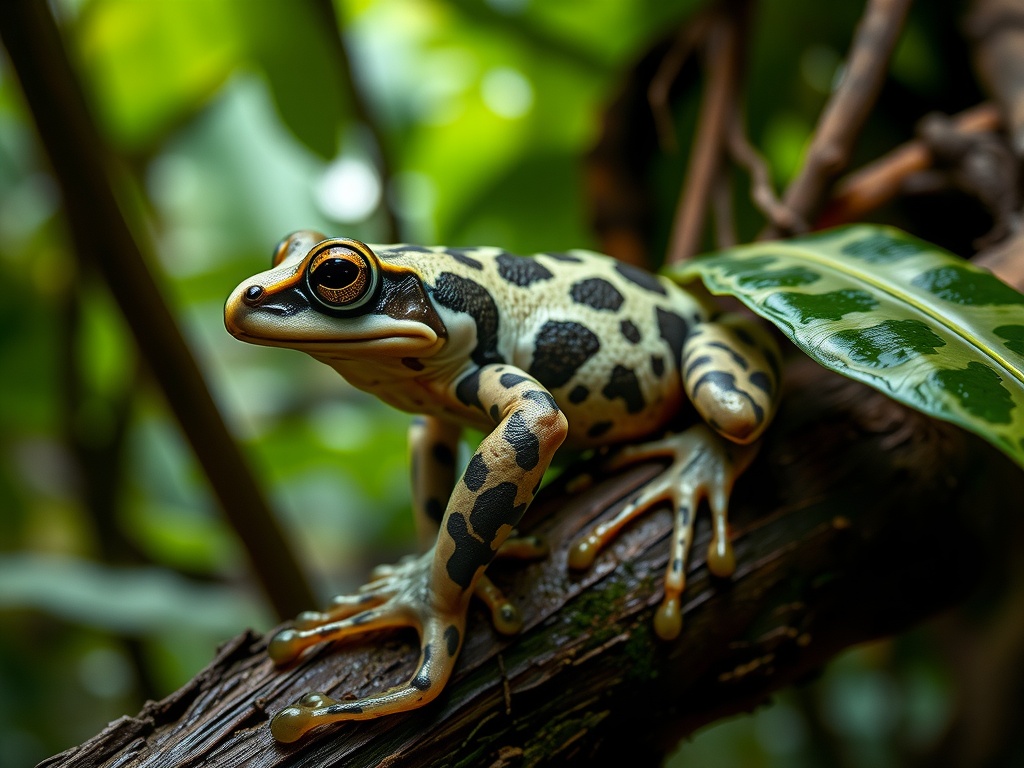
The Amazon Milk Frog is a striking tree frog native to the Amazon Rainforest, easily recognized by its pale blue-gray body adorned with brown or black banding. This nocturnal amphibian gets its name from the milky, sticky secretion it produces when stressed, which serves as a defense against predators. They are arboreal, spending most of their life high in the rainforest canopy, and are known for their loud, distinctive calls during the rainy season. Amazon Milk Frogs thrive in humid, tropical environments and are popular in the pet trade due to their unique appearance and manageable size.
Fascinating facts
Arboreal Lifestyle
Amazon Milk Frogs spend most of their lives in trees, rarely descending to the forest floor except to breed in water-filled tree holes.
Milky Secretions
When threatened, these frogs excrete a sticky, white, milk-like substance from their skin, which is toxic to many predators.
Loud Vocalizations
Males produce loud, barking calls during the rainy season to attract females and establish territory.
Detailed description
The Amazon Milk Frog (Trachycephalus resinifictrix) is a robust, medium-to-large hylid frog, with adults typically reaching 6–10 cm (2.4–4 in) in snout-vent length and weighing up to 40 grams. Its striking coloration consists of a pale blue-gray or greenish base with bold, irregular dark brown or black banding, and juveniles often appear more vividly colored than adults. The skin is smooth but covered with small, granular tubercles, giving it a slightly bumpy texture. Notably, the species has large, golden or bronze eyes with horizontal pupils, which aid in nocturnal vision. Specialized toe pads enable strong adhesion to smooth, vertical surfaces, facilitating an arboreal lifestyle high in the rainforest canopy. Amazon Milk Frogs are primarily nocturnal, emerging at dusk to forage and vocalize. Their name derives from the milky, mildly toxic secretion produced by their skin glands when threatened, which deters predators. They are generally solitary outside of the breeding season but may aggregate in suitable breeding sites. During the rainy season, males produce loud, distinctive calls to attract females, and breeding occurs in tree holes or water-filled cavities, where eggs and tadpoles develop. This species is adapted to humid, stable microclimates and is sensitive to environmental changes.
Did you know?
Despite their striking appearance and secretions, Amazon Milk Frogs are not dangerous to humans and are often kept as exotic pets.
Research & sources
Wikipedia summary
The Mission golden-eyed tree frog or Amazon milk frog is a large species of arboreal frog native to the Amazon Rainforest in South America. It is sometimes referred to as the blue milk frog due to a sticky, milk-like substance that they produce when feeling threatened. It was first discovered along the Maracanã River in Brazil. This species was previously within the genus Phrynohyas, which was recently synonymized with Trachycephalus.
Behaviour & social structure
Amazon Milk Frogs are primarily nocturnal and arboreal, spending daylight hours hidden in tree hollows or among dense foliage to avoid desiccation and predation. At night, they become active, foraging for a variety of invertebrates such as insects, spiders, and occasionally smaller frogs. Their hunting strategy is sit-and-wait ambush, relying on camouflage and quick tongue projection to capture prey. Social interactions are limited outside the breeding season, with individuals maintaining loose territories. During the breeding season, males congregate at water-filled tree holes and engage in vocal competitions, producing resonant, low-pitched calls to attract females and deter rivals. Aggressive encounters between males are rare but may involve physical posturing and wrestling. Tadpoles are gregarious and may exhibit cannibalistic behavior if food resources are scarce.
Reproduction & life cycle
Breeding is closely tied to the onset of the rainy season, typically from November to April in the Amazon basin. Males call from the edges of tree holes or phytotelmata (water-filled plant cavities), and receptive females are drawn by these vocalizations. Amplexus is axillary, with the male grasping the female behind her forelimbs. Females lay clutches of 100–200 eggs on the inner walls of tree holes above the waterline. Upon hatching (after 24–36 hours), the tadpoles drop into the water below, where they continue development. Larval period lasts 6–8 weeks, depending on temperature and food availability. There is no parental care post-oviposition, but females may return to lay additional eggs, providing a food source for earlier-hatched tadpoles (oophagy). Metamorphosed juveniles leave the water and climb into the canopy.
Adaptations & survival
Amazon Milk Frogs possess several adaptations for arboreal life, including enlarged toe pads with specialized mucous glands for adhesion, and long limbs for leaping between branches. Their skin secretes a milky, mildly toxic substance containing peptides and alkaloids, which acts as a chemical defense against predators and pathogens. The cryptic banded coloration provides camouflage among lichen- and moss-covered bark. Their ability to breed in phytotelmata reduces competition and predation risk for eggs and tadpoles. Physiologically, they exhibit resistance to dehydration, with behaviors such as nocturnal activity and retreating to humid microhabitats. The species also demonstrates rapid larval development, an adaptation to the ephemeral nature of tree hole water bodies.
Cultural significance
While not deeply embedded in indigenous mythology, the Amazon Milk Frog is occasionally referenced in local folklore as a rain-bringer due to its vocalizations during storms. In modern times, it has gained popularity in the exotic pet trade for its striking appearance and manageable care requirements. Its unique defensive secretions have attracted scientific interest for potential pharmacological applications, though no traditional medicinal uses are widely documented.
Recent research
Recent studies have focused on the chemical composition of the skin secretions, revealing antimicrobial peptides that may have biomedical applications. Ongoing research examines the species' reproductive ecology, particularly the role of oophagy and larval competition in tree hole environments. Genetic analyses have clarified its taxonomic placement, confirming the synonymization of Phrynohyas with Trachycephalus. Conservation research is monitoring the effects of habitat fragmentation and climate variability on population dynamics. The species is also used as a model for studying arboreal amphibian adaptations and the evolution of phytotelm breeding.
Videos
Habitat
Tropical rainforest canopy
 Tropical Regions
Rainforest
Dense, wet forests with the highest biodiversity on Earth, containing more than half of the world's plant and animal species.
 Global
Forest
Wooded areas with significant tree cover and diverse plant and animal communities.
 Global
Freshwater
Lakes, rivers, and wetlands with diverse aquatic ecosystems.
Conservation
The Amazon Milk Frog is currently classified as Least Concern on the IUCN Red List.
Threats & challenges
Currently assessed as Least Concern by the IUCN, Amazon Milk Frogs have stable populations across much of their range. However, localized threats include habitat loss due to deforestation, logging, and conversion of rainforest to agriculture. The pet trade poses a potential risk, though most individuals in captivity are now captive-bred. Climate change and associated alterations in rainfall patterns could impact breeding success by reducing the availability of suitable tree hole habitats. Pollution and disease, particularly chytridiomycosis, are emerging concerns for amphibian populations globally, though there is limited evidence of significant impact on this species to date.
Taxonomy
Scientific name
Trachycephalus resinifictrix
- Kingdom
- Animalia
- Phylum
- Chordata
- Class
- Amphibia
- Order
- Anura
- Family
- Hylidae
- Genus
- Trachycephalus
- Species
- resinifictrix
Where to see an amazon milk frog
7 zoos and aquariums in 1 country are recorded as keeping this species.
 Georgia Aquarium🇺🇸 Atlanta, United States
 Santa Barbara Zoological Gardens🇺🇸 Santa Barbara, United States
 Memphis Zoo🇺🇸 Memphis, United States
 Sacramento Zoo🇺🇸 Sacramento, United States
 Cleveland Metroparks Zoo🇺🇸 Cleveland, United States
Community notes
Share your observations about the Amazon Milk Frog.
No community notes yet. Be the first!
Discover more wildlife
More fascinating animals from the encyclopedia.