
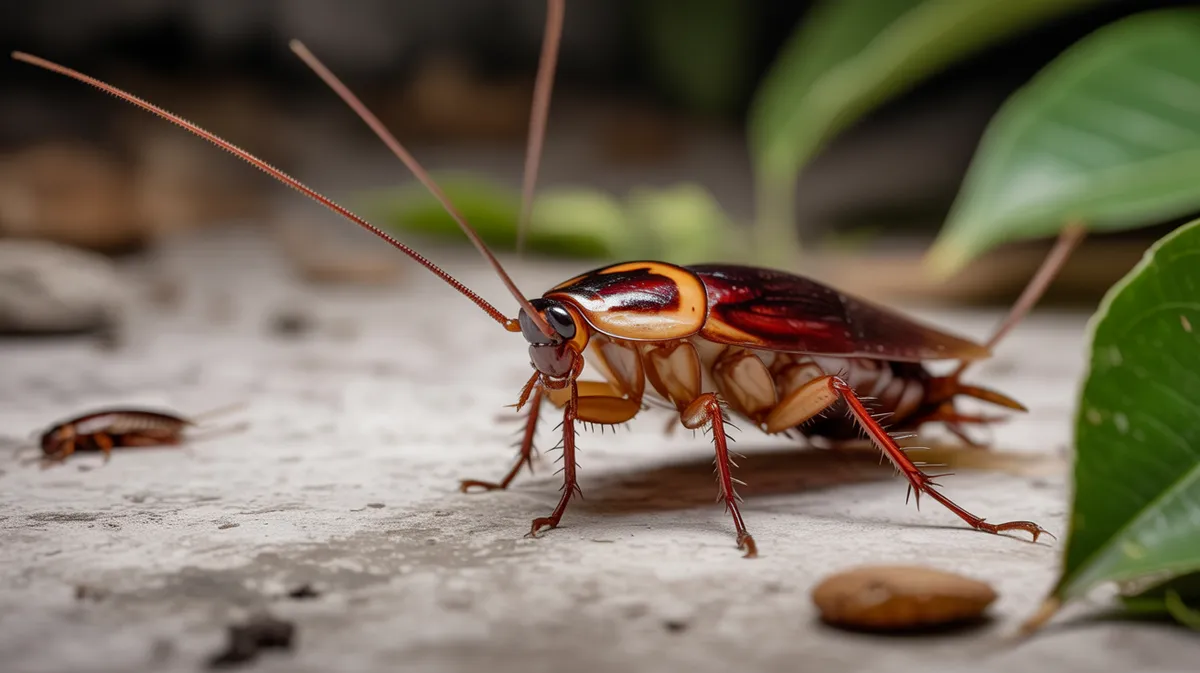
About the American cockroach
The American cockroach is one of the largest and most common cockroach species found worldwide, particularly in warm and humid environments. Recognizable by its reddish-brown color and yellowish figure-eight pattern on the back of its head, this insect is highly adaptable and thrives in both natural and human-inhabited environments. Despite its name, the American cockroach is believed to have originated in Africa and was introduced to the Americas in the 17th century. It is an omnivorous scavenger, feeding on a wide variety of decaying organic matter, and is known for its rapid movements and impressive resilience.
Fascinating facts
Fast Movers
American cockroaches are among the fastest running insects, capable of scurrying at speeds up to 3.4 miles per hour.
Excellent Survivors
They can survive for weeks without food and up to a week without water, making them highly resilient pests.
Global Travelers
Although called 'American,' this species originally came from Africa and has now spread globally due to human activity.
Detailed description
The American cockroach (Periplaneta americana) is a large, hemimetabolous insect, typically measuring 30–54 mm in length, with a wingspan that can reach up to 100 mm in adults. Its body is elongated and oval-shaped, with a glossy reddish-brown exoskeleton and a distinctive yellowish figure-eight pattern on the pronotum (the shield-like structure behind the head). Both sexes possess fully developed wings, though they are primarily gliders rather than strong fliers. The antennae are long, slender, and highly sensitive, aiding in navigation and food detection. American cockroaches are nocturnal, spending daylight hours hidden in moist, dark environments. Their compound eyes provide a wide field of vision, enhancing their ability to evade predators. The legs are spiny and adapted for rapid movement, allowing them to reach speeds up to 5.4 km/h (1.5 m/s). Internally, they possess a highly efficient digestive system capable of processing a wide range of organic materials, contributing to their success as scavengers. Their respiratory system consists of spiracles and tracheae, enabling them to survive in low-oxygen environments such as sewers and basements.
Did you know?
Despite their reputation, American cockroaches play an important role in the ecosystem by breaking down organic matter and recycling nutrients.
Research & sources
Wikipedia summary
The American cockroach is the largest species of common cockroach, and often considered a pest. In certain regions of the U.S. it is colloquially known as the waterbug, though it is not a true waterbug since it is not aquatic. It is also known as the ship cockroach, kakerlac, and Bombay canary. It is often misidentified as a palmetto bug.
Behaviour & social structure
American cockroaches are primarily solitary but may aggregate in favorable environments with abundant food and moisture. They are omnivorous scavengers, feeding on decaying plant and animal matter, starchy materials, and even non-food items like paper and glue. Foraging activity peaks during the night, with individuals using chemical cues and pheromones to locate food sources. They exhibit thigmotaxis, preferring to stay in contact with surfaces, which aids in their concealment. When threatened, they can rapidly flee and may employ gliding to escape predators. Social interactions are limited, but nymphs and adults may communicate via cuticular hydrocarbons and aggregation pheromones. Cannibalism can occur, especially under crowded or resource-limited conditions. Their daily routine involves periods of rest in sheltered locations, interspersed with active foraging and grooming.
Reproduction & life cycle
Reproduction in Periplaneta americana involves internal fertilization following a courtship that includes antennal contact and pheromone signaling. Females produce oothecae (egg cases), each containing 14–16 eggs, and deposit them in hidden, moist locations. The incubation period is temperature-dependent, typically lasting 24–38 days. Females can produce up to 90 oothecae in their lifetime, leading to prolific population growth under optimal conditions. Nymphs emerge from the oothecae and undergo 10–13 molts over 6–12 months before reaching adulthood. There is no parental care after ootheca deposition. Breeding occurs year-round in warm environments, but may be seasonally restricted in cooler climates.
Adaptations & survival
American cockroaches possess several adaptations for survival in urban and natural environments. Their flattened bodies allow them to squeeze through narrow crevices, while their rapid running speed aids in predator evasion. The cuticle is resistant to desiccation, enabling survival in dry conditions. They can tolerate a wide range of temperatures (0–40°C) and can survive without food for up to a month, though only a week without water. Their omnivorous diet and ability to digest cellulose and other tough materials, thanks to symbiotic gut bacteria and protozoa, allow them to exploit diverse food sources. Behavioral plasticity, such as aggregation and thigmotaxis, enhances their ability to find suitable microhabitats. They also display resistance to certain insecticides, a result of both behavioral avoidance and physiological detoxification mechanisms.
Cultural significance
The American cockroach is often associated with filth and disease in human culture, leading to its status as a symbol of resilience and uncleanliness. It appears in urban legends and is frequently referenced in literature and media as an example of pestiferous tenacity. In some cultures, cockroaches are used in traditional medicine or as food, though Periplaneta americana is not commonly consumed. The species' adaptability and survival skills have made it a subject of scientific study and a metaphor for persistence in adversity.
Recent research
Recent research has focused on the American cockroach's microbiome, revealing a diverse array of symbiotic bacteria and fungi that contribute to digestion and resistance to pathogens. Genomic studies have identified genes associated with detoxification and insecticide resistance, providing insights into their adaptability. Behavioral studies have explored their aggregation pheromones and social interactions, with potential applications in pest control. Ongoing research investigates their role as vectors of antibiotic-resistant bacteria in urban environments and their physiological adaptations to extreme conditions, such as hypoxia and dehydration.
Videos
Habitat
Urban environments, sewers, basements, tropical and subtropical regions

Conservation
The American cockroach is currently classified as Least Concern on the IUCN Red List.
Threats & challenges
As a species of Least Concern, American cockroaches face few natural threats, with primary predators including birds, amphibians, reptiles, and some mammals. Human control efforts, such as sanitation and insecticide application, are the main challenges to their populations in urban settings. However, their adaptability and resistance to many chemical treatments make eradication difficult. Urbanization and climate change may further expand their range, particularly in temperate regions. While not currently threatened, their presence can pose health risks to humans as mechanical vectors of pathogens and allergens.
Taxonomy
Scientific name
Periplaneta americana
- Kingdom
- Animalia
- Phylum
- Arthropoda
- Class
- Insecta
- Order
- Blattodea
- Family
- Blattidae
- Genus
- Periplaneta
- Species
- americana
Community notes
Share your observations about the American cockroach.
No community notes yet. Be the first!
Discover more wildlife
More fascinating animals from the encyclopedia.