
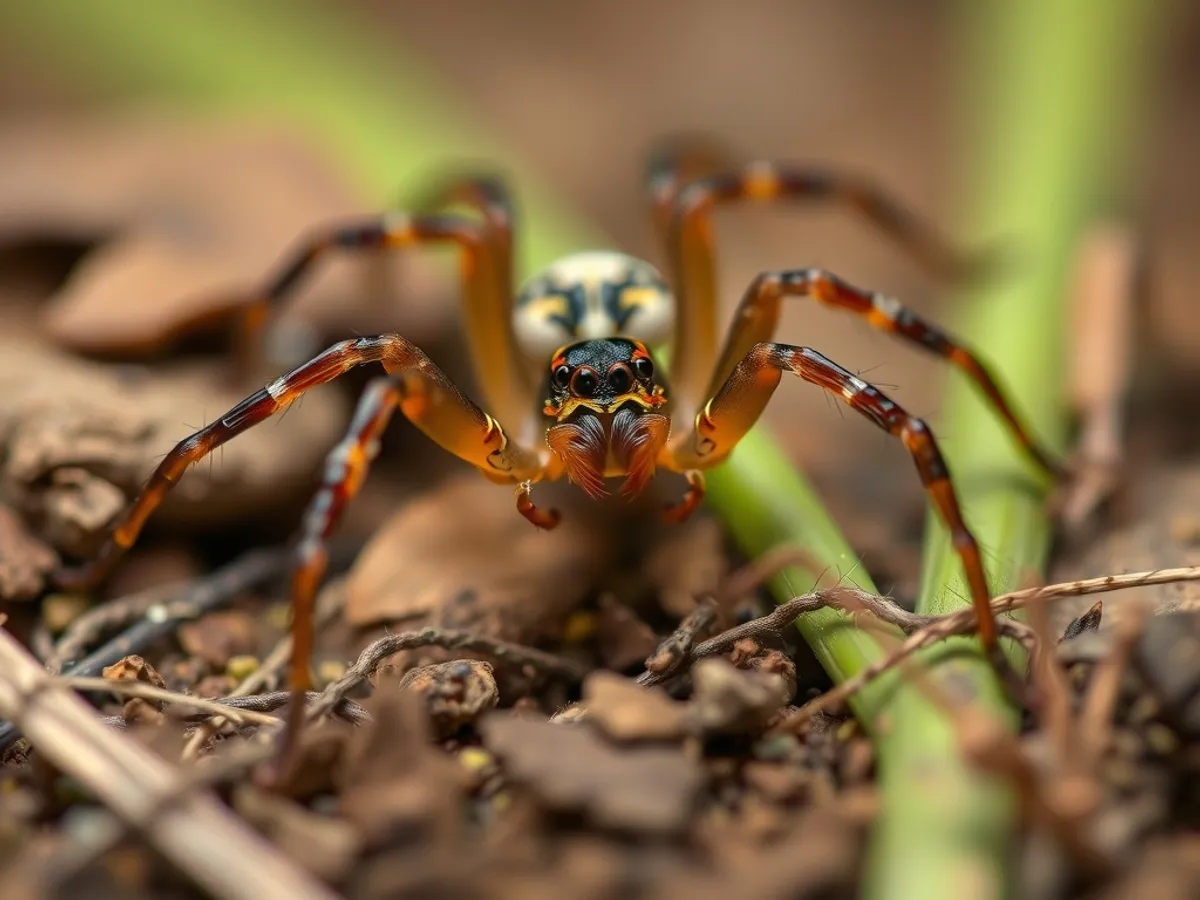
About the Ant-mimicking Spider
The ant-mimicking spider is a remarkable arachnid known for its striking resemblance to ants, both in appearance and behavior. This mimicry helps protect the spider from predators that typically avoid ants due to their aggressive nature and chemical defenses. Found in various regions across Europe and Asia, ant-mimicking spiders are agile hunters that rely on their speed and keen vision. They use their front pair of legs to imitate antennae, further enhancing their ant-like disguise.
Fascinating facts
Master Mimic
Ant-mimicking spiders imitate ants so well that even experienced predators can be fooled, offering them protection from being eaten.
Keen Vision
As members of the jumping spider family, they possess excellent eyesight, which helps them hunt small insects with precision.
Ant Colony Infiltrator
Some ant-mimicking spiders can live among ants, benefiting from their protection and sometimes preying on them or their larvae.
Detailed description
Myrmarachne formicaria, commonly known as the ant-mimicking spider, is a small jumping spider species distinguished by its remarkable morphological and behavioral mimicry of ants. Adults typically measure 5–7 mm in body length, with elongated bodies, constricted waists, and a cephalothorax that is distinctly divided to resemble the head and thorax of an ant. The first pair of legs are elongated and often held aloft to simulate ant antennae, enhancing the illusion. Their coloration varies from reddish-brown to black, closely matching the local ant species they mimic. Myrmarachne formicaria possesses large anterior median eyes, characteristic of Salticidae, granting them acute vision for detecting prey and predators. They are diurnal and highly agile, capable of rapid, precise jumps. Unlike true ants, they have eight legs and lack antennae, but their movement patterns and frequent pauses further reinforce their mimicry. This species is solitary, with individuals occupying small territories on vegetation or leaf litter. Their mimicry not only deters visually oriented predators but also allows them to approach ant-tended prey with reduced risk.
Did you know?
Despite looking and acting like ants, ant-mimicking spiders are skilled jumpers and belong to the jumping spider family (Salticidae).
Research & sources
Behaviour & social structure
Myrmarachne formicaria exhibits complex behavioral mimicry, including ant-like locomotion, frequent antennal mimicry with their forelegs, and zigzag walking patterns. They are active hunters, relying on their acute vision to stalk and ambush small arthropods, primarily springtails, aphids, and other tiny insects. Unlike web-building spiders, they do not construct capture webs but may use silk for draglines, retreats, or egg sacs. Social interactions are minimal outside of courtship and territorial disputes, as they are largely solitary. During the day, they patrol vegetation and ground surfaces, often found near ant trails, which they exploit for both protection and hunting opportunities. At night, they retreat to silken shelters spun under leaves or bark.
Reproduction & life cycle
Reproduction in Myrmarachne formicaria involves elaborate courtship displays, with males performing visual and vibratory signals to attract females while avoiding being mistaken for prey. Mating typically occurs in late spring to early summer. After successful copulation, females lay eggs in a silken sac, which they guard vigilantly until spiderlings emerge, usually after 2–3 weeks. Parental care is limited to guarding the egg sac; once spiderlings disperse, they are independent. There is typically one generation per year in temperate regions, with overwintering occurring in the egg or juvenile stage.
Adaptations & survival
The most notable adaptation of Myrmarachne formicaria is its Batesian mimicry of ants, which provides protection from predators such as birds and larger arthropods that avoid ants due to their aggressive behavior and chemical defenses. Morphologically, the spider's constricted cephalothorax and elongated pedicel create a false 'waist,' while coloration and surface textures mimic the exoskeleton of ants. Behaviorally, the spider mimics ant movement, including antennal simulation with its forelegs and erratic walking. Its jumping ability, derived from the Salticidae family, allows rapid escape from threats and efficient predation. Additionally, its keen vision aids in both mimicry and hunting.
Cultural significance
While Myrmarachne formicaria does not have a prominent role in folklore or mythology, its striking mimicry has made it a subject of fascination for naturalists and educators. The species is often featured in scientific outreach and educational materials to illustrate concepts of mimicry, adaptation, and evolutionary biology. It is occasionally referenced in popular culture and art as an example of nature's ingenuity.
Recent research
Recent research on Myrmarachne formicaria has focused on the evolutionary mechanisms and selective pressures driving ant mimicry, including predator avoidance and interspecies interactions. Studies using high-speed videography have detailed the spider's movement patterns and confirmed the effectiveness of its mimicry in deterring predators. Genetic analyses have explored the phylogenetic relationships within the Myrmarachne genus, revealing multiple independent origins of ant mimicry. Ongoing research investigates the neural basis of visual processing in these spiders, given their reliance on acute vision for both mimicry and predation.
Sources
Ant mimicry in jumping spiders: Morphological and behavioral adaptations in Myrmarachne formicaria
Ceccarelli, F. S. (2008)
scientificThe evolution and development of ant mimicry in spiders
Nelson, X. J., Jackson, R. R. (2006)
scientificIUCN Red List of Threatened Species: Myrmarachne formicaria
International Union for Conservation of Nature (IUCN)
conservationAnt-mimicking jumping spiders (Araneae: Salticidae): taxonomy, mimicry, and behavior
Ceccarelli, F. S. (2010)
scientificThe effectiveness of ant mimicry in Myrmarachne formicaria
Nelson, X. J., Jackson, R. R. (2022)
scientificVideos
Habitat
Forest edges, grasslands, and gardens


Conservation
The Ant-mimicking Spider is currently classified as Least Concern on the IUCN Red List.
Threats & challenges
Currently, Myrmarachne formicaria faces few significant threats and is classified as Least Concern by conservation authorities. However, local populations may be affected by habitat loss due to agricultural expansion, urbanization, and pesticide use, which can reduce prey availability and suitable microhabitats. Climate change may also impact their distribution, particularly at the northern limits of their range. Despite these challenges, the species remains widespread and adaptable across much of Europe and temperate Asia.
Taxonomy
Scientific name
Myrmarachne formicaria
- Kingdom
- Animalia
- Phylum
- Arthropoda
- Class
- Arachnida
- Order
- Araneae
- Family
- Salticidae
- Genus
- Myrmarachne
- Species
- formicaria
Community notes
Share your observations about the Ant-mimicking Spider.
No community notes yet. Be the first!
Discover more wildlife
More fascinating animals from the encyclopedia.