
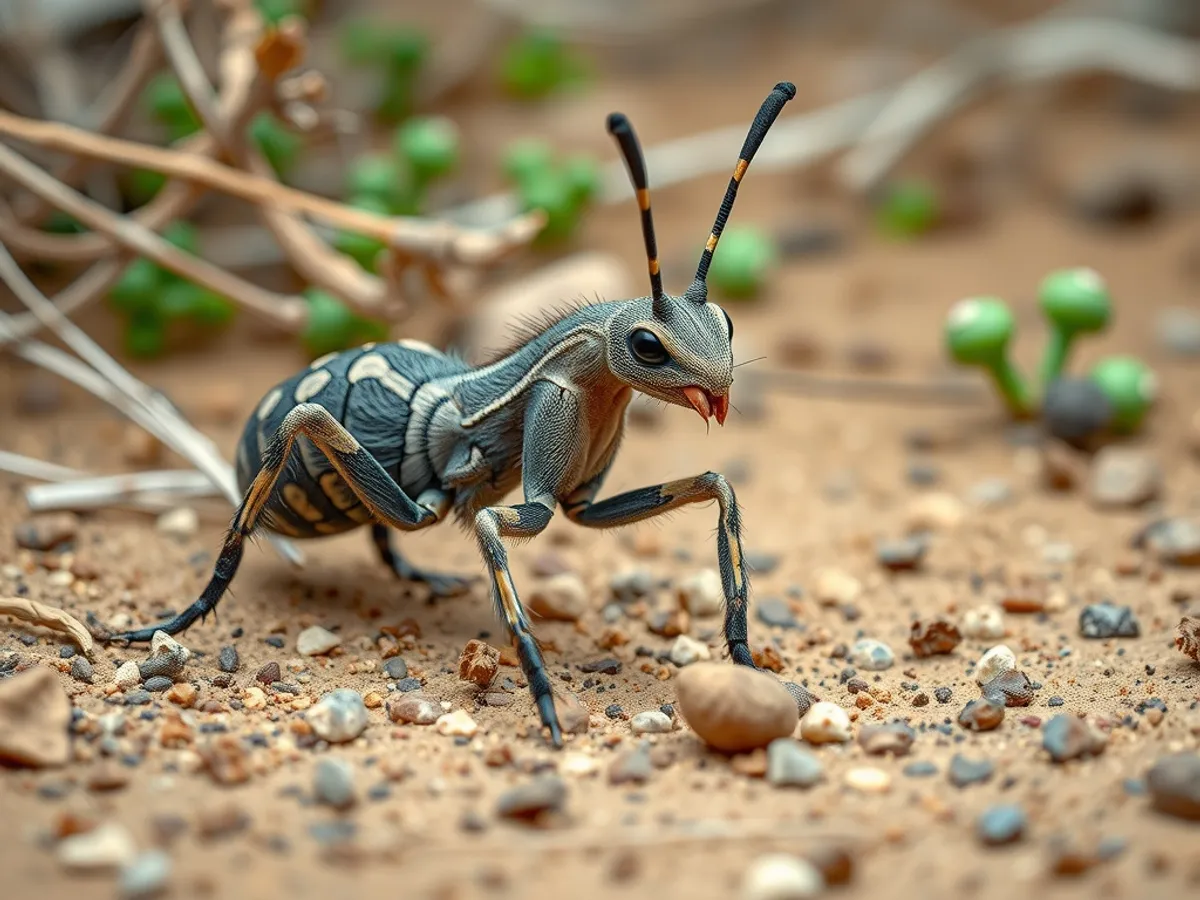
About the Antlion
Antlions are fascinating insects best known for their predatory larvae, which create conical pits in sandy soils to trap unsuspecting ants and other small insects. The larvae are equipped with large, powerful jaws used to seize and consume prey. Adult antlions resemble slender, delicate damselflies but are nocturnal and weak fliers. They are most commonly found in warm, sandy habitats where their larvae can easily excavate pits for hunting. Despite their fierce appearance as larvae, adult antlions feed primarily on nectar and pollen.
Fascinating facts
Pitfall Architects
Antlion larvae build perfectly shaped conical sand traps to ensnare ants and other small insects.
Ferocious Larvae
Their larvae possess massive, sickle-shaped jaws capable of injecting digestive enzymes to liquefy their prey.
Nocturnal Adults
Adult antlions are mostly active at night and are often mistaken for damselflies due to their slender bodies and delicate wings.
Detailed description
The antlion (Myrmeleon formicarius) is a neuropteran insect distinguished by its remarkable life cycle and predatory larval stage. The larva, often called a 'doodlebug,' measures about 8–15 mm in length and has a robust, flattened body with a broad thorax and a tapering abdomen. Its most notable anatomical feature is a pair of elongated, sickle-shaped mandibles equipped with hollow channels for injecting digestive enzymes into prey. The larva is covered in fine bristles that aid in camouflage and sand manipulation. Adult antlions, in contrast, are delicate, slender insects with a wingspan of 50–70 mm, long clubbed antennae, and two pairs of intricately veined, transparent wings held roof-like over the body at rest. Adults are weak fliers, typically active at dusk or night, and are often mistaken for damselflies, though they can be distinguished by their longer, clubbed antennae and different wing venation. Antlions exhibit holometabolous development, undergoing complete metamorphosis from egg to larva, pupa, and adult. The larvae are solitary and highly specialized ambush predators, while adults are primarily nectarivorous and play a minor role in pollination. The species is widespread across Europe and temperate Asia, favoring sandy soils in open woodlands, heaths, and grasslands, where larvae can easily construct their characteristic conical pits. Their cryptic coloration and nocturnal habits make adults seldom seen, while larvae are more frequently encountered by their distinctive pitfall traps.
Did you know?
Despite their fearsome larval hunting strategies, adult antlions do not eat other insects and instead feed on nectar and pollen.
Research & sources
Wikipedia summary
The antlions are a group of about 2,000 species of insect in the neuropteran family Myrmeleontidae. They are known for the predatory habits of their larvae, which mostly dig pits to trap passing ants or other prey. In North America, the larvae are sometimes referred to as doodlebugs because of the marks they leave in the sand. The adult insects are less well known due to their relatively short lifespans in comparison with the larvae. Adults, sometimes known as antlion lacewings, mostly fly at dusk or just after dark and may be mistakenly identified as dragonflies or damselflies.
Behaviour & social structure
Antlion larvae are solitary and territorial, each constructing its own pit, typically 2–5 cm in diameter and up to 2 cm deep, in loose, dry sand sheltered from rain and wind. The larva buries itself at the base of the pit, leaving only its jaws exposed. When an ant or other small arthropod falls in, the larva rapidly flicks sand to destabilize the prey, causing it to slide toward the center where it is seized and immobilized with venomous saliva. Digestion is external: the larva injects enzymes and then sucks out the liquefied tissues. Larvae are largely sedentary, remaining in their pits for weeks or months, but may relocate if conditions become unfavorable. Adults are crepuscular to nocturnal, flying weakly and often resting on vegetation during the day. They are solitary, non-territorial, and do not form aggregations. Adults feed on nectar and pollen, rarely hunting live prey.
Reproduction & life cycle
Mating in Myrmeleon formicarius occurs shortly after adult emergence, typically in late spring or summer. Courtship is minimal, with males locating females by pheromones or visual cues. Copulation lasts several minutes, after which females lay eggs singly or in small clusters, often buried in loose sand or soil near suitable larval habitats. Each female can lay several hundred eggs over her lifespan. The eggs hatch after 2–3 weeks, depending on temperature. Larvae undergo three instars, with development spanning one to three years, particularly in cooler climates. Pupation occurs in a silken cocoon constructed from sand grains and silk, buried just beneath the surface. The pupal stage lasts 3–4 weeks, after which the adult emerges, leaving the cocoon behind. There is no parental care; all life stages are independent.
Adaptations & survival
Antlion larvae exhibit several remarkable adaptations for their ambush predatory lifestyle. Their conical pit traps exploit the physics of granular materials: the slope angle is close to the sand's angle of repose, making escape difficult for prey. The larva's backward movement and flicking of sand help maintain the pit and dislodge prey. Their jaws are highly specialized for both subduing prey and sucking out liquefied tissues. Camouflage is enhanced by body bristles that collect sand grains. Adults have cryptic coloration and nocturnal habits to avoid predation. Both larvae and adults possess well-developed sensory organs for detecting vibrations and chemical cues in their environment.
Cultural significance
Antlions have captured human imagination for centuries, particularly their larval pit-building behavior. In European folklore, they were sometimes associated with patience and cunning. The name 'antlion' derives from the larva's predation on ants, likening it to a lion among ants. In North America, the term 'doodlebug' refers to the winding trails larvae leave in the sand. Antlions occasionally appear in literature and children's stories as symbols of cleverness or as metaphors for traps and patience. There are no significant traditional uses, but their unique behavior makes them popular subjects in natural history education.
Recent research
Recent research has focused on the biomechanics of pit construction and prey capture, revealing that antlion larvae optimize pit geometry to maximize prey capture efficiency. Studies using high-speed videography and granular physics have elucidated how larvae use rapid sand flicking to destabilize prey. Molecular phylogenetic studies have clarified relationships within Myrmeleontidae, indicating that pit-building evolved multiple times independently. Ongoing research investigates the impact of microhabitat selection on larval survival and the potential effects of climate change on distribution. Antlions are also used as model organisms in studies of predator-prey interactions and behavioral ecology.
Sources
Videos
Habitat
Sandy soils, dry open forests, and grasslands
 Various Continental Regions
Grassland
Open areas dominated by grasses rather than trees, supporting numerous herbivores and their predators.
 Arid Regions
Desert
Arid lands with minimal rainfall, extreme temperatures, and specialized wildlife adapted to harsh conditions.
 Global
Forest
Wooded areas with significant tree cover and diverse plant and animal communities.
Conservation
The Antlion is currently classified as Least Concern on the IUCN Red List.
Threats & challenges
Currently, Myrmeleon formicarius is listed as Least Concern, with stable populations across much of its range. However, local threats include habitat loss due to urbanization, intensive agriculture, and afforestation, which reduce the availability of loose, sandy soils required for larval pits. Pesticide use can impact both larvae and adults directly or indirectly by reducing prey availability. Climate change may alter habitat suitability, particularly in marginal regions. Despite these challenges, the species' wide distribution and adaptability to various open habitats buffer it against significant declines at present.
Taxonomy
Scientific name
Myrmeleon formicarius
- Kingdom
- Animalia
- Phylum
- Arthropoda
- Class
- Insecta
- Order
- Neuroptera
- Family
- Myrmeleontidae
- Genus
- Myrmeleon
- Species
- formicarius
Community notes
Share your observations about the Antlion.
No community notes yet. Be the first!
Discover more wildlife
More fascinating animals from the encyclopedia.