
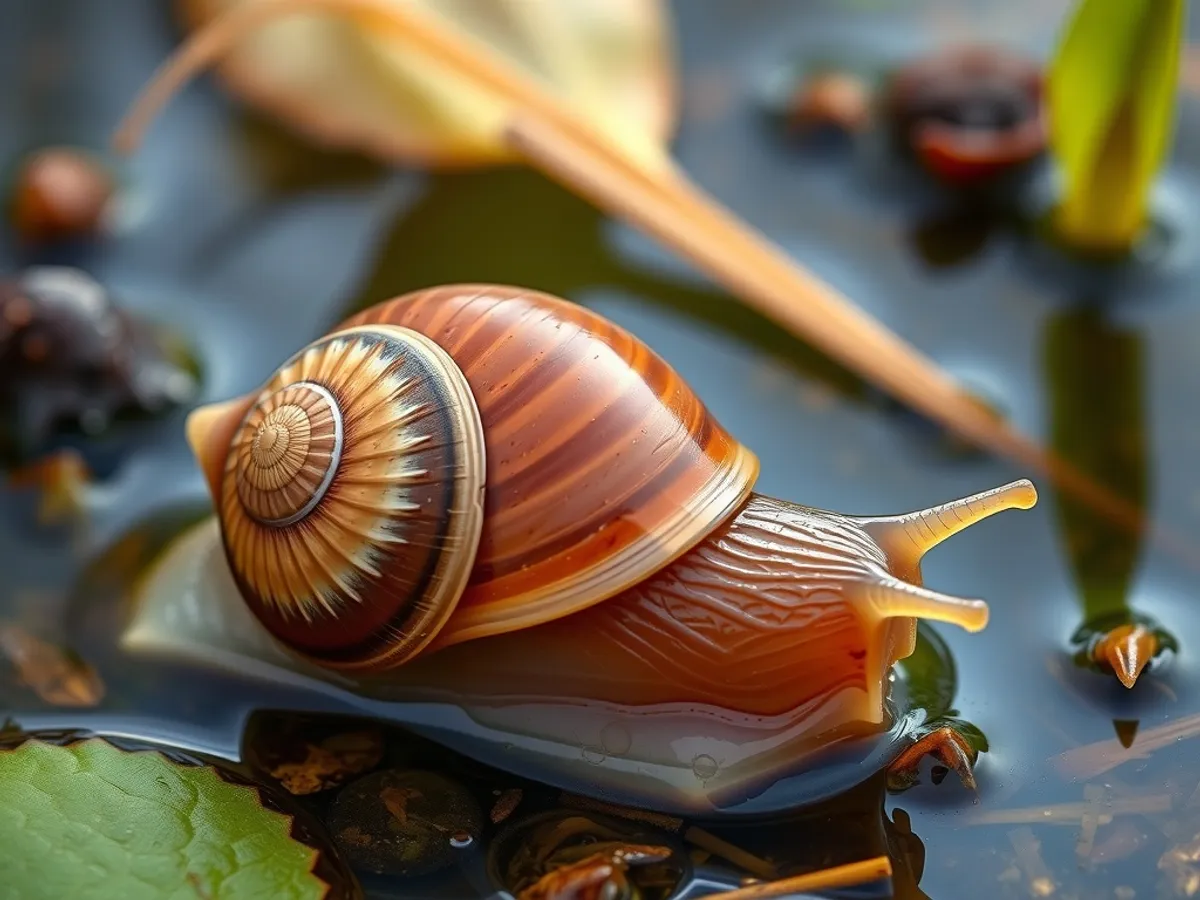
About the Apple Snail
The Apple Snail is a large freshwater gastropod known for its rounded shell, which can range in color from golden yellow to dark brown. Native to South America, this snail is highly adaptable and has been introduced to many regions worldwide, often becoming an invasive species. Apple Snails are equipped with both gills and lungs, allowing them to survive in oxygen-poor waters and even on land for short periods. Their voracious appetite for aquatic plants can have significant impacts on local ecosystems and agriculture, particularly rice paddies.
Fascinating facts
Dual Breathing
Apple Snails possess both gills and a lung, enabling them to extract oxygen from water and air.
Colorful Eggs
Their eggs are laid in vibrant pink clusters above the waterline, which helps protect them from aquatic predators.
Ecosystem Impact
As voracious herbivores, Apple Snails can decimate aquatic vegetation and damage crops, especially rice fields.
Detailed description
The Apple Snail (Pomacea canaliculata) is a large, globular freshwater gastropod, typically reaching shell diameters of 40–60 mm, though some individuals can exceed 80 mm. The shell is thick, with 5–6 whorls, and varies in color from pale yellow to brownish or even dark olive, often with subtle banding. Its body is soft and pale, with a large, muscular foot and a long, extensible siphon used for aerial respiration. Apple snails possess both gills and a lung, separated by a partition in the mantle cavity, allowing them to exploit both aquatic and aerial oxygen sources. The head bears two pairs of tentacles: the upper pair with eyes at the base, and a lower, shorter pair for tactile sensing. This species is primarily nocturnal, emerging at dusk to feed and retreating during the day to avoid predators and desiccation. Apple snails are highly adaptable, tolerating a wide range of water conditions, including low oxygen, variable pH, and temporary droughts by burrowing into mud. They are known for their prolific breeding, with females depositing large, bright pink egg masses above the waterline on vegetation or structures. Their ability to aestivate during dry periods and rapid reproductive rate contribute to their invasive potential in non-native habitats.
Did you know?
Apple Snails can close their shells with a special plate called an operculum, sealing themselves off from predators and harsh conditions.
Research & sources
Wikipedia summary
Ampullariidae, whose members are commonly known as apple snails, is a family of large freshwater snails that includes the mystery snail species. They are aquatic gastropod mollusks with a gill and an operculum. These snails simultaneously have a gill and a lung as functional respiratory structures, which are separated by a division of the mantle cavity. This adaptation allows these animals to be amphibious. Species in this family are considered gonochoristic, meaning that each individual organism is either male or female.
Behaviour & social structure
Apple snails are primarily herbivorous, feeding voraciously on a variety of aquatic plants, algae, and detritus. They use a rasping radula to scrape plant material and can decimate submerged vegetation, particularly in rice paddies and wetlands. Feeding activity peaks during twilight and nighttime hours, reducing predation risk. While generally solitary, individuals may aggregate in areas with abundant food or during breeding. Apple snails are capable of both aquatic and aerial respiration, surfacing to extend their siphon above water to breathe air, especially in oxygen-poor environments. When threatened, they retract into their shells and seal the aperture with a tough operculum. They are also known to burrow into soft substrates during adverse conditions, such as drought or cold, entering a state of dormancy (aestivation).
Reproduction & life cycle
Pomacea canaliculata is gonochoristic, with distinct male and female individuals. Mating occurs primarily during the wet season, often after heavy rains. Courtship involves the male mounting the female, sometimes for several hours. Fertilization is internal, and females lay conspicuous clusters of 200–800 bright pink eggs above the waterline, typically on emergent vegetation, rocks, or artificial structures. The eggs are calcified and contain toxins (mainly perivitelline proteins) that deter predators. Incubation lasts 10–15 days depending on temperature and humidity. Upon hatching, juveniles drop into the water and begin independent life; there is no parental care post-oviposition. Females can lay multiple clutches per season, contributing to rapid population growth.
Adaptations & survival
Key adaptations of the apple snail include its dual respiratory system (gills and lungs), enabling survival in hypoxic waters and brief terrestrial excursions. The long siphon allows for aerial breathing while remaining submerged. The thick, calcified shell and operculum provide protection against predation and desiccation. Egg masses are laid above water to avoid aquatic predators, and their bright coloration and chemical defenses reduce predation risk. The ability to aestivate in mud during droughts or cold periods allows survival in fluctuating environments. Rapid growth and high fecundity enhance colonization and invasiveness.
Cultural significance
Apple snails are used in some cultures as a food source, particularly in Southeast Asia, though their consumption is discouraged in some areas due to parasite risks. In the aquarium trade, related species are popular for their attractive appearance and algae-eating habits. In folklore, apple snails are sometimes symbols of fertility due to their prolific breeding. Their invasive impact has made them a subject of agricultural policy and public awareness campaigns in affected regions.
Recent research
Recent research has focused on the ecological impacts of Pomacea canaliculata as an invasive species, its physiological adaptations to hypoxia and drought, and the biochemistry of its egg toxins. Studies have also examined its role as a vector for parasites affecting humans and livestock. Genomic analyses have provided insights into its rapid adaptation and invasive potential. Ongoing research aims to develop targeted control methods and to better understand its reproductive biology and environmental tolerances.
Videos
Habitat
Freshwater wetlands, ponds, lakes, rivers, and rice fields

Conservation
The Apple Snail is currently classified as Least Concern on the IUCN Red List.
Threats & challenges
In its native range, Pomacea canaliculata faces predation from birds, mammals, and fish, as well as parasitism by trematodes. However, in introduced regions, it has few natural enemies and can become highly invasive, threatening native biodiversity and agricultural productivity, particularly rice cultivation. Control measures include habitat management, manual removal, and biological control, but eradication is challenging. The species is also an intermediate host for the rat lungworm (Angiostrongylus cantonensis), posing a public health risk. While globally listed as Least Concern by the IUCN, local populations may be targeted for control due to their pest status.
Taxonomy
Scientific name
Pomacea canaliculata
- Kingdom
- Animalia
- Phylum
- Mollusca
- Class
- Gastropoda
- Order
- Architaenioglossa
- Family
- Ampullariidae
- Genus
- Pomacea
- Species
- canaliculata
Community notes
Share your observations about the Apple Snail.
No community notes yet. Be the first!
Discover more wildlife
More fascinating animals from the encyclopedia.