
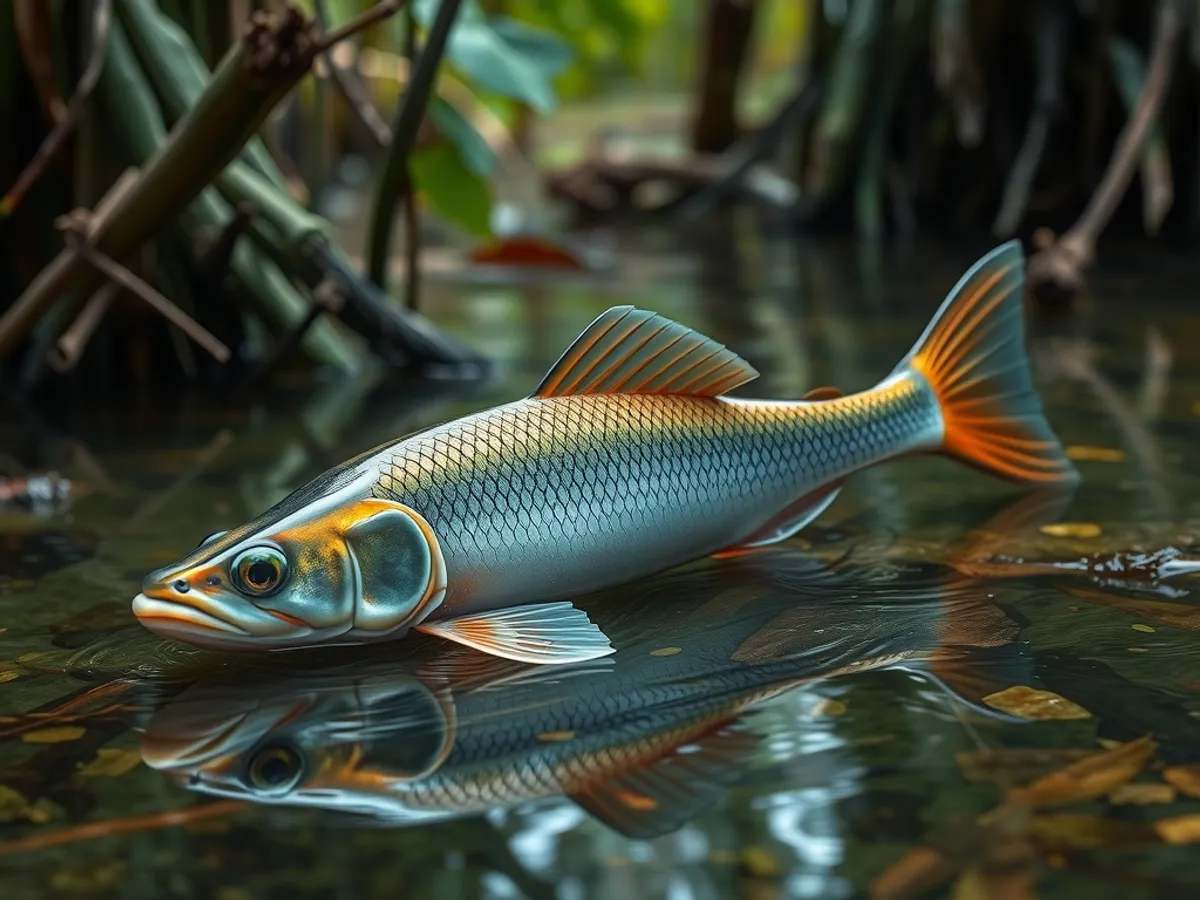
About the Asian arowana
The Asian arowana is the most expensive aquarium fish in the world, and the reason is entirely cultural rather than biological: its large metallic scales, barbels and sinuous swimming resemble a Chinese dragon, and it is prized in Chinese communities as a bringer of wealth and a deflector of bad luck. Red-toned specimens have changed hands for tens of thousands of dollars. Listed on CITES Appendix I since 1975, it can legally cross borders only from registered captive-breeding farms, and individual fish are microchipped and issued certificates — a paperwork regime that looks more like the diamond trade than the pet trade. Biologically it is a surface predator with an upturned, drawbridge mouth, and it can launch itself well clear of the water to snatch insects and even small birds from overhanging branches, which is why it is called the water monkey. The male is a mouthbrooder, carrying eggs and then free-swimming fry inside his mouth for weeks and releasing them to feed.
Fascinating facts
Dragon Fish
The Asian arowana is often called the 'dragon fish' due to its shiny, metallic scales and elongated body that resemble Chinese dragon imagery.
Carnivorous Hunter
In the wild, Asian arowanas are skilled surface predators, feeding on insects, smaller fish, and sometimes even birds or amphibians.
Parental Care
Male Asian arowanas exhibit mouthbrooding behavior, carrying fertilized eggs and young fry in their mouths to protect them from predators.
Detailed description
The Asian arowana (Scleropages formosus) is a large, elongate freshwater fish, typically reaching lengths of 60–90 cm, with some individuals exceeding 1 meter in optimal conditions. Its body is laterally compressed and covered in large, metallic, mosaic-like scales that reflect hues of gold, red, green, or silver, depending on the geographic variety. The dorsal and anal fins are set far back on the body and are nearly symmetrical, contributing to its streamlined, dragon-like appearance. The mouth is upturned and equipped with two prominent barbels on the lower jaw, which serve as tactile sensors in murky waters. Asian arowanas are obligate air-breathers, possessing a modified swim bladder that allows them to extract oxygen from air, an adaptation to oxygen-poor habitats. They are primarily crepuscular, being most active at dawn and dusk. In the wild, they are solitary and highly territorial, often patrolling defined stretches of river or swamp. Their keen eyesight and rapid strike make them formidable ambush predators. Reproduction involves complex courtship displays, and the species is renowned for its paternal mouthbrooding, where males incubate fertilized eggs and protect fry in their mouths for several weeks. These fish are long-lived, with lifespans exceeding 20 years in captivity, and exhibit slow growth rates, especially after reaching sexual maturity.
Did you know?
The Asian arowana is so protected that international trade is strictly regulated by CITES, and each permitted aquarium specimen is microchipped for identification.
Research & sources
Wikipedia summary
The Asian arowana comprises several phenotypic varieties of freshwater fish distributed geographically across Southeast Asia. While most consider the different varieties to belong to a single species, work by Pouyaud et al. (2003) differentiates these varieties into multiple species. They have several other common names, including Asian bonytongue, dragonfish, and a number of names specific to the different color varieties.
Behaviour & social structure
Asian arowanas are solitary and highly territorial, especially during the breeding season. They establish and defend territories using visual displays and physical posturing. Their hunting behavior is characterized by slow, deliberate stalking followed by rapid lunges to capture prey, which includes fish, insects, crustaceans, and occasionally small amphibians or birds. They are surface-oriented feeders, often leaping out of the water to snatch prey from overhanging branches. Social interactions are generally limited to brief encounters during the breeding season, with aggression displayed towards conspecifics outside of mating. Daily activity peaks at dawn and dusk, aligning with the movements of their prey. In captivity, they may recognize and interact with their caretakers, displaying learned behaviors such as surface feeding.
Reproduction & life cycle
Breeding occurs during the rainy season, when rising water levels and increased food availability trigger spawning. Courtship involves synchronized swimming and circling, with the female releasing 30–100 large, yolk-rich eggs. The male fertilizes the eggs externally and immediately collects them in his mouth, where he incubates them for 6–8 weeks. During this period, the male does not feed and provides protection against predators and environmental hazards. Upon hatching, the fry remain in the male's mouth until their yolk sacs are absorbed and they are capable of independent swimming. Parental care is exclusively paternal, and the survival rate of fry is closely tied to the male's health and environmental stability.
Adaptations & survival
The Asian arowana exhibits several key adaptations for survival in slow-moving, oxygen-poor waters. Its upturned mouth and barbels facilitate surface feeding and prey detection in turbid conditions. The swim bladder is highly vascularized, functioning as a primitive lung to allow aerial respiration. Large, reflective scales provide camouflage among floating vegetation and dappled sunlight. Their acute vision enables precise targeting of prey, while the ability to leap out of water aids in capturing terrestrial insects and avoiding predators. Territorial aggression and solitary habits reduce competition for resources.
Cultural significance
The Asian arowana is deeply embedded in East and Southeast Asian cultures, where it is revered as the 'dragon fish' due to its resemblance to mythical dragons. It symbolizes prosperity, luck, and power, making it a coveted status symbol among collectors and businesspeople. In Feng Shui, it is believed to attract wealth and ward off misfortune. Historically, it has also featured in local folklore and traditional medicine, though its primary significance today is ornamental. The high demand has led to the development of specialized breeding farms and a thriving black market.
Recent research
Recent genetic studies (e.g., Pouyaud et al., 2003) have proposed splitting Scleropages formosus into several distinct species based on morphological and mitochondrial DNA differences, though this remains controversial and not universally accepted. Conservation genetics research is ongoing to assess genetic diversity in captive and wild populations. Advances in captive breeding, including hormonal induction and artificial incubation, have improved fry survival rates and reduced pressure on wild stocks. Ecological studies are focused on habitat requirements, migration patterns, and the impact of environmental changes on reproductive success. There is also interest in understanding the physiological mechanisms underlying their air-breathing capabilities and longevity.
Videos
Habitat
Slow-moving freshwater rivers and swamps


Conservation
The Asian arowana is currently classified as Critically Endangered on the IUCN Red List.
Threats & challenges
Major threats include habitat loss due to deforestation, dam construction, and conversion of wetlands to agriculture, which fragment and degrade breeding sites. Overexploitation for the aquarium trade, driven by high market value and cultural demand, has led to illegal poaching and population declines. Genetic bottlenecking from captive breeding and release of non-native varieties pose risks to wild genetic integrity. Pollution and climate change further exacerbate habitat degradation. Despite legal protections under CITES Appendix I and national laws, enforcement remains inconsistent, and wild populations are estimated to have declined by over 70% in the past few decades.
Taxonomy
Scientific name
Scleropages formosus
- Kingdom
- Animalia
- Phylum
- Chordata
- Class
- Actinopterygii
- Order
- Osteoglossiformes
- Family
- Osteoglossidae
- Genus
- Scleropages
- Species
- formosus
Where to see an asian arowana
1 zoo and aquarium in 1 country are recorded as keeping this species.

Community notes
Share your observations about the Asian arowana.
No community notes yet. Be the first!
Discover more wildlife
More fascinating animals from the encyclopedia.