
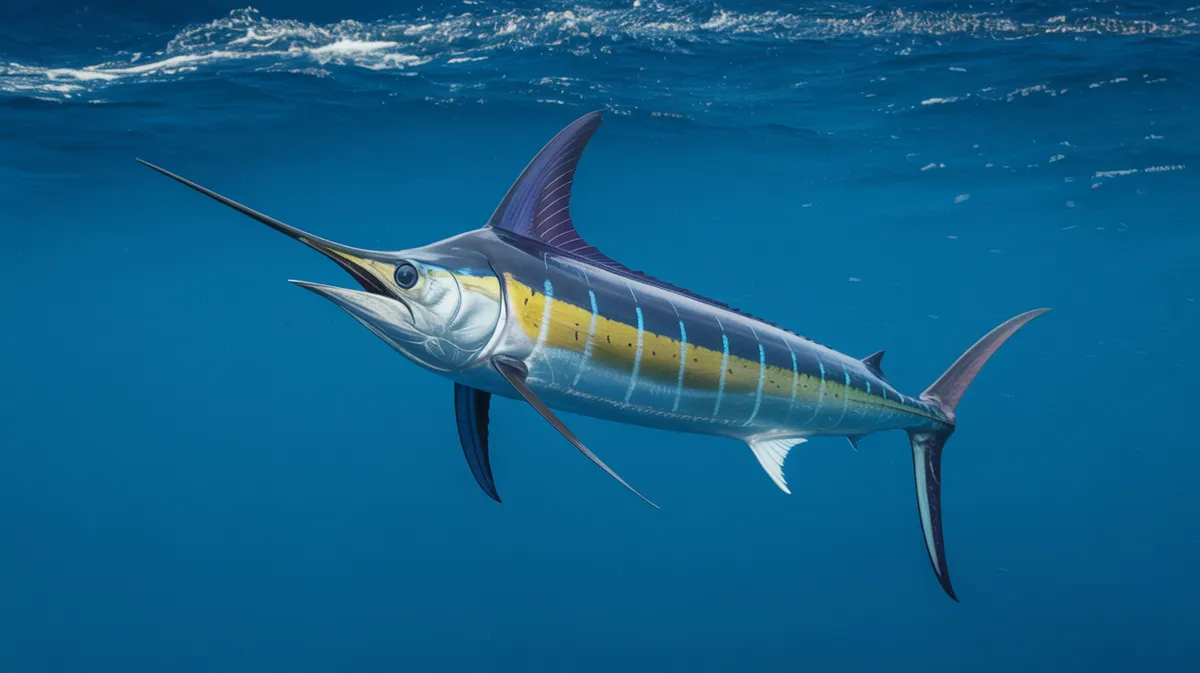
About the Atlantic Blue Marlin
The Atlantic Blue Marlin is one of the largest and most powerful fish in the ocean, renowned for its elongated bill and vibrant cobalt-blue coloration. Found throughout the tropical and subtropical waters of the Atlantic Ocean, this majestic predator is a prized catch among sport fishers due to its incredible speed and acrobatic leaps. Blue marlins are solitary hunters, using their sharp bills to slash through schools of fish with precision. Females are notably larger than males, and the species plays a vital role in maintaining the balance of open-ocean ecosystems.
Fascinating facts
Incredible Speed
The Atlantic Blue Marlin is one of the fastest fish in the ocean, capable of reaching bursts of speed up to 80 km/h (50 mph) when pursuing prey.
Sport Fishing Icon
Highly sought after by anglers, the blue marlin is considered one of the ultimate prizes in big-game sport fishing due to its size, strength, and fighting ability.
Long-Distance Migrator
Atlantic Blue Marlins are known for their extensive migrations, often traveling thousands of kilometers across the Atlantic Ocean between feeding and spawning areas.
Detailed description
The Atlantic blue marlin (Makaira nigricans) is a large, apex pelagic predator recognized for its streamlined, torpedo-shaped body, long rigid dorsal fin (the 'sail'), and an elongated, spear-like upper jaw or bill. Adult females, which can reach lengths of up to 5 meters (16.4 feet) and weigh over 820 kg (1,800 lbs), are significantly larger than males, which rarely exceed 160 kg (350 lbs). The marlin's coloration is striking: cobalt-blue dorsally with silvery-white flanks and a series of vertical, iridescent stripes that can become more pronounced during hunting or excitement. Its body is built for speed and endurance, with a powerful, lunate (crescent-shaped) tail and deeply forked caudal peduncle. The species is endothermic, able to regulate body temperature above ambient water, which enhances muscle performance and vision in the deep, cooler waters it often frequents. Blue marlins are solitary or occasionally found in loose aggregations, especially where prey is abundant. Their diet consists mainly of schooling fish such as mackerel and tuna, as well as squid, which they stun or injure with rapid slashes of their bill. The species is highly migratory, traversing vast distances across the Atlantic, often following warm ocean currents. Reproduction is oviparous, with females capable of releasing several million eggs in a single spawning event, usually in tropical and subtropical waters. The Atlantic blue marlin's role as a top predator is crucial for maintaining the structure and health of open-ocean ecosystems.
Did you know?
Female Atlantic Blue Marlins can be almost four times heavier than males, making them some of the largest sexually dimorphic fish in the world.
Research & sources
Wikipedia summary
The Atlantic blue marlin is a species of marlin endemic to the Atlantic Ocean. It is closely related to, and usually considered conspecific with, the Indo-Pacific blue marlin, then simply called blue marlin. Some authorities consider both species distinct.
Behaviour & social structure
Atlantic blue marlins are primarily solitary hunters, though they may occasionally be observed in small, loose groups where prey is concentrated. They are diurnal, with peak activity during daylight hours, and exhibit remarkable agility and speed, capable of bursts exceeding 80 km/h (50 mph). Their hunting strategy involves using their bill to slash through dense schools of fish, stunning or injuring prey before circling back to consume them. Blue marlins are known for their extensive migratory behavior, often crossing entire ocean basins in response to seasonal changes in water temperature and prey availability. Social interactions are limited outside of spawning aggregations, and there is little evidence of complex social structures. They are known for spectacular aerial displays, including leaping and tail-walking, which are believed to be both feeding-related and possibly a means of parasite removal.
Reproduction & life cycle
Atlantic blue marlins are batch spawners, with females capable of releasing between 7 and 10 million eggs per spawning season, often in multiple batches. Spawning typically occurs in warm, offshore waters at temperatures above 26°C (79°F), with peaks observed from late spring to early autumn depending on latitude. Fertilization is external, and there is no parental care; eggs and larvae are pelagic and subject to high predation rates. Larvae grow rapidly, feeding on zooplankton and small fish, and undergo significant morphological changes as they mature. Sexual maturity is reached at approximately 2–4 years for males and 3–5 years for females. The species exhibits pronounced sexual dimorphism, with females attaining much larger sizes, which is thought to be an adaptation for increased fecundity.
Adaptations & survival
The Atlantic blue marlin possesses several remarkable adaptations for pelagic life. Its endothermic physiology, achieved via specialized heat-exchange organs (rete mirabile) near the eyes and brain, allows it to maintain elevated body and eye temperatures, improving vision and muscle performance in cold, deep waters. The elongated bill is a specialized adaptation for stunning prey and reducing hydrodynamic drag. Its large, rigid pectoral fins and streamlined body minimize resistance, enabling high-speed pursuits. The marlin's acute vision, aided by a high density of rod and cone cells, is adapted for detecting prey in the open ocean. Additionally, the ability to rapidly change coloration, especially the vertical stripes, is thought to play a role in communication and camouflage during hunting.
Cultural significance
The Atlantic blue marlin holds a prominent place in sport fishing culture, symbolizing strength, endurance, and the thrill of the open ocean. It is celebrated in literature, most notably in Ernest Hemingway's 'The Old Man and the Sea,' and features in the folklore and iconography of many Atlantic coastal communities. While not a primary target for commercial fisheries, its high value as a game fish has led to the development of catch-and-release practices and international tournaments, which contribute to local economies and raise awareness of marine conservation.
Recent research
Recent research has focused on the marlin's migratory patterns using satellite tagging, revealing trans-Atlantic movements and fidelity to spawning areas. Genetic studies have clarified the relationship between Atlantic and Indo-Pacific blue marlins, supporting their status as distinct species based on mitochondrial DNA and morphological differences. Ongoing studies are examining the impacts of climate change on distribution and spawning, as well as the efficacy of international management measures such as ICCAT quotas and time-area closures. Advances in electronic tagging have provided new insights into vertical habitat use, showing that marlins regularly dive to depths exceeding 500 meters (1,640 feet), likely in pursuit of prey.
Videos
Habitat
Open ocean (pelagic zone)

Conservation
The Atlantic Blue Marlin is currently classified as Vulnerable on the IUCN Red List.
Threats & challenges
Atlantic blue marlins face significant threats from overfishing, primarily as bycatch in commercial longline fisheries targeting tuna and swordfish, as well as from targeted sport fishing. Their slow growth, late maturity, and high fecundity are offset by high juvenile mortality and intense fishing pressure, leading to population declines. Habitat degradation, climate change, and shifts in oceanic currents may also impact spawning grounds and prey availability. The IUCN currently lists the species as Vulnerable, with population trends indicating a continuing decline. International management is complicated by the species' highly migratory nature, necessitating coordinated conservation efforts across national jurisdictions.
Taxonomy
Scientific name
Makaira nigricans
- Kingdom
- Animalia
- Phylum
- Chordata
- Class
- Actinopterygii
- Order
- Istiophoriformes
- Family
- Istiophoridae
- Genus
- Makaira
- Species
- nigricans
Community notes
Share your observations about the Atlantic Blue Marlin.
No community notes yet. Be the first!
Discover more wildlife
More fascinating animals from the encyclopedia.