
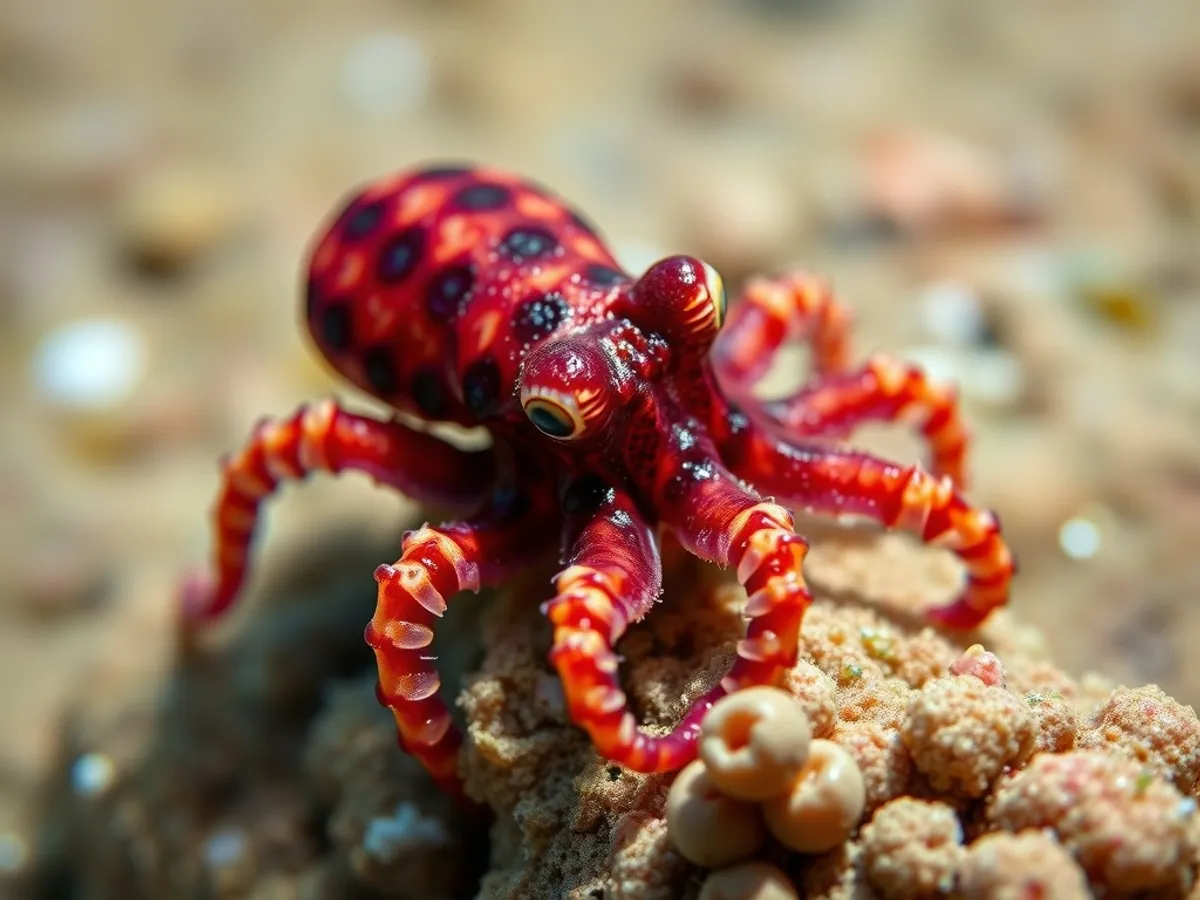
About the Atlantic Pygmy Octopus
The Atlantic Pygmy Octopus is a small, secretive cephalopod found in shallow coastal waters of the western Atlantic Ocean, particularly in the Caribbean and Gulf of Mexico. Typically measuring no more than 12 centimeters in arm span, this octopus is renowned for its agility, intelligence, and remarkable ability to camouflage among rocks, shells, and sea grass. It spends much of its time hidden during the day, becoming more active at night to hunt small crustaceans and mollusks. Its short lifespan and cryptic behavior make it a rarely observed but fascinating inhabitant of tropical marine ecosystems.
Fascinating facts
Miniature Size
The Atlantic Pygmy Octopus rarely grows larger than 12 cm across, making it one of the smallest octopus species in the Atlantic.
Camouflage Expert
This species can rapidly change its color and texture to blend in with its surroundings, helping avoid predators.
Nocturnal Hunter
It hunts primarily at night, preying on small crustaceans, worms, and snails found among rocks and coral.
Detailed description
The Atlantic Pygmy Octopus (Octopus joubini) is a diminutive cephalopod distinguished by its compact mantle, which rarely exceeds 4.5 cm in length, and proportionally long, slender arms that can reach up to 9 cm. Its soft, flexible body is covered in chromatophores, specialized pigment cells that allow rapid color and texture changes for camouflage, aiding both in predator avoidance and ambush hunting. The species typically displays a mottled brown or reddish coloration, blending seamlessly with sandy or rocky substrates. Its large, well-developed eyes provide acute vision, even in low-light environments, facilitating nocturnal activity. The Atlantic Pygmy Octopus possesses a highly developed nervous system relative to its size, supporting complex behaviors such as problem-solving, escape artistry, and tool use. It is a solitary and secretive animal, spending daylight hours concealed in self-constructed dens made from shells, rocks, or debris. At night, it emerges to forage, using its dexterous arms and sensitive suckers to probe crevices for prey. Its short lifespan, typically less than a year, is characterized by rapid growth and a single reproductive event (semelparity). This species plays an important ecological role as both predator and prey in tropical shallow-water ecosystems, contributing to the health and balance of coral reef and seagrass habitats.
Did you know?
Despite its tiny size, the Atlantic Pygmy Octopus is highly intelligent and has been observed solving simple problems and exploring its environment in captivity.
Research & sources
Wikipedia summary
The Atlantic pygmy octopus, also known as the small-egg Caribbean pygmy octopus, is a small species of octopus in the order Octopoda. Fully grown, this cephalopod reaches a mantle length of 4.5 cm with arms up to 9 cm long. They are known for being intelligent creatures with keen senses, particularly good sight.
Behaviour & social structure
O. joubini is primarily nocturnal, remaining hidden during the day to avoid predators such as fish, crabs, and larger cephalopods. It exhibits advanced hunting strategies, including stalking, ambush, and the use of its arms to flush out prey from hiding places. Its diet consists mainly of small crustaceans (such as shrimp and crabs), bivalves, and occasionally small fish. The octopus uses its sharp beak to penetrate shells and excrete venom to immobilize prey. It is known for its problem-solving abilities, such as opening jars or manipulating objects to access food. Social interactions are minimal outside of mating, as individuals are highly territorial and may display threat postures or color changes to deter intruders. Daily routines involve den maintenance, foraging, and frequent relocation to avoid detection.
Reproduction & life cycle
Reproduction in the Atlantic Pygmy Octopus is seasonal, typically peaking in warmer months. Mating involves the male transferring a spermatophore to the female using a specialized arm called the hectocotylus. After mating, the female lays small, numerous eggs (hence the 'small-egg' moniker) in a protected den, attaching them to the substrate. The incubation period lasts approximately 30–60 days, depending on water temperature. During this time, the female guards and aerates the eggs, refraining from feeding and often dying shortly after the eggs hatch—a reproductive strategy known as semelparity. Hatchlings are planktonic, dispersing into the water column before settling to the benthos as juveniles.
Adaptations & survival
O. joubini exhibits several adaptations for survival in dynamic coastal environments. Its chromatophores and papillae allow for rapid changes in color and skin texture, providing effective camouflage against predators and while hunting. The octopus can squeeze through remarkably small openings due to its lack of rigid skeletal structures, facilitating escape and den construction. Its keen eyesight and chemoreceptive suckers enhance prey detection and environmental awareness. The species' short life cycle and high fecundity are evolutionary responses to high predation pressures and variable habitat conditions.
Cultural significance
Due to its small size and cryptic nature, O. joubini has limited direct significance in human culture or fisheries. It is occasionally featured in public aquaria as an example of cephalopod intelligence and adaptive behavior. In broader Caribbean folklore, octopuses are sometimes associated with mystery and transformation, but there are no specific myths or traditional uses tied to this species.
Recent research
Recent studies have focused on the cognitive abilities of O. joubini, including maze learning, object manipulation, and escape behaviors, contributing to the broader understanding of cephalopod intelligence. Genetic research is ongoing to clarify its relationship to other pygmy octopus species and to assess population structure across its range. Ecological studies have highlighted its role in controlling populations of small crustaceans and its sensitivity to habitat changes, making it a potential indicator species for coastal ecosystem health.
Videos
Habitat
Shallow coastal waters, coral reefs, and seagrass beds

Conservation
The Atlantic Pygmy Octopus is currently classified as Least Concern on the IUCN Red List.
Threats & challenges
Currently assessed as Least Concern by the IUCN, the Atlantic Pygmy Octopus faces localized threats from habitat degradation, particularly the loss of seagrass beds and coral reefs due to coastal development, pollution, and climate change. Bycatch in artisanal fisheries and collection for the aquarium trade may also impact populations in some areas. However, its wide distribution and high reproductive rate confer resilience. Ongoing monitoring is needed to detect potential declines linked to environmental changes.
Taxonomy
Scientific name
Octopus joubini
- Kingdom
- Animalia
- Phylum
- Mollusca
- Class
- Cephalopoda
- Order
- Octopoda
- Family
- Octopodidae
- Genus
- Octopus
- Species
- joubini
Community notes
Share your observations about the Atlantic Pygmy Octopus.
No community notes yet. Be the first!
Discover more wildlife
More fascinating animals from the encyclopedia.