
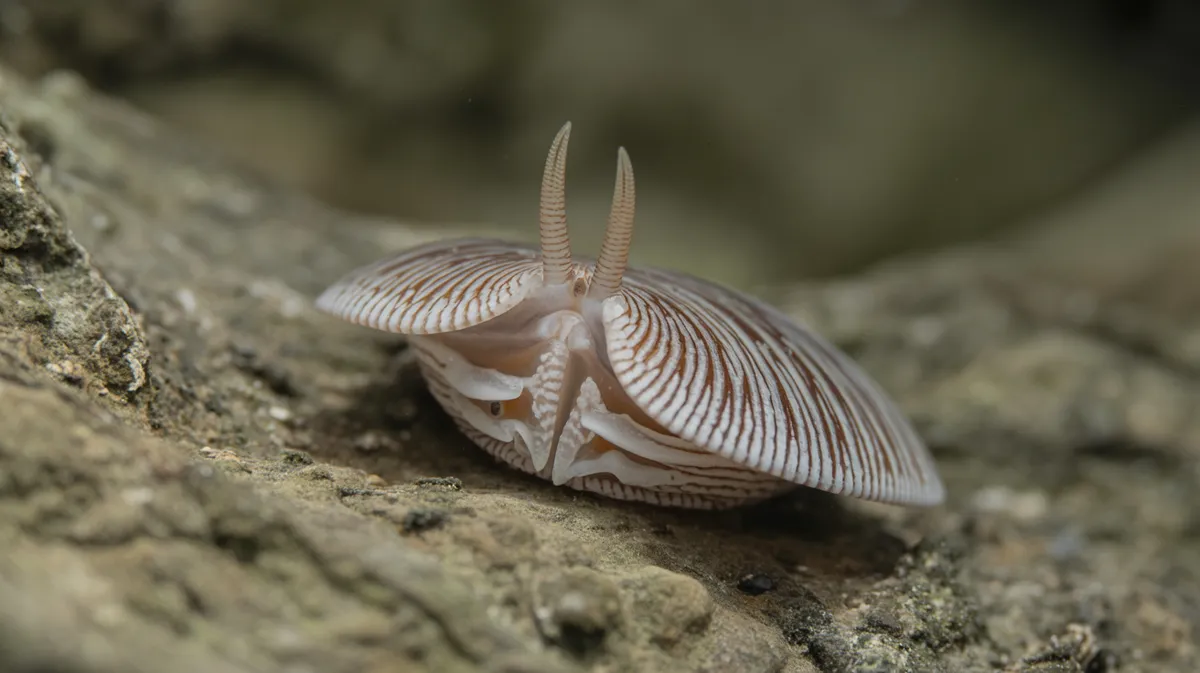
About the Atlantic slipper limpet
The Atlantic slipper limpet is a small marine mollusk recognized by its distinctively shaped shell, which resembles a slipper or a boat. This invertebrate typically forms stacked chains of individuals, with the largest female at the bottom and smaller males on top. Originally native to the east coast of North America, it has since become widespread in European waters due to shipping and aquaculture. The species is known for its remarkable ability to change sex during its life, transitioning from male to female as it matures.
Fascinating facts
Stacked Living
Atlantic slipper limpets form distinctive living 'chains' with individuals attached to each other's shells in a stack.
Sex Change
They are protandric hermaphrodites, meaning they start life as males and later become females.
Invasive Species
The species has spread to European and other coasts, sometimes outcompeting native marine life.
Detailed description
The Atlantic slipper limpet (Crepidula fornicata) is a medium-sized marine gastropod mollusk, typically measuring 20–50 mm in shell length, with exceptional specimens reaching up to 56 mm. Its shell is oval and convex, with a distinctive internal shelf or 'deck' that partially divides the shell, giving it the appearance of a slipper or boat. The exterior is smooth, often yellowish, brown, or gray, sometimes with darker streaks or bands. The animal's soft body is protected by the shell and features a muscular foot used for limited movement and attachment to substrates or other limpets. C. fornicata is well known for forming stacked aggregations, or 'chains,' where individuals adhere to each other in vertical columns, with the oldest and largest (female) at the base and progressively smaller (male) individuals above. This stacking behavior is linked to their unique sequential hermaphroditism: individuals begin life as males and later transform into females. The species is a suspension feeder, using ciliated gills to filter plankton and organic particles from the water. Its gills also serve a dual function in respiration. The Atlantic slipper limpet is highly adaptable, thriving in a range of salinities and temperatures, and can colonize both hard and soft substrates, including rocks, shells, and artificial structures. Its invasive success in European waters is attributed to its high reproductive output, rapid growth, and tolerance of environmental variability.
Did you know?
Despite their name, Atlantic slipper limpets are not true limpets but are more closely related to snails.
Research & sources
Wikipedia summary
Crepidula fornicata is a species of medium-sized sea snail, a marine gastropod mollusc in the family Calyptraeidae, the slipper snails and cup and saucer snails. It has many common names, including common slipper shell, common Atlantic slippersnail, boat shell, quarterdeck shell, fornicating slipper snail, Atlantic slipper limpet and it is in Britain as the "common slipper limpet".
Behaviour & social structure
Crepidula fornicata is largely sedentary, spending most of its life attached to hard substrates or to other individuals in stacks. Feeding occurs continuously as the limpet filters suspended particles from the water column using its gill cilia, which generate currents to draw in food. The species does not actively hunt but relies on passive suspension feeding. Socially, the stacked arrangement facilitates reproductive interactions, with males on top fertilizing the eggs of females below. Movement is limited in adults, though juveniles may crawl to find suitable attachment sites. The species is capable of limited locomotion via its muscular foot, particularly when seeking new substrates or during early life stages. Daily activity is largely dictated by tidal cycles, with feeding and respiration rates increasing during immersion. There is little evidence of aggressive behavior; competition is primarily for space and attachment sites.
Reproduction & life cycle
C. fornicata exhibits protandric sequential hermaphroditism: individuals start life as males and, as they grow and age, transition to females. Males at the top of stacks fertilize the eggs of females below through external sperm transfer. Spawning occurs primarily in spring and summer, but can extend into autumn in warmer regions. Females brood fertilized eggs under their shell, attached to the internal deck, for 2–4 weeks depending on temperature. Each female can produce multiple broods per season, with clutch sizes ranging from several hundred to over 10,000 eggs. After brooding, planktonic veliger larvae are released into the water column, where they remain for 2–4 weeks before settling and metamorphosing into juveniles. There is no parental care beyond brooding; larvae are independent upon release.
Adaptations & survival
Key adaptations include the internal shell deck, which provides protection for the brooded eggs and structural support for stacking. The ability to change sex (protandry) ensures reproductive flexibility and maximizes mating opportunities within dense aggregations. Suspension feeding via ciliated gills allows exploitation of abundant planktonic resources. The species exhibits high tolerance to salinity and temperature fluctuations, enabling colonization of estuarine and coastal habitats. Its adhesive foot allows secure attachment to a variety of substrates, reducing predation risk and dislodgement. Rapid growth and high fecundity contribute to its invasive potential and resilience in disturbed environments.
Cultural significance
While not a traditional food source, C. fornicata has been studied for its ecological impacts and as a model organism for research on sex change and developmental biology. In some regions, it is considered a pest due to its effects on shellfish aquaculture. There are no significant roles in mythology or symbolism, but its distinctive shell is sometimes collected by beachcombers and used in educational displays.
Recent research
Recent research has focused on the mechanisms and triggers of sex change in C. fornicata, including hormonal and environmental cues. Studies have also examined its invasive ecology, impacts on native benthic communities, and potential for bioremediation due to its filtration capacity. Genetic analyses have traced invasion pathways and population structure in introduced ranges. Ongoing research addresses its interactions with native species, responses to climate change, and potential management strategies for controlling invasive populations.
Videos
Habitat
Coastal and estuarine waters, often on rocky or sandy substrates

Conservation
The Atlantic slipper limpet is currently classified as Least Concern on the IUCN Red List.
Threats & challenges
In its native range, C. fornicata faces predation from crabs, sea stars, and some fish, as well as competition with other filter feeders. Invasive populations in Europe and elsewhere can disrupt native benthic communities by outcompeting local bivalves (e.g., oysters, mussels) for space and food, altering sediment structure, and changing nutrient dynamics. Human impacts include habitat modification, pollution, and unintentional spread via shipping and aquaculture. Despite these pressures, the species is not considered threatened and is classified as Least Concern by the IUCN. However, its invasive status in non-native regions presents ongoing management challenges.
Taxonomy
Scientific name
Crepidula fornicata
- Kingdom
- Animalia
- Phylum
- Mollusca
- Class
- Gastropoda
- Order
- Littorinimorpha
- Family
- Calyptraeidae
- Genus
- Crepidula
- Species
- fornicata
Community notes
Share your observations about the Atlantic slipper limpet.
No community notes yet. Be the first!
Discover more wildlife
More fascinating animals from the encyclopedia.