
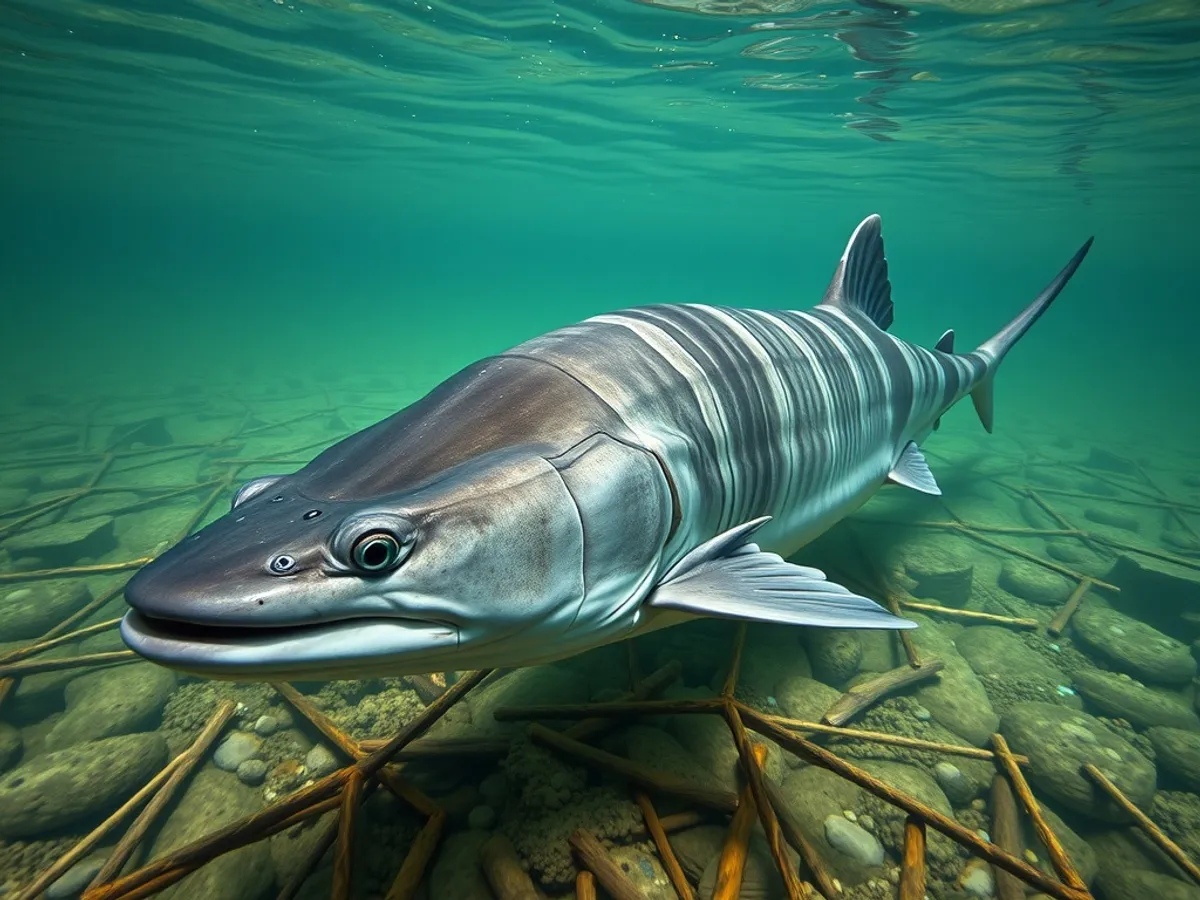
About the Atlantic sturgeon
The Atlantic sturgeon is armoured with bony scutes rather than scales, has a skeleton that is largely cartilage, and finds its food without ever seeing it. Four barbels drag along the bottom, and the underside of the long snout is studded with ampullae — electroreceptors that detect the faint electrical fields of buried worms and crustaceans — after which the toothless mouth extends downward as a tube and vacuums them up. Anadromous like salmon, it runs up rivers to spawn, but it plays a much slower game: females may not mature until somewhere between seven and thirty years old depending on latitude, and then spawn only once every two to five years. That reproductive schedule is what makes them so easy to destroy. In the 1880s a caviar rush on the Delaware River made the Atlantic sturgeon a "black gold" fishery, and the population was gutted within a generation. Fish reach 4 m and can live sixty years, and they leap clear of the water for reasons still argued over — group cohesion is the leading hypothesis.
Fascinating facts
Ancient Lineage
Atlantic sturgeons belong to one of the oldest families of bony fish still in existence, dating back to the age of the dinosaurs.
Leaping Giants
These fish sometimes leap several feet out of the water, an impressive display for such large animals.
Long-Distance Migrants
Atlantic sturgeon migrate hundreds of miles between saltwater and freshwater habitats to complete their life cycle.
Detailed description
The Atlantic sturgeon (Acipenser oxyrinchus) is a robust, torpedo-shaped fish distinguished by five longitudinal rows of bony scutes (armor-like plates) along its body, a heterocercal tail, and a long, conical snout equipped with four sensitive barbels in front of its toothless, protrusible mouth. Adult sturgeon can reach lengths of up to 4.3 meters (14 feet) and weigh over 360 kg (800 lbs), though most individuals are smaller. Their coloration ranges from bluish-black or olive-brown dorsally to pale ventrally, providing camouflage in both riverine and marine environments. Atlantic sturgeon are anadromous, spending most of their adult lives in coastal marine waters but migrating into large rivers to spawn. They are bottom-dwellers, using their barbels to detect prey such as benthic invertebrates and small fish, which they vacuum from the substrate. The species is notable for its longevity, with lifespans commonly exceeding 60 years and some individuals living over a century. Sexual maturity is reached late, typically at 10–20 years for males and 15–30 years for females, depending on latitude. Their slow growth, late maturity, and infrequent spawning (every 2–6 years) make populations particularly vulnerable to exploitation and environmental changes. Atlantic sturgeon exhibit strong natal homing, returning to their birth rivers to spawn, and display remarkable physiological adaptations to tolerate both freshwater and saline conditions.
Did you know?
Atlantic sturgeon can live longer than most other North American fish, sometimes reaching over 60 years of age.
Research & sources
Wikipedia summary
The Atlantic sturgeon is a large species of sturgeon native to both sides of the Atlantic Ocean, and associated river basins. It is a member of the family Acipenseridae, and, along with other sturgeon, it is sometimes considered a living fossil. The main range of the Atlantic sturgeon is in eastern North America, extending from New Brunswick, Canada, to the eastern coast of Florida, United States. A highly endangered disjunct population occurs in the Baltic region of Europe.
Behaviour & social structure
Atlantic sturgeon are primarily solitary, except during spawning migrations when they may form loose aggregations in rivers. They are crepuscular to nocturnal feeders, actively foraging along the river or sea bottom at dusk and night. Their diet consists mainly of polychaete worms, amphipods, crustaceans, mollusks, and occasionally small fish, which they locate using their highly sensitive barbels and electroreceptors. Feeding involves rooting in the substrate and creating characteristic feeding pits. Outside of the spawning season, sturgeon are largely sedentary, moving between feeding grounds and deeper overwintering habitats. Juveniles may display more localized, riverine movement, while adults undertake long-distance coastal migrations. Social interactions are minimal, with little evidence of territoriality or complex social hierarchies.
Reproduction & life cycle
Spawning occurs in spring to early summer (April–June in the southern range, May–July in the north), triggered by rising water temperatures (13–20°C) and increased river flow. Males typically arrive at spawning grounds before females. Courtship is subtle and involves tactile cues. Females release between 400,000 and 8 million adhesive eggs over gravel or rocky substrates in fast-flowing river sections, which are then externally fertilized by males. There is no parental care; eggs hatch after 6–8 days, and larvae drift downstream to nursery habitats. Juveniles remain in freshwater or brackish estuaries for 1–6 years before migrating to the ocean. Females spawn infrequently, every 2–6 years, while males may spawn more often, every 1–3 years. The protracted maturation and infrequent spawning cycles contribute to slow population recovery.
Adaptations & survival
Atlantic sturgeon possess several adaptations for their benthic and anadromous lifestyle. Their bony scutes provide protection from predators and abrasive substrates. The elongated snout and sensitive barbels allow them to detect prey buried in sediment, while their protrusible, vacuum-like mouth efficiently ingests invertebrates. Sturgeon have a highly developed lateral line system and electroreceptors for detecting movement and electrical signals in murky waters. Physiologically, they are euryhaline, capable of osmoregulation in both freshwater and marine environments, which is essential for their migratory life cycle. Their large size and armored bodies deter most predators, though juveniles are vulnerable to predation by large fish and birds.
Cultural significance
Atlantic sturgeon have played an important role in the history and culture of Indigenous peoples and early European settlers along the Atlantic coast, valued for their meat, oil, and especially their roe (caviar). Sturgeon fisheries were once economically significant, particularly in the 19th and early 20th centuries, but overexploitation led to severe declines. The species is sometimes referred to as a 'living fossil' due to its ancient lineage, inspiring fascination and conservation efforts. In some regions, sturgeon feature in local folklore and are symbolic of river health and heritage.
Recent research
Recent research has focused on population genetics, migratory behavior (using telemetry and genetic markers), and the impacts of habitat fragmentation. Genetic studies have clarified the distinction between Atlantic and European sturgeon and identified unique lineages within the species. Telemetry has revealed long-distance migrations along the Atlantic coast and highlighted the importance of estuarine and marine habitats. Ongoing restoration projects include dam removals, habitat restoration, and reintroduction efforts, particularly in the Baltic region. Studies on contaminant loads and their effects on sturgeon health are ongoing, as are investigations into the impacts of climate change on spawning phenology and habitat suitability.
Sources
Videos
Habitat
Coastal oceans and large freshwater rivers


Conservation
The Atlantic sturgeon is currently classified as Critically Endangered on the IUCN Red List.
Threats & challenges
Major threats to Atlantic sturgeon include historical overfishing (for meat and caviar), bycatch in commercial fisheries, habitat loss from damming and river modification, pollution (especially from industrial and agricultural runoff), and vessel strikes. Spawning habitats have been degraded or rendered inaccessible by dams, while water pollution can impair reproductive success and larval survival. Bycatch mortality remains a significant issue, particularly in coastal gillnet fisheries. The species' slow growth, late maturity, and infrequent spawning make populations highly susceptible to decline and slow to recover. Current population trends are generally stable or increasing in some rivers due to conservation measures, but most populations remain at a fraction of historical levels. The Baltic population (A. o. oxyrinchus ssp. oxyrinchus) is considered critically endangered.
Taxonomy
Scientific name
Acipenser oxyrinchus
- Kingdom
- Animalia
- Phylum
- Chordata
- Class
- Actinopterygii
- Order
- Acipenseriformes
- Family
- Acipenseridae
- Genus
- Acipenser
- Species
- oxyrinchus
Community notes
Share your observations about the Atlantic sturgeon.
No community notes yet. Be the first!
Discover more wildlife
More fascinating animals from the encyclopedia.