
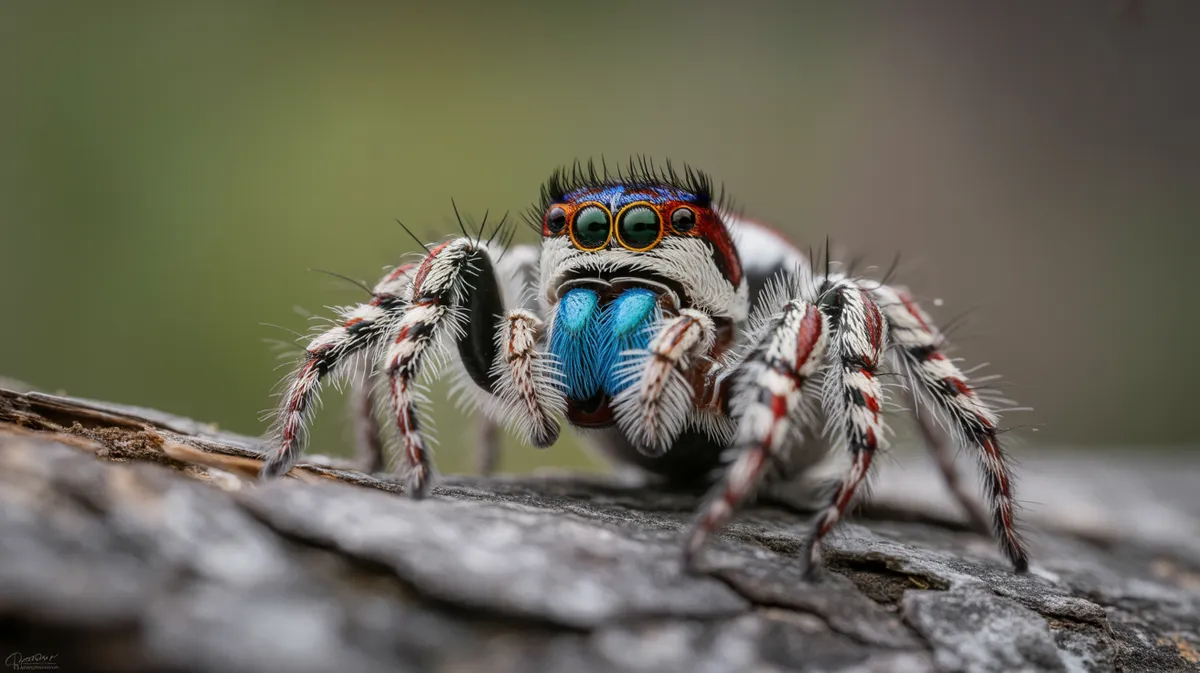
About the Australian Peacock Spider
Peacock spiders are jumping spiders about 4 to 5 mm long — small enough to sit comfortably on a fingernail — that perform one of the most elaborate courtship displays of any animal. The male raises a flap on his abdomen like a fan and vibrates his legs and body while shuffling side to side, and he is not only being seen: he is also drumming, sending substrate-borne vibration songs through the leaf litter that the female detects through her legs. Colour and sound have to work together, and a male who gets it wrong is frequently eaten. The colour itself is a physics exhibit. The blues are structural, produced by three-dimensional nanoscale gratings rather than pigment, and the black regions are "super black": microscopic lens-and-brush structures on the scales trap light and reflect as little as half a percent of it, which makes the adjacent colours look far more saturated by contrast — the same trick used by birds of paradise. More than a hundred species are known, most described in the last fifteen years.
Fascinating facts
Spectacular Dance
Male Australian Peacock Spiders perform a vibrant, rhythmic dance, waving their legs and abdominal flaps to attract potential mates.
Colorful Abdomens
Their iridescent abdominal patterns are unique among spiders and can include striking reds, blues, and oranges.
Tiny Hunters
Despite their small size, these spiders are effective hunters, using excellent eyesight and leaping ability to catch prey.
Detailed description
The Australian Peacock Spider (Maratus volans) is a diminutive arachnid, with adult males typically measuring 3.8–5 mm in body length and females slightly larger but less vividly colored. Males are renowned for their striking, iridescent abdominal flaps, which display a vivid palette of blues, reds, oranges, and greens, created by microscopic scales that refract light. These flaps can be extended laterally and elevated during elaborate courtship rituals. The spider's cephalothorax is compact, with large anterior median eyes providing acute vision, crucial for their active hunting and complex visual communication. Females and juveniles are cryptically colored in browns and greys, aiding camouflage. Maratus volans is diurnal, relying on keen eyesight and agility to stalk and ambush small arthropod prey. Their legs are robust and adapted for jumping, a primary mode of locomotion and predation. The species is solitary outside of mating, with individuals occupying small territories within leaf litter, low vegetation, or bark crevices. Their remarkable courtship displays are among the most sophisticated in the animal kingdom, involving coordinated movements, vibrational signals, and visual cues to reduce the risk of female aggression.
Did you know?
The intricate dances of male peacock spiders are so complex that some scientists have compared them to bird-of-paradise displays.
Research & sources
Behaviour & social structure
Maratus volans exhibits solitary and highly territorial behavior, with individuals actively patrolling and defending small home ranges. They are primarily active during daylight hours, utilizing their excellent vision to detect prey and potential mates. Hunting is characterized by a sit-and-stalk strategy, where the spider slowly approaches prey before executing rapid, precise jumps to capture it with their chelicerae. Prey consists mainly of small insects and other spiders. Social interactions are limited to courtship and mating, with males engaging in elaborate visual and vibrational displays to communicate with females. Outside of the breeding season, encounters between individuals are rare and often result in avoidance or aggressive posturing. Daily routines involve periods of active hunting interspersed with rest in concealed retreats, such as under bark or within leaf litter.
Reproduction & life cycle
Reproduction in Maratus volans is highly seasonal, typically occurring during the Australian spring and early summer (September to December). Males initiate courtship by approaching females and performing a complex display: raising their colorful abdominal flaps, waving their third pair of legs, and vibrating their bodies to produce substrate-borne signals. Females are highly selective, often responding aggressively to subpar displays or unwanted advances. Successful mating involves the male transferring sperm via specialized pedipalps. Females lay eggs in a silken sac, which they guard until spiderlings emerge, usually after 3–4 weeks. There is minimal parental care post-hatching, with spiderlings dispersing quickly to avoid cannibalism and competition.
Adaptations & survival
Maratus volans has evolved several unique adaptations, including highly developed anterior median eyes for acute color vision, enabling them to interpret complex visual signals during courtship and hunting. The iridescent abdominal flaps are a product of structural coloration, providing both sexual signaling and potential predator deterrence. Their jumping ability, facilitated by hydraulic pressure in their legs, allows rapid escape from threats and effective ambush predation. Behavioral adaptations include the use of vibrational communication to reduce the risk of predation by females during courtship. Camouflage in females and juveniles enhances survival by reducing detection by predators.
Cultural significance
The Australian Peacock Spider has gained significant popularity in recent years, becoming an icon of Australian biodiversity and a subject of fascination on social media and in natural history documentaries. Their vivid coloration and charismatic courtship displays have inspired artwork, educational materials, and even fashion motifs. While there are no known traditional uses or mythological associations, their appeal has contributed to increased public interest in arachnid conservation and appreciation of invertebrate diversity.
Recent research
Recent research has focused on the biomechanics and optical properties of Maratus volans' iridescent scales, revealing sophisticated nanostructures responsible for their vivid coloration. Studies on their visual system have demonstrated advanced color discrimination, rare among spiders. Behavioral ecologists have documented the complexity of their courtship displays, including the integration of vibrational and visual signals. Ongoing taxonomic work continues to reveal new species within the Maratus genus, highlighting the evolutionary radiation of peacock spiders in Australia. Citizen science initiatives and high-resolution videography have greatly expanded knowledge of their natural history and distribution.
Sources
Systematics and Biology of the Australian Peacock Spiders (Araneae: Salticidae: Maratus)
Jürgen C. Otto & David E. Hill (2012)
scientificDancing with the peacock spider: the multiple signals of Maratus volans courtship
Jürgen C. Otto & David E. Hill (2012)
scientificExtreme color diversity generated by microscale photonic structures in peacock spiders
Harvard John A. Paulson School of Engineering and Applied Sciences (2016)
scientificVideos
Habitat
Woodland and heathland


Conservation
The Australian Peacock Spider is currently classified as Least Concern on the IUCN Red List.
Threats & challenges
Currently, Maratus volans is not considered threatened and is classified as Least Concern. However, habitat loss due to urbanization, agriculture, and frequent bushfires poses localized risks, particularly in fragmented woodland and heathland ecosystems. Pesticide use and climate change may also impact prey availability and microhabitat suitability. Despite these challenges, the species' adaptability and wide distribution across southeastern Australia have helped maintain stable populations. Ongoing monitoring is necessary to assess potential future threats, especially as interest in the species grows among wildlife photographers and collectors.
Taxonomy
Scientific name
Maratus volans
- Kingdom
- Animalia
- Phylum
- Arthropoda
- Class
- Arachnida
- Order
- Araneae
- Family
- Salticidae
- Genus
- Maratus
- Species
- volans
Community notes
Share your observations about the Australian Peacock Spider.
No community notes yet. Be the first!
Discover more wildlife
More fascinating animals from the encyclopedia.