
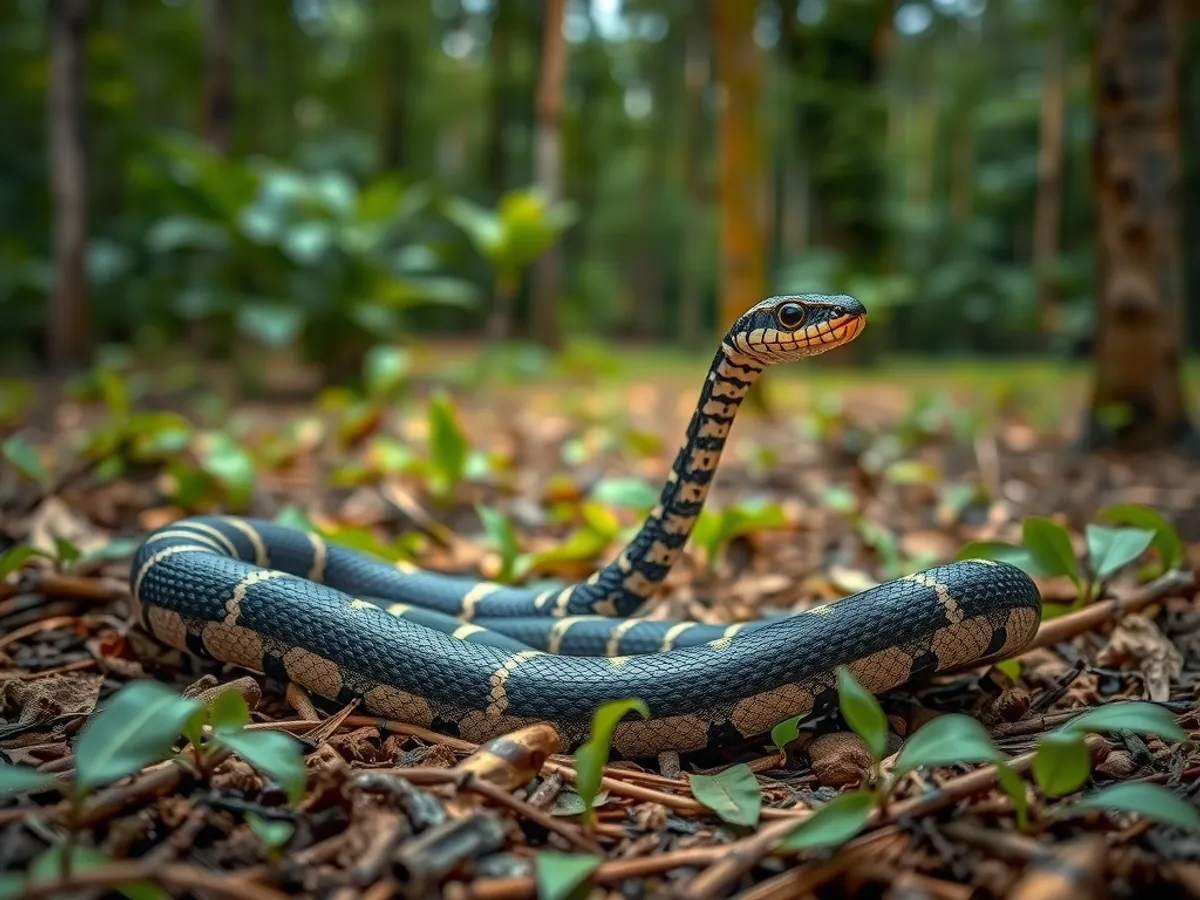
About the Banded Krait
The Banded Krait is a highly venomous elapid snake native to South and Southeast Asia. It is easily recognized by its distinctive black and yellow crossbands, which serve as a warning to potential predators. Primarily nocturnal and secretive, the banded krait is often found near water bodies such as rice paddies, marshes, and slow-moving streams. Although it possesses potent neurotoxic venom, it is generally shy and rarely bites humans unless provoked. Due to its reclusive behavior, encounters with this snake are infrequent despite its wide distribution.
Fascinating facts
Distinctive Appearance
The banded krait is easily identified by its alternating black and yellow bands running the length of its body.
Nocturnal Hunter
This snake is nocturnal, hunting mainly at night when it preys on other snakes, fish, frogs, and small mammals.
Powerful Venom
Its venom is highly neurotoxic, affecting the nervous system and causing paralysis, though bites to humans are rare.
Detailed description
The banded krait (Bungarus fasciatus) is a large, robust elapid snake, typically reaching lengths of 1.5 to 2.2 meters, with exceptional individuals exceeding 2.5 meters. Its most striking feature is the alternating pattern of broad black and yellow (sometimes creamy white) bands encircling the body, which serve as aposematic coloration to deter predators. The head is slightly distinct from the neck, with a blunt, rounded snout and small, inconspicuous eyes with round pupils. Scales are smooth and glossy, contributing to the snake's characteristic sheen. The ventral surface is usually pale yellow. The banded krait is primarily nocturnal and terrestrial, although it is a competent swimmer and often found near water bodies. Its diet consists mainly of other snakes, including venomous and non-venomous species, but it will also consume small mammals, frogs, and occasionally fish. The species is solitary and secretive, spending much of the day hidden under debris, in rodent burrows, or beneath logs. When threatened, it may coil loosely and hide its head beneath its body, rarely displaying aggression. The venom is highly neurotoxic, causing paralysis by blocking neuromuscular transmission, but bites to humans are rare due to its docile nature. Reproduction is oviparous, with females laying clutches of 4–14 eggs, typically during the rainy season.
Did you know?
Despite its deadly venom, the banded krait is so docile that it often does not bite even when handled.
Research & sources
Wikipedia summary
The banded krait is an extremely venomous species of elapids endemic to Asia, from Indian Subcontinent through Southeast Asia to Southern China. With a maximum length exceeding 2 m, it is the longest krait with a distinguishable gold and black pattern. While this species is generally considered timid and docile, resembling other members of the genus, its venom is highly neurotoxic which is potentially lethal to humans. Although toxicity of the banded krait based upon murine LD50 experiments is lower than that of many other kraits, its venom yield is the highest due to its size.
Behaviour & social structure
Banded kraits are predominantly nocturnal, emerging at dusk to hunt. They exhibit slow, deliberate movements and are generally non-confrontational, preferring to avoid conflict. Their hunting strategy is based on active foraging rather than ambush, using chemosensory cues to locate prey, especially other snakes. They are known to enter human settlements in search of food, particularly in agricultural areas with abundant rodents and other snakes. Feeding is infrequent due to their slow metabolism; adults may go weeks between meals. Social interactions are minimal outside of the breeding season, as individuals are highly solitary. During the day, they seek shelter in burrows, termite mounds, or under dense vegetation. When disturbed, they may flatten their bodies and display their warning coloration but rarely strike unless persistently provoked.
Reproduction & life cycle
Banded kraits are oviparous, with breeding activity peaking during the monsoon (May to August) in most of their range. Courtship involves tactile stimulation, with males engaging in body alignment and gentle nudging of the female. Females lay 4–14 elongated, leathery eggs in concealed, humid locations such as under logs or within abandoned burrows. Incubation lasts approximately 60–70 days, depending on ambient temperature and humidity. Females do not exhibit parental care after oviposition. Hatchlings measure 25–30 cm in length and are fully independent at birth, displaying the same banded pattern as adults. Sexual maturity is typically reached at 2–3 years of age.
Adaptations & survival
The banded krait's aposematic coloration is a classic example of warning coloration, signaling its venomous nature to potential predators. Its neurotoxic venom is highly specialized, targeting the nervous system of prey and providing an efficient means of subduing other snakes, which constitute the bulk of its diet. The smooth, glossy scales reduce friction, aiding in stealthy movement through dense vegetation and water. Its slow, deliberate locomotion conserves energy and reduces detection by both prey and predators. The krait's resistance to the venom of other snakes, including cobras and other kraits, is a notable evolutionary adaptation facilitating ophiophagy (snake-eating). Chemoreception via the forked tongue and Jacobson's organ is highly developed, allowing precise tracking of prey.
Cultural significance
In many parts of South and Southeast Asia, the banded krait features in folklore and traditional beliefs, often regarded with a mixture of fear and respect. Its striking appearance has led to its depiction in local art and mythology, sometimes symbolizing danger or protection. In some regions, its venom has been used in traditional medicine, although such practices are now rare and discouraged. The krait's docile nature is recognized by local communities, and it is less frequently persecuted than other venomous snakes. In India, it is one of the 'Big Four' snakes responsible for the majority of medically significant bites, though actual bite incidence is low.
Recent research
Recent studies have focused on the molecular composition of banded krait venom, revealing a complex mixture of neurotoxins, including alpha- and beta-bungarotoxins, which have become valuable tools in neuroscience research for studying synaptic transmission. Population genetics research indicates significant genetic structuring across its range, suggesting possible cryptic diversity. Ecological studies are examining its role as a top predator in controlling populations of other snakes and small vertebrates. Ongoing radio-telemetry projects are providing new insights into its home range, movement patterns, and habitat preferences, which are essential for effective conservation planning.
Videos
Habitat
Wetlands, forests, agricultural fields near water
 Various Continental Regions
Grassland
Open areas dominated by grasses rather than trees, supporting numerous herbivores and their predators.
 Global
Forest
Wooded areas with significant tree cover and diverse plant and animal communities.
 Global
Freshwater
Lakes, rivers, and wetlands with diverse aquatic ecosystems.
Conservation
The Banded Krait is currently classified as Least Concern on the IUCN Red List.
Threats & challenges
Although currently listed as 'Least Concern' by the IUCN, the banded krait faces localized threats from habitat destruction, particularly wetland drainage, deforestation, and agricultural expansion. Road mortality is a significant risk in areas with expanding infrastructure. The species is sometimes killed out of fear due to its venomous reputation, although it rarely poses a threat to humans. Collection for the traditional medicine trade and occasional use in snake shows or for venom extraction may impact some populations. Despite these pressures, the species remains widespread and relatively stable, but continued monitoring is recommended due to ongoing habitat changes.
Taxonomy
Scientific name
Bungarus fasciatus
- Kingdom
- Animalia
- Phylum
- Chordata
- Class
- Reptilia
- Order
- Squamata
- Family
- Elapidae
- Genus
- Bungarus
- Species
- fasciatus
Community notes
Share your observations about the Banded Krait.
No community notes yet. Be the first!
Discover more wildlife
More fascinating animals from the encyclopedia.